Artwork
宋人摹职贡图卷

宋人摹职贡图卷 is an unspecified painting by Unknown. It is held in the collection of the National Museum of China.
About this work
Overview
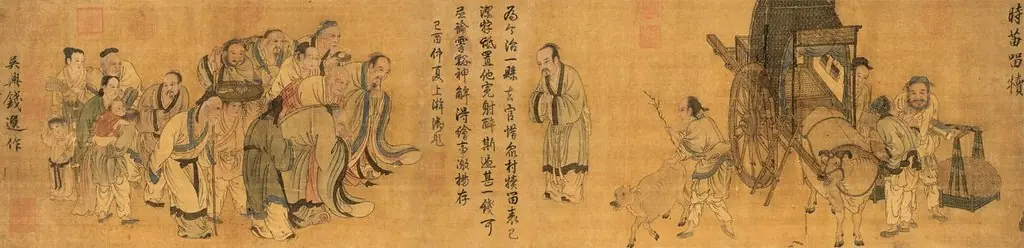
The composition avoids dramatic action, favoring stillness and balance, characteristic of scholarly painting traditions of the period.
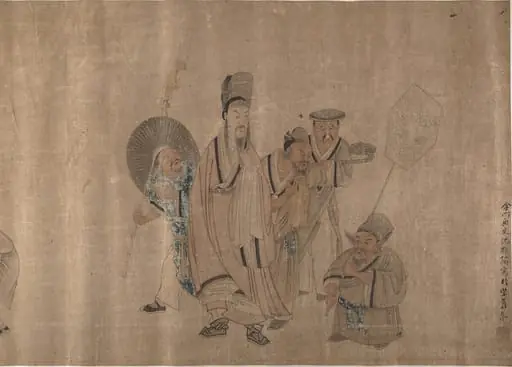
This handscroll, attributed to Song-dynasty artists, presents a linear procession of figures in traditional attire, arranged horizontally across a muted beige background. Each figure faces forward with a slight rightward turn, creating a rhythmic, orderly flow. Vertical inscriptions in cursive script run centrally, integrating text and image as a unified visual field. The composition avoids dramatic action, favoring stillness and balance, characteristic of scholarly painting traditions of the period.
Subject & Meaning
The figures likely represent envoys or tribute bearers from regional or foreign polities, aligned with the imperial court’s idealized vision of cosmopolitan order. Their uniform posture and restrained gestures suggest ritualized submission rather than individual identity. The accompanying text, possibly a descriptive poem or official record, reinforces the political message of centralized authority and cultural hierarchy, framing the scene as an emblem of dynastic legitimacy.
Technique & Style
Painted in fine ink and light color on silk, the figures are rendered with delicate, controlled brushwork, emphasizing contour over modeling. Clothing folds and hair are suggested with minimal strokes, avoiding excess detail. The background remains unadorned except for the central calligraphy, which is executed with formal elegance. The integration of text and image reflects the Song ideal of literati harmony, where poetry and painting serve complementary roles in conveying meaning.
History & Provenance
The scroll is a later copy, likely from the Southern Song period, of an earlier Liang-dynasty original attributed to Xiao Yi. While the original is lost, this version preserves the compositional structure and textual elements of the lost model. It passed through imperial collections and private hands before entering institutional care, its attribution refined over centuries by connoisseurs who valued its historical continuity over stylistic innovation.
Context
Created during a time when the Song court emphasized cultural refinement over military expansion, such scrolls served as visual affirmations of China’s perceived civilizational supremacy. Tribute scenes were common in court art, reflecting diplomatic exchanges and the Confucian worldview that positioned the emperor as the center of a harmonious, hierarchical world order. This work aligns with broader literary and artistic trends that privileged restraint, allusion, and textual integration.
Legacy
As a surviving example of a lost early model, this scroll offers insight into how historical narratives were visually transmitted across dynasties. It influenced later tribute paintings and reinforced the aesthetic principle that text and image must coexist to convey layered meaning. Though not widely exhibited in its time, it remains a key reference for scholars studying the intersection of diplomacy, art, and textual culture in imperial China.
Artist & collection

 Domestic Scene
 Giacomo and Cardinal Marco, investing Andrea, Abbot of San Zeno, with his Benefice
 The Nymph of Fontainebleau
 Portrait of a Woman
 Madonna and Child with Saints in the Enclosed Garden
 Venus and Minerva
 Family Group of Four on Sofa
 Wall painting from Room H of the Villa of P. Fannius Synistor at Boscoreale
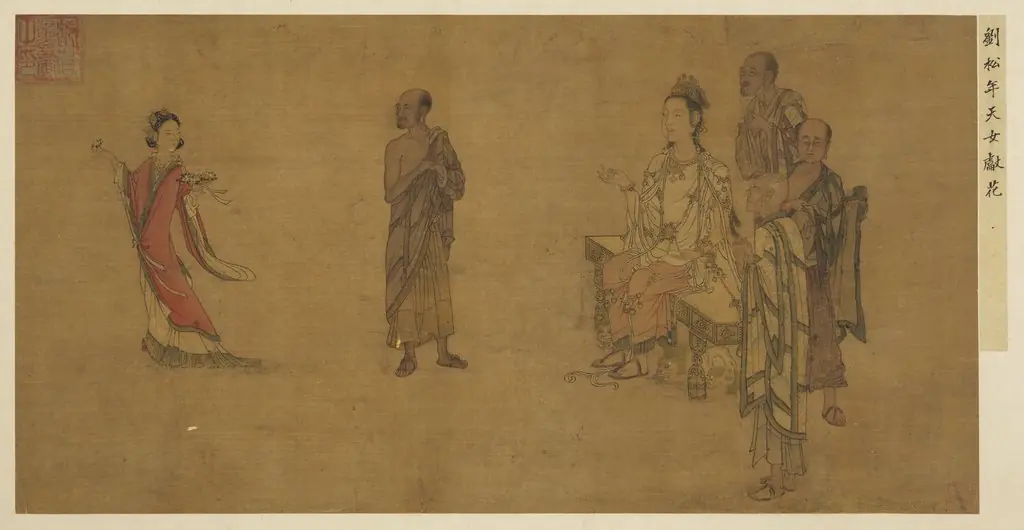 名繪集珍 冊 宋劉松年天女獻花
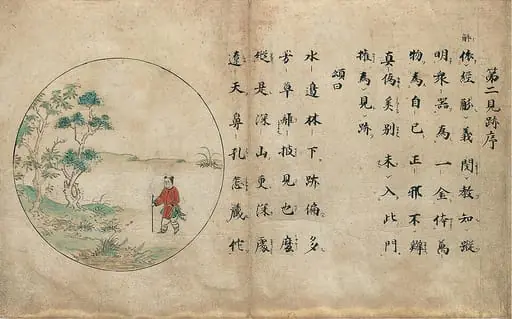 十牛頌図巻|Ten Verses on Oxherding
 『過去現在絵因果経』 断簡 (松永本)|Scene from The Illustrated Sutra of Past and Present Karma (Kako genzai e-inga-kyō; Matsunaga Version)
 Regal Assembly
 Untitled
 宋/明? 佚名 仿王齊翰 挑耳圖 卷|Library Scene
 大般若経(中尊寺経)|Great Wisdom Sutra (Daihannya-kyō), from the Chūsonji Temple Sutra Collection (Chūsonji-kyō)
 Untitled
 Buddha Amitābha with Two Attending Bodhisattvas
 Leaving Behind the Calf
 Untitled
 Lohans