Artwork
Gibbon
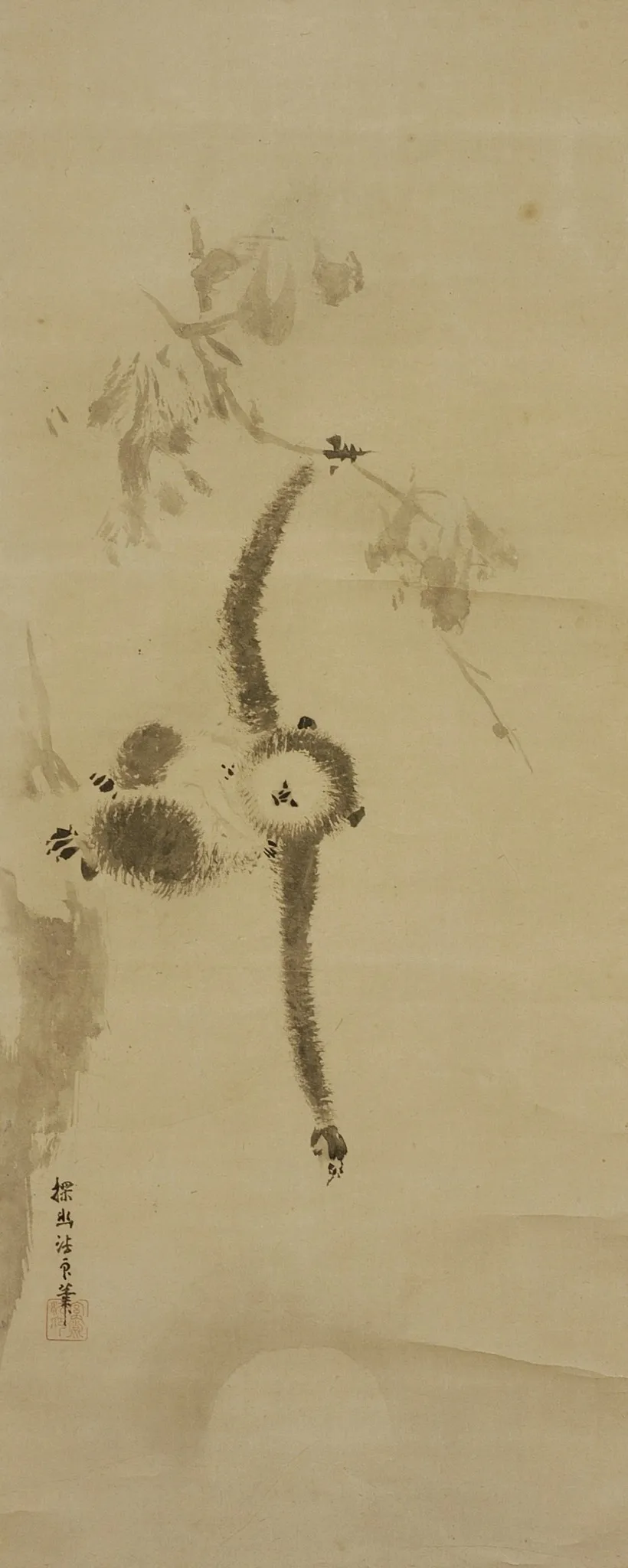
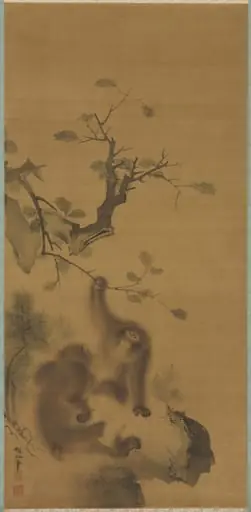
Gibbon is an unspecified painting by Unknown. It is held in the collection of the Los Angeles County Museum of Art.
About this work
Overview
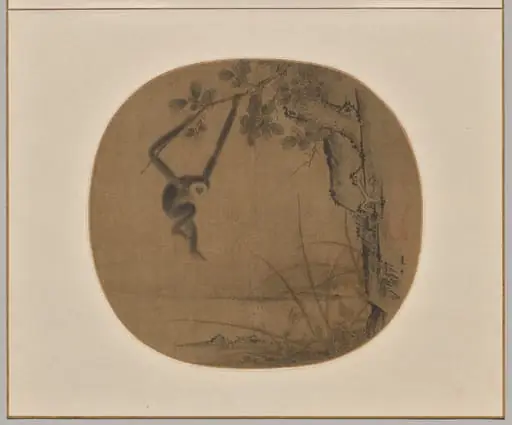
The animal’s dark fur and pale face contrast sharply against a muted brown background, drawing immediate attention to its form.
This painting depicts a gibbon suspended upside down from a slender, curved tree branch. The animal’s dark fur and pale face contrast sharply against a muted brown background, drawing immediate attention to its form. The composition is tightly focused, eliminating distractions to emphasize the creature’s posture and presence. The rendering is detailed and observational, prioritizing anatomical accuracy over symbolic or narrative elements.
Subject & Meaning
The gibbon, shown in a moment of stillness while hanging, reflects an interest in the natural behavior of primates. Its inverted position suggests a moment captured in motion, not staged. There is no overt symbolism or human narrative; the subject stands as a quiet study of wildlife, inviting contemplation of the animal’s physicality and autonomy within its environment.
Technique & Style
The artist employs fine brushwork to render the texture of the gibbon’s fur, with subtle variations in tone to suggest depth and volume. The limbs are curled with anatomical precision, and the thin branch is rendered with delicate lines that imply flexibility. The background is uniformly light brown, avoiding gradient or shadow, which isolates the figure and enhances its three-dimensionality.
History & Provenance
The painting’s origin and ownership history are not documented in the provided details. No artist, date, or collection is specified, limiting its placement within a known artistic tradition or timeline. Its style suggests a possible connection to 19th-century naturalist painting, though without further evidence, its provenance remains uncertain.
Context
This work aligns with a broader 18th- and 19th-century trend in European and colonial art that sought to document exotic fauna with scientific precision. While not part of a formal zoological survey, its naturalistic approach mirrors the observational methods used in biological illustration of the period, where accuracy often outweighed aesthetic flourish.
Legacy
The painting contributes to a visual record of non-human primates as subjects of quiet study rather than spectacle. Its emphasis on physical detail and environmental minimalism reflects a shift toward empirical observation in art, influencing later naturalist and wildlife depictions that valued fidelity to life over romanticized interpretation.
Artist & collection

 Domestic Scene
 Giacomo and Cardinal Marco, investing Andrea, Abbot of San Zeno, with his Benefice
 The Nymph of Fontainebleau
 Portrait of a Woman
 Madonna and Child with Saints in the Enclosed Garden
 Venus and Minerva
 Family Group of Four on Sofa
 Wall painting from Room H of the Villa of P. Fannius Synistor at Boscoreale