Artwork
The Fountain of Life
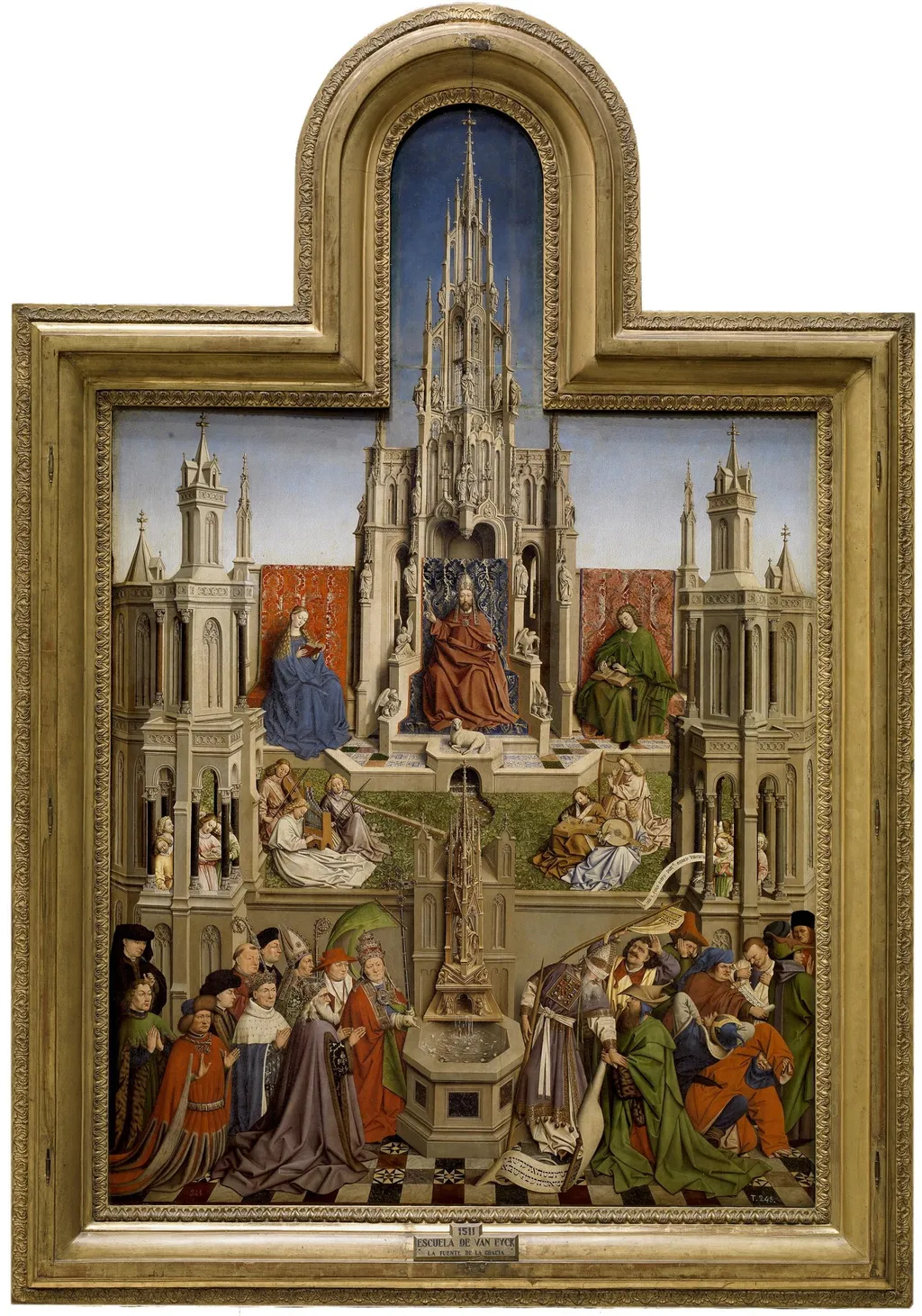
The Fountain of Life is an unspecified painting. It dates from 1440 and is held in the collection of the Museo del Prado.
About this work
Overview
The work known as The Fountain of Life, also referred to as The Fountain of Grace and the Triumph of the Church over the Synagogue, is an oil painting on panel dating to around 1432. It has spent most of its existence in Spain and is now held by the Museo del Prado, where it was recently included in a dedicated exhibition.
Subject & Meaning
The iconography reflects a 15th‑century Spanish preoccupation with the relationship between Christianity and the sizable Jewish community of the era.
The composition presents a theological hierarchy: a heavenly Deësis with Christ, the Virgin Mary and St. John the Evangelist occupies the upper tier; angels populate the middle zone; and below, groups of holy men—identified as Christians—are gathered. The iconography reflects a 15th‑century Spanish preoccupation with the relationship between Christianity and the sizable Jewish community of the era.
Technique & Style
The painting’s visual language echoes the 1432 Ghent Altarpiece by Jan and Hubert van Eyck, employing meticulous detail, luminous colour, and a layered spatial arrangement. Technical studies indicate the panel was produced in the Low Countries, likely within Jan van Eyck’s workshop, rather than on the Iberian Peninsula.
History & Provenance
Although unsigned, the work has long been linked to Jan van Eyck, prompting scholarly debate over whether it is an autograph piece, a youthful effort by the master, a contribution by his brother Hubert, or the product of later hands such as Petrus Christus. Its documented presence in Spain dates back centuries, culminating in its current location at the Prado.
Context
The painting’s thematic focus on the triumph of the Church over the Synagogue resonated in a Spain that housed the largest Jewish population in Europe at the time. Its stylistic affinities with the Ghent Altarpiece have made it a reference point for discussions of workshop practices and cross‑regional artistic exchange in the early 15th century.
Artist & collection
