Artwork
Durga Slaying Mahisha
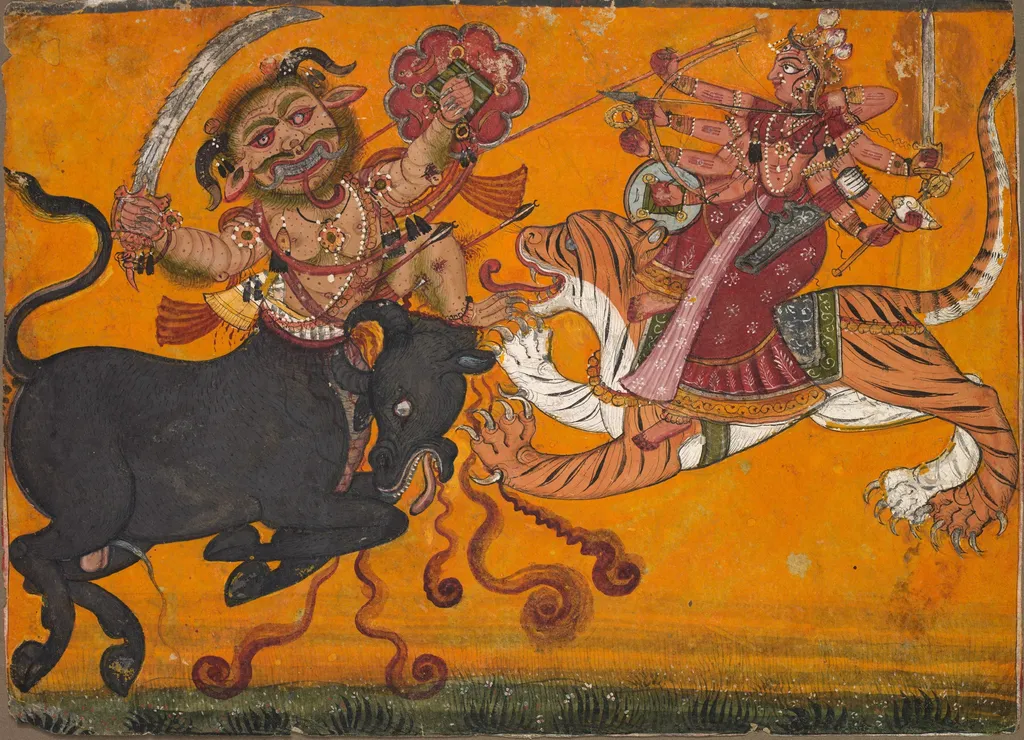
Durga Slaying Mahisha is an unspecified painting. It dates from 1705 and is held in the collection of the Cleveland Museum of Art. The work portrays a multi‑armed female figure astride a tiger, confronting a boar‑headed male wielding a sword.
About this work
Overview
The composition captures a moment of intense motion, with the woman's arms extended and sword raised, while the male opponent adopts a defensive stance.
The work portrays a multi‑armed female figure astride a tiger, confronting a boar‑headed male wielding a sword. Both figures are clad in red and white garments, set against an orange backdrop. The composition captures a moment of intense motion, with the woman's arms extended and sword raised, while the male opponent adopts a defensive stance. The tiger and boar are also locked in combat, heightening the scene’s dynamism.
Subject & Meaning
The painting illustrates the mythic episode of the goddess Durga battling the buffalo demon Mahisha. Durga’s multiple arms symbolize her divine power, and her mounted tiger serves as her vehicle. The boar‑headed adversary represents the chaotic force she subdues. The confrontation conveys themes of triumph over evil and the protective role of the deity within Hindu tradition.
Technique & Style
Executed with bold, saturated hues, the artist employs a vivid orange field to unify the tableau. Contrasting reds and whites on the figures emphasize their movement and delineate form. Dynamic poses and exaggerated gestures create a sense of kinetic energy, while the interplay of light and shadow on the tiger and boar adds depth to the violent encounter.
Context
The subject derives from Hindu iconography, where Durga’s victory over Mahisha is a central narrative celebrated in festivals such as Navaratri. The visual language—multiple arms, animal mounts, and vivid coloration—aligns with traditional depictions found in temple reliefs and manuscript illustrations, reflecting the cultural importance of the myth.
Artist & collection