Artwork
Saint Monica from an Augustinian altarpiece
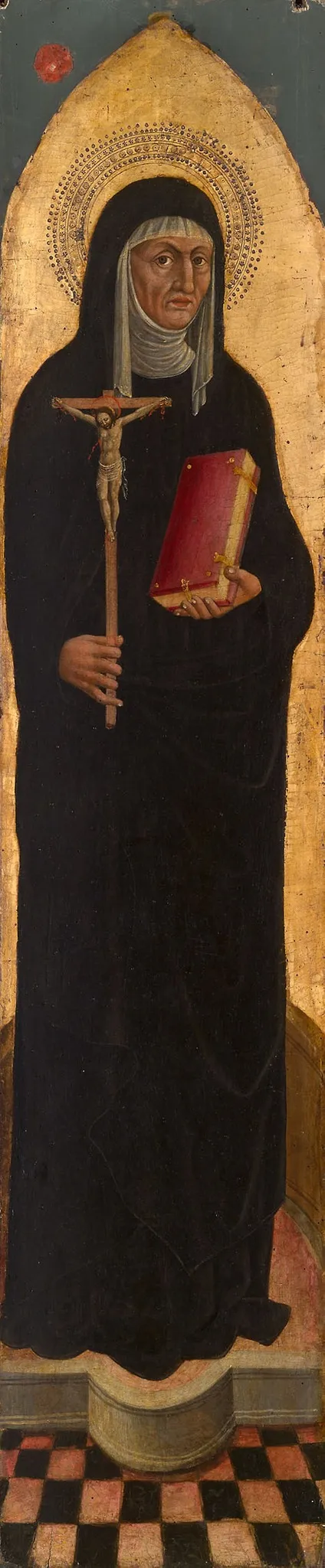
Saint Monica from an Augustinian altarpiece is an unspecified painting by the Early Renaissance artist Unknown. It dates from 1462 and is held in the collection of the Art Institute of Chicago.
About this work
Overview
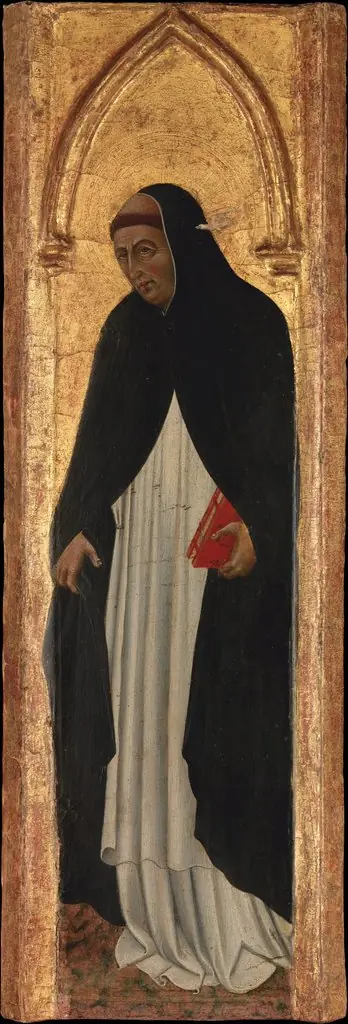
The work depicts a solemn female figure dressed in a black habit with a white veil, holding a small wooden cross in one hand and a red-bound book in the other. She stands on a floor of alternating red and white tiles, framed by a simple gold arch adorned with dotted ornamentation.
Subject & Meaning
The attire and attributes identify the figure as Saint Monica, revered for her piety and role as the mother of Saint Augustine. The cross signifies her Christian devotion, while the red book likely represents the Scriptures or a devotional text associated with her spiritual life.
Technique & Style
The composition employs a restrained palette and clear modeling of forms, suggesting an early use of chiaroscuro to model the saint’s features against the flat gold background. The contrast between the dark robe and illuminated skin enhances the sense of three‑dimensionality within a largely decorative setting.
History & Provenance
The painting formed part of an Augustinian altarpiece, indicating it was originally intended for a church setting linked to the Order of Saint Augustine. Its precise date and original location remain uncertain, but the work reflects the devotional program of Augustinian patronage.
Context
Saint Monica was a frequent subject in medieval and early Renaissance art, especially within Augustinian contexts, where her intercessory role was emphasized. The inclusion of the checkerboard floor and gold arch aligns with contemporary conventions for framing holy figures in a timeless, sacred space.
Artist & collection

 Domestic Scene
 Giacomo and Cardinal Marco, investing Andrea, Abbot of San Zeno, with his Benefice
 The Nymph of Fontainebleau
 Portrait of a Woman
 Madonna and Child with Saints in the Enclosed Garden
 Venus and Minerva
 Family Group of Four on Sofa
 Wall painting from Room H of the Villa of P. Fannius Synistor at Boscoreale