Artwork
The Burial of the Count of Orgaz
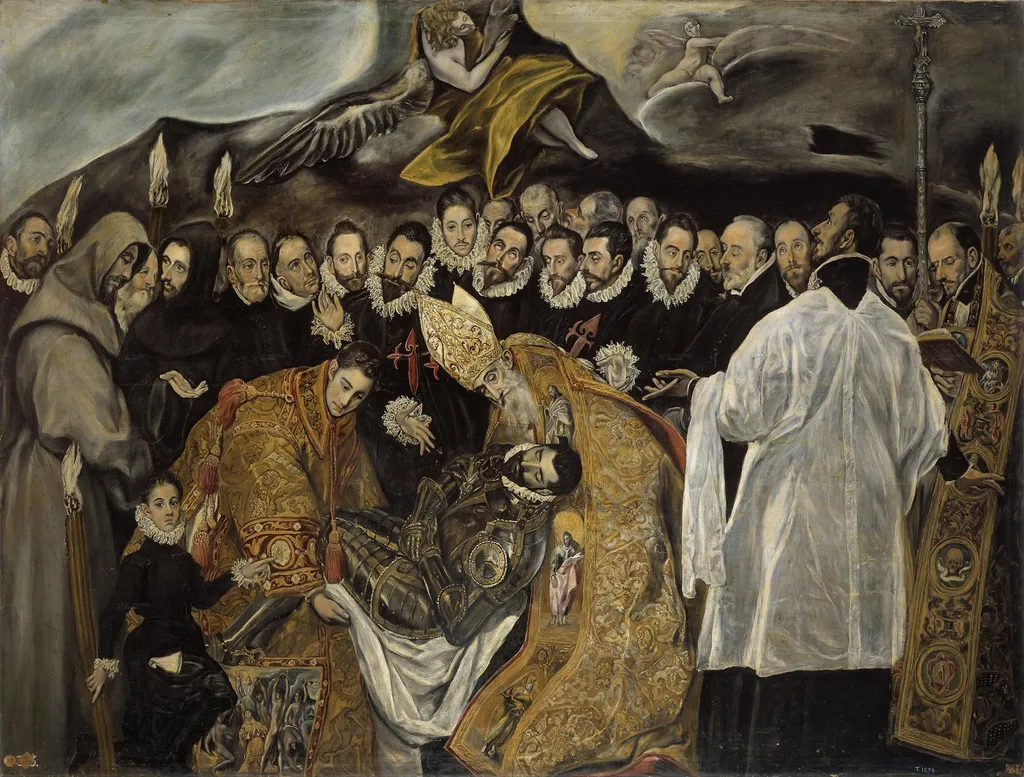
The Burial of the Count of Orgaz is an oil painting. It dates from 1618 and is held in the collection of the Museo del Prado.
About this work
Overview
El Greco’s *The Burial of the Count of Orgaz* (1586‑1588) is an oil painting that occupies the high altar of the Cathedral of Toledo. The composition is divided between a terrestrial scene of mourners and a celestial realm of angels, linked by a dramatic contrast of light and shadow that guides the viewer’s eye from the earthly funeral to the heavenly witnesses.
Subject & Meaning
The work commemorates the legendary intercession of Saint Stephen and Saint Augustine, who, according to local tradition, descended to assist in the burial of Don Gonzalo Ruiz de Toledo, Count of Orgaz. The lower register shows aristocratic mourners, a kneeling woman with a child, and a priest holding a crucifix, while the upper register presents ethereal angels, emphasizing the union of earthly piety and divine grace.
Technique & Style
El Greco employs a pronounced chiaroscuro, allowing illuminated faces and richly textured armor to emerge from a darker background. The painter’s elongated figures and fluid brushwork create a sense of movement, while the meticulous rendering of metal and fabric demonstrates his mastery of oil as a medium, balancing realism with a spiritual, otherworldly atmosphere.
History & Provenance
Commissioned by the cathedral chapter in the late 1580s, the painting has remained in situ since its completion, never leaving the Toledo Cathedral. Its presence has been documented in contemporary inventories, and it survived the iconoclastic periods of the 19th century, retaining its original frame and placement above the high altar.
Context
Created during the Spanish Counter‑Reformation, the painting reflects the era’s emphasis on didactic religious imagery. El Greco, a Greek-born artist active in Spain, merged Byzantine iconography with Mannerist tendencies, producing a work that aligns with the Catholic Church’s call for emotionally resonant, visually compelling art to inspire devotion.
Legacy
The composition has influenced successive generations of Spanish painters, serving as a reference point for integrating narrative depth with dramatic lighting. Art historians cite the work as a pinnacle of El Greco’s mature style, illustrating his ability to fuse narrative clarity with a transcendent visual language.
Artist & collection
