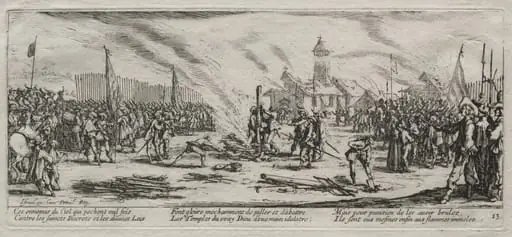
Artwork
The Large Miseries of War: The Hospital
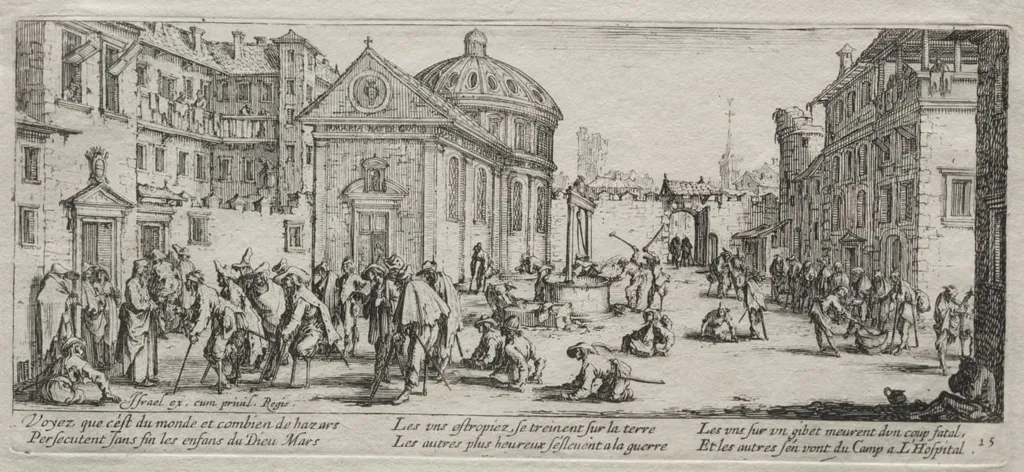
The Large Miseries of War: The Hospital is a print by the Baroque artist Jacques Callot. It dates from 1633 and is held in the collection of the Cleveland Museum of Art.
About this work
Overview
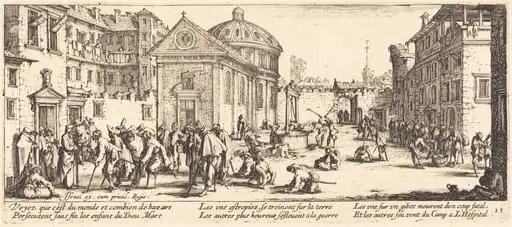
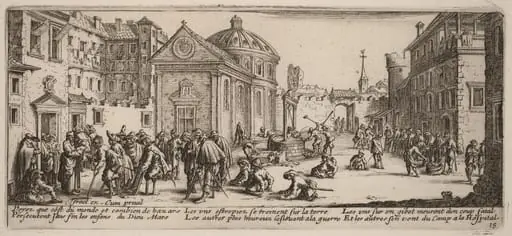
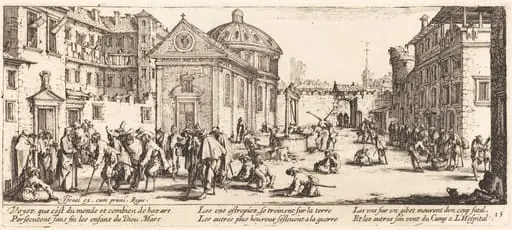
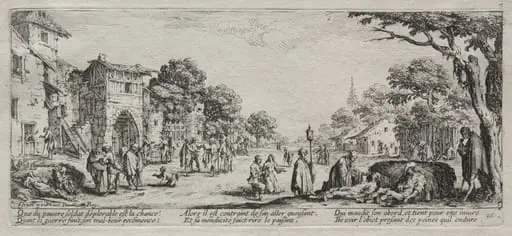
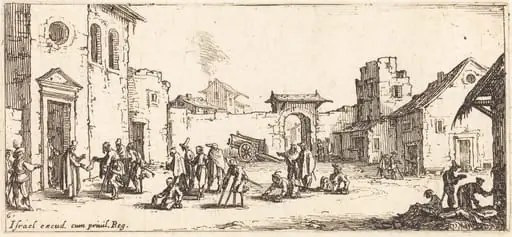
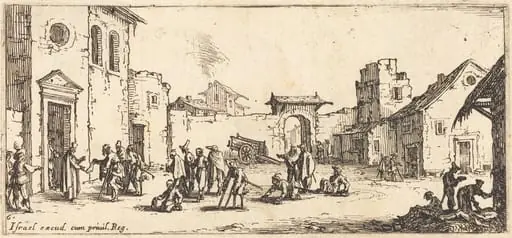
Created in 1633 by Jacques Callot, this etching is part of a series depicting the human toll of war. Rendered in fine, detailed lines, it captures a crowded urban scene outside a large institutional building. The composition conveys disorder and suffering through dense figures and layered architecture, reflecting the aftermath of military conflict in early 17th-century Europe.
Subject & Meaning
The French inscription at the base reinforces the narrative of collective suffering, grounding the image in a specific historical reality.
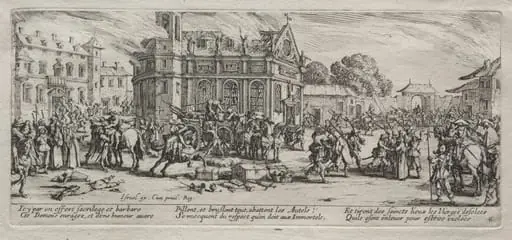
The scene portrays civilians enduring the consequences of war—wounded, displaced, and destitute. Figures lie on the ground, are carried on stretchers, or move with makeshift supports. Dogs roam freely among them, and onlookers gather in doorways, suggesting a society overwhelmed by crisis. The French inscription at the base reinforces the narrative of collective suffering, grounding the image in a specific historical reality.
Technique & Style
Callot employed etching with exceptional precision, using fine lines to render hundreds of individual figures and architectural elements. Subtle variations in line weight and density create depth and movement. Facial expressions are deliberately blurred in places, enhancing the sense of anonymity and chaos. The inclusion of small, incidental details—like stray animals and crumbling facades—adds narrative texture without overt sentimentality.
History & Provenance
The print belongs to Callot’s series Les Grandes Misères de la Guerre, produced after his observations of troop movements in Lorraine. It entered the Cleveland Museum of Art’s collection in the 20th century, where it remains part of a broader holdings of early modern European prints. Its preservation reflects its significance as a documentary record of wartime civilian life.
Context
Made during the Thirty Years’ War, the work responds to widespread devastation in the Holy Roman Empire. Unlike glorified battle scenes, Callot focused on non-combatants—women, children, the elderly—caught in the collapse of social order. His choice to depict urban ruin rather than battlefield heroism marked a departure from traditional war imagery of the period.
Legacy
Callot’s series influenced later artists addressing the consequences of conflict, including Goya. The work’s unflinching realism and attention to marginalized figures established a precedent for social commentary in printmaking. Its enduring presence in museum collections underscores its role as a visual record of war’s civilian cost.
Artist & collection
Artist
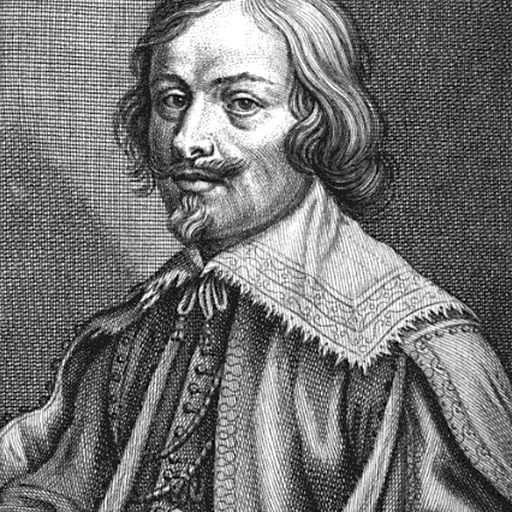
Jacques Callot was a baroque printmaker and draftsman from the Duchy of Lorraine.

 Holy Family at supper
 Restoration of the Aqueduct at Pisa
 Restoration of the Aqueduct at Pisa
 Square in Paris with Many Figures
 Square in Paris with Many Figures
 Horsemen Attacked by Robbers
 HOW WILL A COVERED PART BE CORRECTED?HOW WIKA A COVERED HEART DEED CORRECTED?
![Christ Walking on the Water [second plate], by Jacques Callot](https://artifactworldgallery.com/img/jacques-callot--christ-walking-on-the-water-second-plate--2069f3bfe4cb2126-w320.webp) Christ Walking on the Water [second plate]
Christ Walking on the Water [second plate]