Artwork
The Large Miseries of War: The Beggars and the Dying
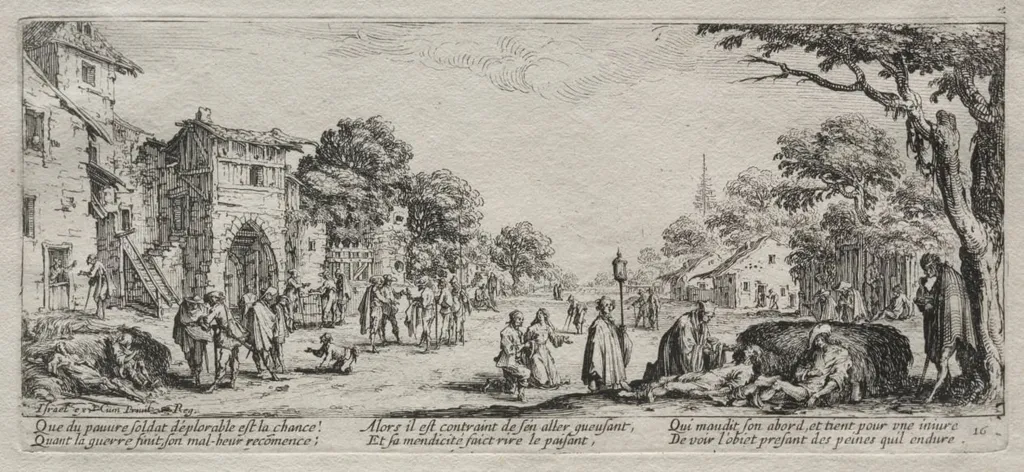
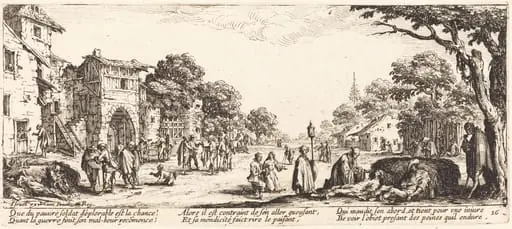
The Large Miseries of War: The Beggars and the Dying is a print by the Baroque artist Jacques Callot. It dates from 1633 and is held in the collection of the Cleveland Museum of Art.
About this work
Overview
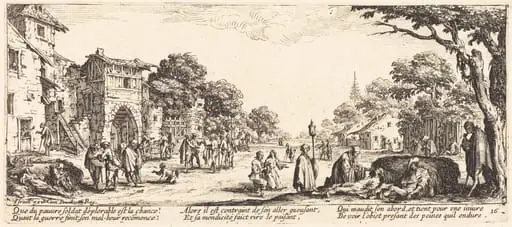
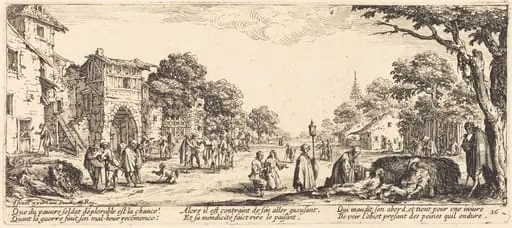
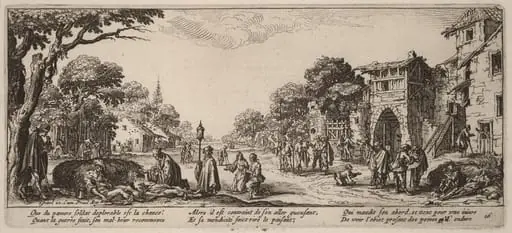
Created in 1633 by Jacques Callot, this etching is part of a series depicting the devastation of war. Rendered in fine black-and-white lines, it captures a crowded urban scene overwhelmed by suffering. The work is held in the collection of The Cleveland Museum of Art and exemplifies Callot’s mastery of detailed engraving to convey large-scale human tragedy without color or embellishment.
Subject & Meaning
The scene portrays civilians caught in the aftermath of conflict: the wounded, the dead, and the destitute scattered among ruined architecture. Figures lie motionless or huddle in despair, while a dog investigates a fallen body, underscoring the absence of care or order. The composition conveys the collapse of social structure, emphasizing the vulnerability of non-combatants amid military chaos.
Technique & Style
The absence of color heightens the somber tone, while controlled contrasts of light and shadow guide the viewer’s eye through the dense composition.
Callot employed fine-line etching to achieve extraordinary detail, rendering individual folds of clothing, facial expressions, and textures of stone and foliage with precision. The absence of color heightens the somber tone, while controlled contrasts of light and shadow guide the viewer’s eye through the dense composition. The meticulous technique intensifies the realism, making each figure’s suffering palpable.
History & Provenance
The print was produced during the Thirty Years’ War, a period of widespread destruction across Central Europe. Callot, who witnessed military campaigns firsthand, created this series to document their impact on civilian life. The work entered The Cleveland Museum of Art’s collection in the 20th century, where it remains a key example of early modern printmaking focused on social realism.
Context
Made during the height of the Thirty Years’ War, the image reflects contemporary European anxieties about the erosion of civil order. Unlike heroic battle scenes common in art of the time, Callot’s focus on the marginalized and the dead offered a rare, unvarnished view of war’s human cost. His work influenced later artists who sought to depict violence without glorification.
Legacy
Callot’s series set a precedent for documentary-style imagery in printmaking, inspiring later generations to use etching for social critique. The precision and emotional restraint of this work contributed to its endurance as a reference point in discussions of war’s impact on civilian populations, particularly in the development of modern visual journalism.
Artist & collection
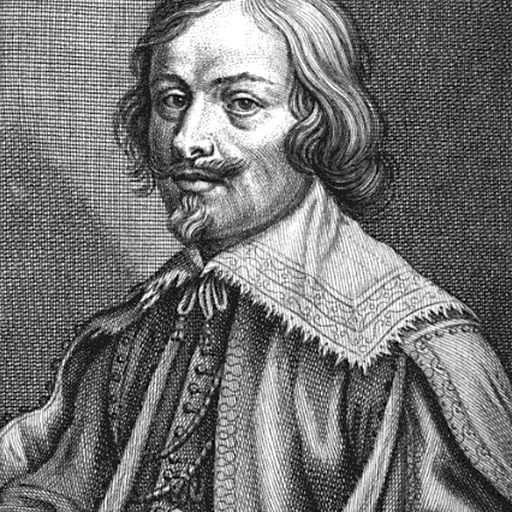
Artist
Jacques Callot was a baroque printmaker and draftsman from the Duchy of Lorraine.

 Holy Family at supper
 Restoration of the Aqueduct at Pisa
 Restoration of the Aqueduct at Pisa
 Square in Paris with Many Figures
 Square in Paris with Many Figures
 Horsemen Attacked by Robbers
 HOW WILL A COVERED PART BE CORRECTED?HOW WIKA A COVERED HEART DEED CORRECTED?
![Christ Walking on the Water [second plate], by Jacques Callot](https://artifactworldgallery.com/img/jacques-callot--christ-walking-on-the-water-second-plate--2069f3bfe4cb2126-w320.webp) Christ Walking on the Water [second plate]
Christ Walking on the Water [second plate]