Artwork
The Life of the Virgin: The Assumption of the Virgin
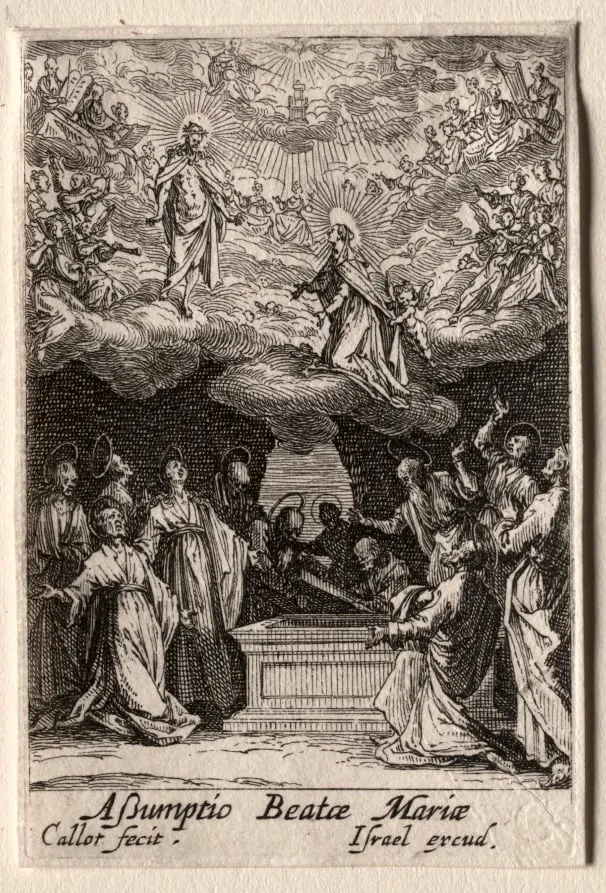
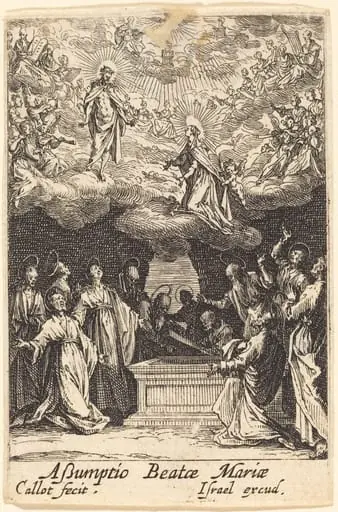
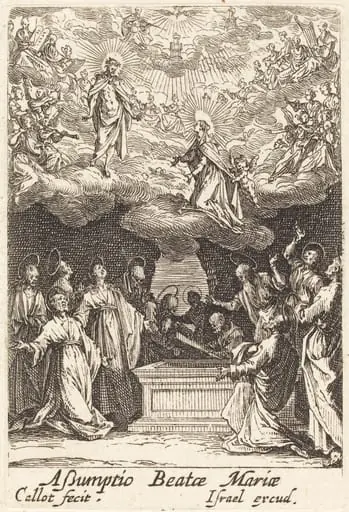
The Life of the Virgin: The Assumption of the Virgin is a print by the Baroque artist Jacques Callot. It dates from 1634 and is held in the collection of the Cleveland Museum of Art.
About this work
Overview
Created around 1634 by Jacques Callot, this print depicts the Assumption of the Virgin as part of a larger series on her life. Executed in etching, it belongs to the collection of The Cleveland Museum of Art. The composition captures a moment of spiritual ascent, rendered with meticulous detail and a sense of vertical motion that draws the viewer’s eye upward through layered figures.
Subject & Meaning
Below, apostles and mourners gather around an empty tomb, their gestures—kneeling, gazing, reaching—convey awe and reverence.
The scene illustrates the Virgin Mary’s bodily ascent into heaven, a doctrine central to Catholic belief. Above, she is lifted by angels amid celestial light, arms outstretched in surrender or reception. Below, apostles and mourners gather around an empty tomb, their gestures—kneeling, gazing, reaching—convey awe and reverence. The moment bridges earthly grief and divine triumph, affirming her unique role in Christian theology.
Technique & Style
Callot employed fine-line etching to achieve remarkable clarity and depth. Delicate hatching defines drapery, facial expressions, and architectural details, while the vertical arrangement enhances the sense of ascent. The figures are rendered with naturalistic postures and varied attention to individual expression, characteristic of early Baroque printmaking. Light is suggested through contrast rather than dramatic chiaroscuro, grounding the scene in quiet solemnity.
History & Provenance
This print was produced during Callot’s mature period in Nancy, following his time in Florence and Rome. It was likely part of a devotional series commissioned for private or ecclesiastical use. The Cleveland Museum of Art acquired it as part of a broader collection of Northern European prints, preserving its place within 17th-century religious imagery traditions.
Context
In the 1630s, Catholic regions emphasized Marian devotion in response to Protestant reforms. Printmakers like Callot translated theological themes into accessible imagery for both public and personal contemplation. His work reflects the Counter-Reformation’s visual language—emotional, detailed, and didactic—while maintaining the refined craftsmanship of Northern European engraving traditions.
Legacy
Callot’s Assumption exemplifies how printmaking could convey complex sacred narratives with precision and emotional nuance. Though less celebrated than his genre scenes, this print influenced later religious imagery by demonstrating how etching could balance narrative clarity with spiritual gravity. Its survival in institutional collections underscores its role in shaping devotional visual culture across Europe.
Artist & collection
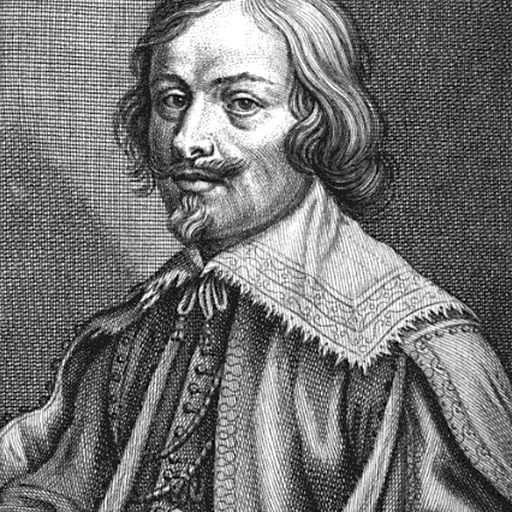
Artist
Jacques Callot was a baroque printmaker and draftsman from the Duchy of Lorraine.

 Holy Family at supper
 Restoration of the Aqueduct at Pisa
 Restoration of the Aqueduct at Pisa
 Square in Paris with Many Figures
 Square in Paris with Many Figures
 Horsemen Attacked by Robbers
 HOW WILL A COVERED PART BE CORRECTED?HOW WIKA A COVERED HEART DEED CORRECTED?
![Christ Walking on the Water [second plate], by Jacques Callot](https://artifactworldgallery.com/img/jacques-callot--christ-walking-on-the-water-second-plate--2069f3bfe4cb2126-w320.webp) Christ Walking on the Water [second plate]
Christ Walking on the Water [second plate]