Artwork
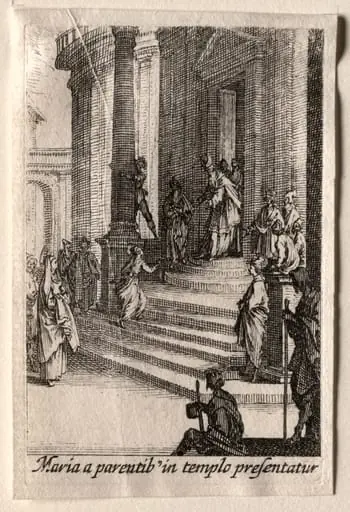
The Mysteries of the Passion: The Presentation in the Temple
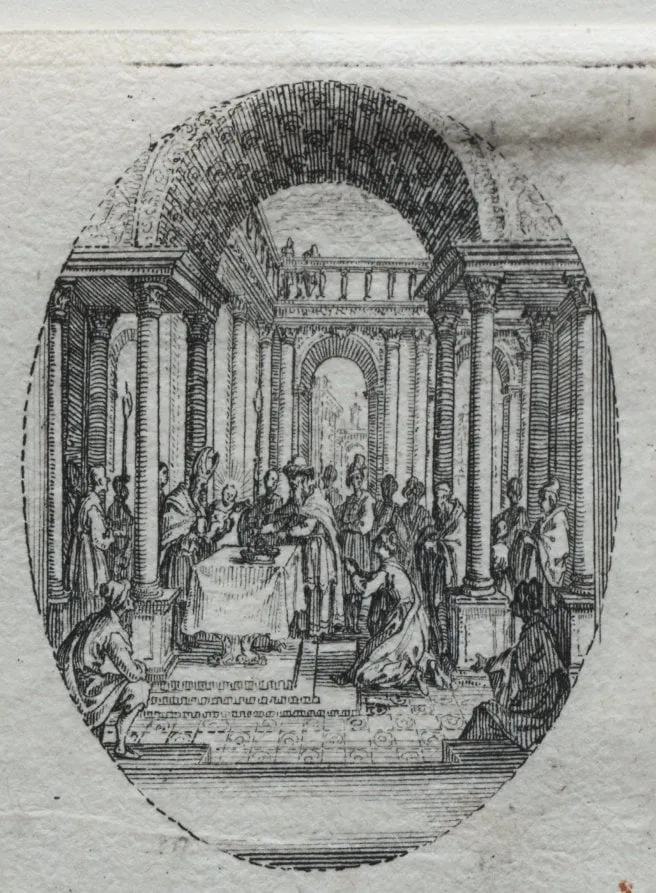
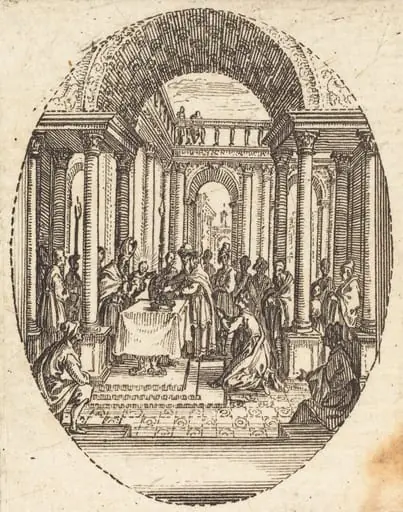
The Mysteries of the Passion: The Presentation in the Temple is a print by the Baroque artist Jacques Callot. It dates from 1631 and is held in the collection of the Cleveland Museum of Art.
About this work
Overview
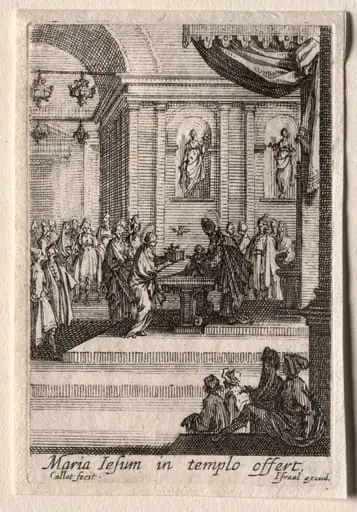
Executed in etching, it captures the biblical moment when Mary and Joseph present the infant Jesus at the Temple in Jerusalem, as prescribed by Jewish law.
Created in 1631 by Jacques Callot, this print is part of a series illustrating scenes from the Passion of Christ. Executed in etching, it captures the biblical moment when Mary and Joseph present the infant Jesus at the Temple in Jerusalem, as prescribed by Jewish law. The work is held in the collection of the Cleveland Museum of Art, where it is recognized for its precise line work and narrative clarity.
Subject & Meaning
The scene depicts the ritual presentation of Jesus to the priest Simeon, as described in the Gospel of Luke. Figures surround the central act with quiet solemnity, their postures and gestures reflecting reverence. The inclusion of temple architecture underscores the religious significance of the event, while the quiet intensity of the gathering emphasizes fulfillment of divine law rather than spectacle.
Technique & Style
Callot employed fine-line etching to render intricate details in clothing, architecture, and facial expressions. Delicate hatching and controlled cross-hatching create texture and volume, while subtle contrasts in ink density suggest chiaroscuro effects. The composition directs attention to the central group through spatial arrangement and layered depth, showcasing Callot’s mastery of the medium.
History & Provenance
The print was produced during Callot’s mature period in Nancy, France, following his earlier work in Italy. It was likely made as part of a devotional series intended for private collectors. The Cleveland Museum of Art acquired the print in the 20th century, where it remains among the most studied examples of early 17th-century Northern European printmaking.
Context
In the early 1630s, religious imagery remained central to artistic production in Catholic and Protestant regions alike, though often in more restrained forms. Callot’s series responded to a demand for intimate, detailed biblical scenes that invited personal contemplation. His work bridged Italian compositional influence with Northern European attention to detail.
Legacy
Callot’s series on the Passion influenced later generations of printmakers through its technical precision and emotional restraint. Though less widely known than his battle scenes or courtly subjects, this series exemplifies his ability to convey sacred narrative with clarity and dignity, securing his reputation as a pivotal figure in Baroque printmaking.
Artist & collection
Artist
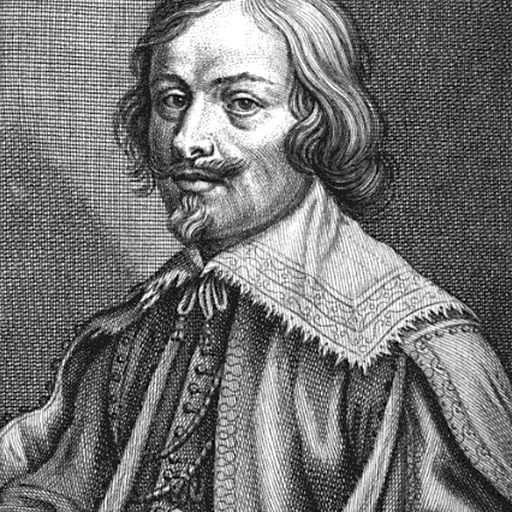
Jacques Callot was a baroque printmaker and draftsman from the Duchy of Lorraine.

 Holy Family at supper
 Restoration of the Aqueduct at Pisa
 Restoration of the Aqueduct at Pisa
 Square in Paris with Many Figures
 Square in Paris with Many Figures
 Horsemen Attacked by Robbers
 HOW WILL A COVERED PART BE CORRECTED?HOW WIKA A COVERED HEART DEED CORRECTED?
![Christ Walking on the Water [second plate], by Jacques Callot](https://artifactworldgallery.com/img/jacques-callot--christ-walking-on-the-water-second-plate--2069f3bfe4cb2126-w320.webp) Christ Walking on the Water [second plate]
Christ Walking on the Water [second plate]