Artwork
The Mysteries of the Passion: The Adoration of the Kings
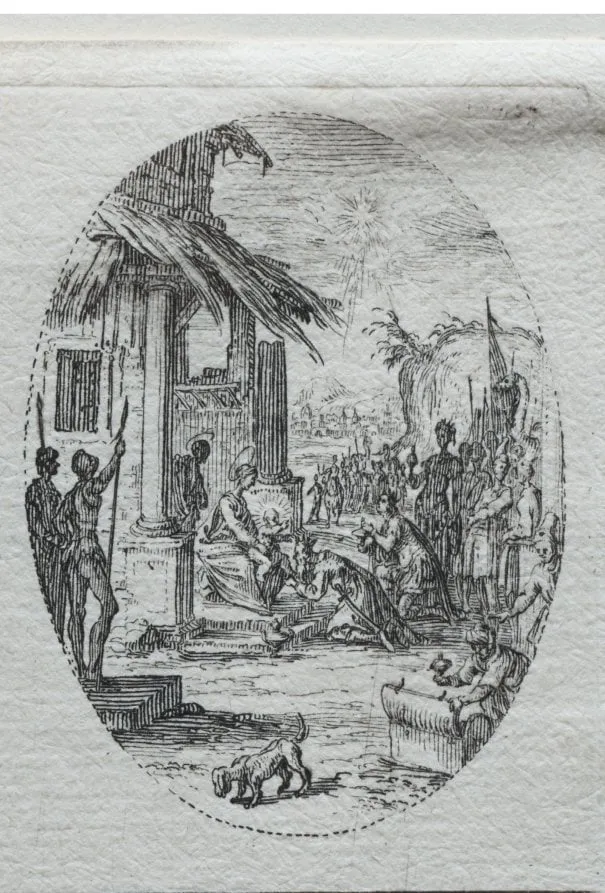
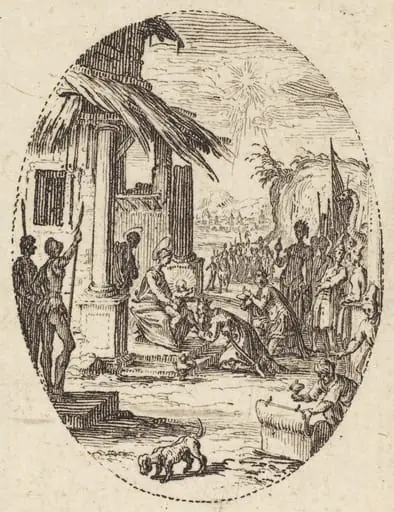
The Mysteries of the Passion: The Adoration of the Kings is a print by the Baroque artist Jacques Callot. It dates from 1631 and is held in the collection of the Cleveland Museum of Art.
About this work
Overview
The work is held in the collection of the Cleveland Museum of Art, where it is valued for its delicate handling of light and spatial composition.
Created in 1631 by Jacques Callot, this black-and-white drawing is part of a series illustrating scenes from the Passion of Christ. Executed with fine linear precision, it depicts the Adoration of the Magi as a quiet, intimate moment rather than a grand spectacle. The work is held in the collection of the Cleveland Museum of Art, where it is valued for its delicate handling of light and spatial composition.
Subject & Meaning
The scene portrays the biblical moment when the Three Kings pay homage to the infant Jesus, who lies on a low surface within a modest structure. Surrounding figures—shepherds, attendants, and onlookers—kneel or sit in orderly reverence, their gazes directed inward. A dog rests near the threshold, grounding the sacred event in everyday reality. The composition emphasizes humility and focused devotion over theatrical display.
Technique & Style
Callot employed fine etched lines and subtle tonal gradations to model form and suggest depth. The use of chiaroscuro directs attention toward the central figure inside the building, while the sparse background and restrained detail enhance the scene’s intimacy. The drawing’s clarity and controlled shading reflect Callot’s mastery of the etching medium and his interest in naturalistic observation.
History & Provenance
This print originates from a series commissioned to illustrate the Mysteries of the Passion, likely intended for devotional use. It entered the Cleveland Museum of Art’s collection through established acquisition channels in the 20th century. Its preservation in good condition allows scholars to study Callot’s preparatory methods and the circulation of religious imagery in early 17th-century Europe.
Context
Produced during the height of the Baroque era, the work aligns with contemporary trends in religious art that favored emotional immediacy over idealized grandeur. While many contemporaries emphasized movement and drama, Callot chose restraint, focusing on quiet reverence. His approach reflects a broader Northern European tradition of detailed, human-centered religious narratives.
Legacy
Callot’s series influenced later printmakers through its narrative clarity and technical precision. Though less celebrated than his battle scenes or courtly subjects, this Adoration exemplifies his ability to convey spiritual gravity through understated means. The work remains a key example of how devotional imagery could be rendered with psychological depth and compositional discipline.
Artist & collection

Artist
Jacques Callot was a baroque printmaker and draftsman from the Duchy of Lorraine.

 Holy Family at supper
 Restoration of the Aqueduct at Pisa
 Restoration of the Aqueduct at Pisa
 Square in Paris with Many Figures
 Square in Paris with Many Figures
 Horsemen Attacked by Robbers
 HOW WILL A COVERED PART BE CORRECTED?HOW WIKA A COVERED HEART DEED CORRECTED?
![Christ Walking on the Water [second plate], by Jacques Callot](https://artifactworldgallery.com/img/jacques-callot--christ-walking-on-the-water-second-plate--2069f3bfe4cb2126-w320.webp) Christ Walking on the Water [second plate]
Christ Walking on the Water [second plate]