Artwork
Untitled
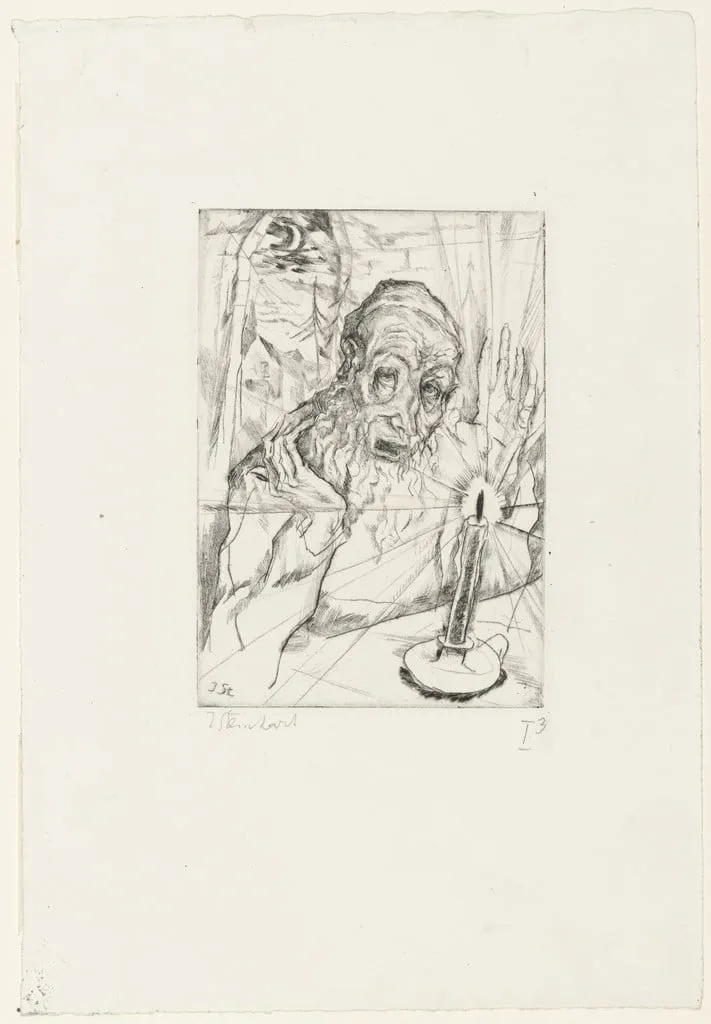
Untitled is an ink print by Jakob Steinhardt. It dates from 1917 and is held in the collection of the Museum of Modern Art.
About this work
Overview
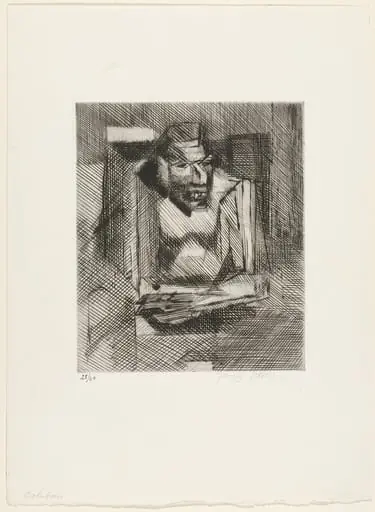
Created around 1917, this drypoint print by Jakob Steinhardt is part of The Museum of Modern Art’s collection. Executed with a needle on metal, the work captures a solitary figure in a modest interior. Its muted tones and textured lines reflect the artist’s interest in emotional immediacy over polished detail, characteristic of early 20th-century German printmaking.
Subject & Meaning
The figure is a bearded man seated in stillness, his posture conveying weariness. His hands rest passively on his knees, and a single lamp casts a narrow pool of light, isolating him from the surrounding darkness. The absence of narrative context invites contemplation of inner solitude, suggesting themes of introspection or emotional exhaustion common in post-war imagery.
Technique & Style
Steinhardt employed drypoint to carve direct, jagged lines into a metal plate, creating rich, velvety blacks and uneven edges.
Steinhardt employed drypoint to carve direct, jagged lines into a metal plate, creating rich, velvety blacks and uneven edges. The face and hands are rendered with rapid, hesitant strokes, avoiding refinement. The background dissolves into coarse, irregular marks, enhancing the sense of enclosure. Light emerges not from idealized form but from the contrast of inked scratches against uninked paper.
History & Provenance
The print was made during Steinhardt’s active years in Berlin, amid the cultural upheavals of World War I. It entered MoMA’s collection in the mid-20th century as part of a broader effort to document Expressionist printmaking. Its preservation reflects institutional recognition of the medium’s capacity for psychological depth, though its specific provenance prior to acquisition remains undocumented.
Context
Produced during a period of social fragmentation, the work aligns with German Expressionist concerns for inner experience over external realism. Steinhardt, associated with the Berlin Secession and later the Jewish cultural revival, often depicted quiet, marginalized figures. This piece echoes contemporaneous works by Kollwitz and Nolde, where light and shadow serve as emotional conduits rather than mere illumination.
Legacy
Though not widely exhibited, the print exemplifies the expressive potential of drypoint in early modernist printmaking. Its unembellished aesthetic influenced later artists seeking authenticity in mark-making. It remains a quiet reference point in studies of emotional representation in print, valued for its restraint and atmospheric precision.
Artist & collection