Artwork
The Seven Deadly Sins: Lust
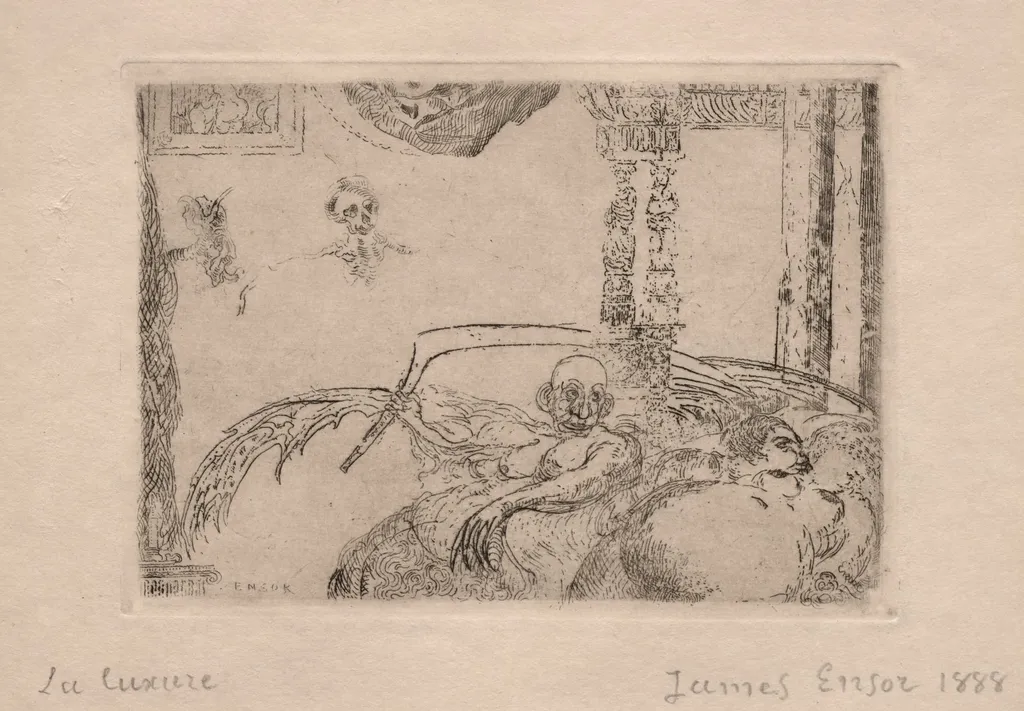
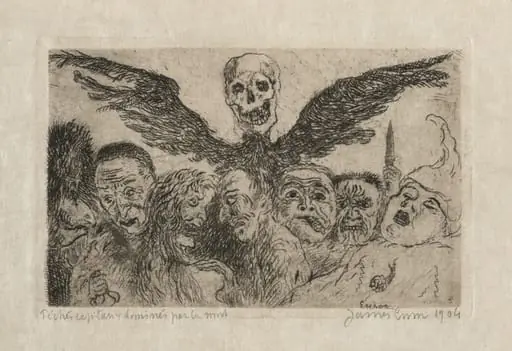
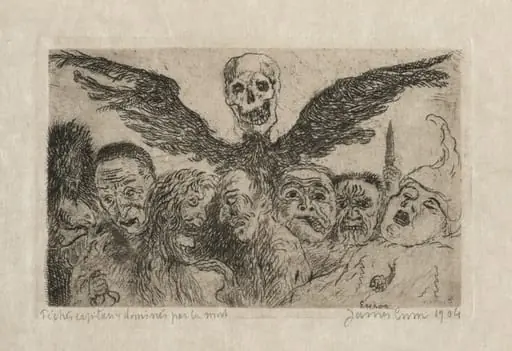
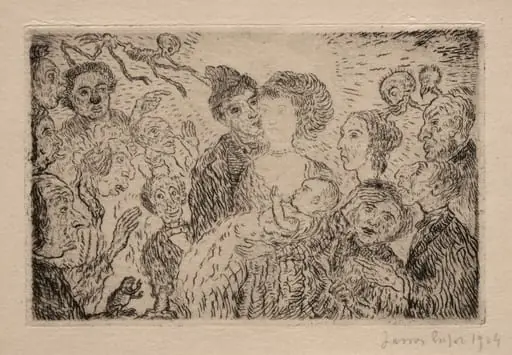
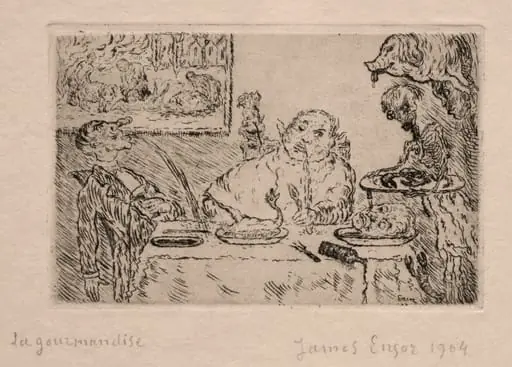
The Seven Deadly Sins: Lust is a print by the Impressionist artist James Ensor. It dates from 1888 and is held in the collection of the Cleveland Museum of Art.
About this work
Overview
Created in 1888, *The Seven Deadly Sins: Lust* is one of seven prints by Belgian artist James Ensor examining moral transgression through unsettling imagery.
Created in 1888, *The Seven Deadly Sins: Lust* is one of seven prints by Belgian artist James Ensor examining moral transgression through unsettling imagery. Executed in etching and aquatint, the work belongs to a series that merges satire with psychological tension. Ensor, who lived most of his life in Ostend, was closely linked to the avant-garde collective Les XX and used printmaking to challenge conventional aesthetics with dark, symbolic narratives.
Subject & Meaning
The scene portrays a bald, aggressive man beside a reclining woman who appears inert, suggesting vulnerability or unconsciousness. A scythe rests near his head, implying impending judgment or death. Surrounding objects—a skull, a cracked mirror, a framed image—hint at vanity, mortality, and fractured identity. The title explicitly links the image to lust, but the composition reframes it not as passion but as domination and decay, subverting romanticized notions of desire.
Technique & Style
Ensor employed etching and aquatint to achieve dense, shadowed textures and sharp contrasts. The figures are distorted, with exaggerated features that evoke caricature and unease. Background elements are rendered with loose, almost chaotic lines, amplifying the sense of psychological disarray. His use of line and tone avoids realism, instead constructing a dreamlike, nightmarish space where moral allegory is conveyed through visual distortion rather than literal depiction.
History & Provenance
The print was produced in 1888 as part of Ensor’s broader exploration of sin and human frailty. It entered the collection of The Cleveland Museum of Art in the 20th century, following its circulation among European collectors and institutions interested in Symbolist and proto-Expressionist works. Its preservation reflects its significance as an early example of psychological intensity in printmaking, distinct from the more decorative traditions of the time.
Context
Ensor created this work amid rising interest in moral allegory and psychological depth in late 19th-century European art. His association with Les XX positioned him against academic norms, allowing him to experiment with grotesque forms and taboo subjects. While contemporaries like Gauguin sought spiritual symbolism, Ensor turned inward, using satire and distortion to expose the grotesque undercurrents of human behavior, particularly in private, intimate spaces.
Legacy
Ensor’s *Lust* anticipates Expressionist and Surrealist concerns with inner turmoil and distorted reality. His unflinching portrayal of desire as menacing and dehumanizing influenced later artists seeking to depict psychological states beyond surface appearances. Though not widely exhibited in his lifetime, the print gained recognition in the 20th century as a pioneering work in the visual language of modern anxiety and moral ambiguity.
Artist & collection
Artist
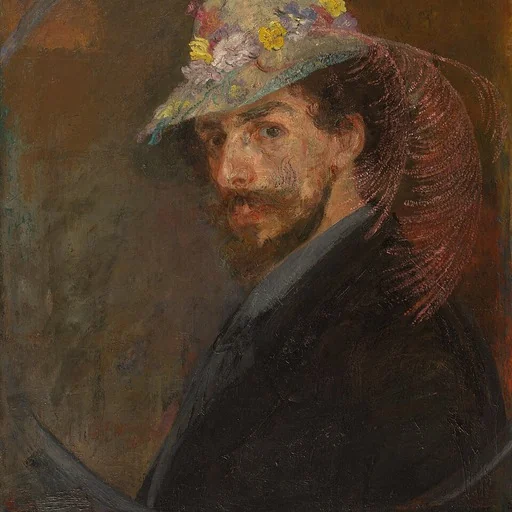
James Sidney Edouard, Baron Ensor (13 April 1860 – 19 November 1949) was a Belgian painter and printmaker, an important influence on expressionism and surrealism who lived in Ostend for most of his life.