Artwork
The Thames
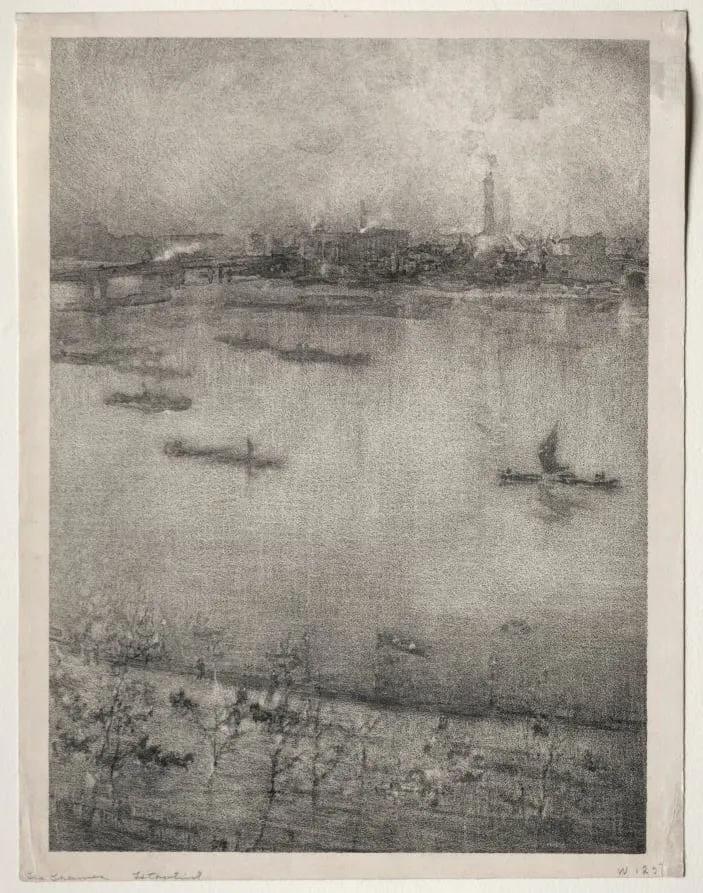
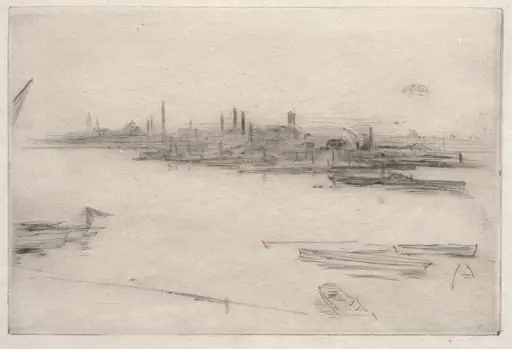
The Thames is a print by the Impressionist artist James McNeill Whistler. It dates from 1896 and is held in the collection of the Cleveland Museum of Art.
About this work
Overview
The work captures a quiet stretch of the river under a muted sky, rendered with subtle tonal variations rather than sharp detail.
Created in 1896, The Thames is a print by James McNeill Whistler, part of his series of nocturnal river scenes. It is currently held in the collection of The Cleveland Museum of Art. The work captures a quiet stretch of the river under a muted sky, rendered with subtle tonal variations rather than sharp detail. Its quiet atmosphere and restrained palette reflect Whistler’s interest in harmony and mood over narrative.
Subject & Meaning
The scene depicts the River Thames at twilight, with faint outlines of distant buildings and a solitary smokestack rising above the mist. Small, indistinct boats drift on the water, suggesting quiet human activity without emphasizing it. The composition avoids dramatic events, instead conveying a sense of stillness and transience. Whistler sought to evoke atmosphere rather than document place, aligning the work with his aesthetic philosophy.
Technique & Style
Whistler employed drypoint and etching to achieve soft, blurred edges and delicate gradations of tone. Lines are loose and suggestive, with areas of ink deliberately smudged to mimic atmospheric haze. The absence of sharp contours and the dominance of gray tones create a sense of depth through light and shadow rather than detail. This approach aligns with his belief in art as an arrangement of form and color, not literal representation.
History & Provenance
The print was made during Whistler’s later years, when he focused increasingly on tonal studies of the Thames. It was likely produced in his London studio and circulated among collectors interested in his nocturnes. The Cleveland Museum of Art acquired it in the 20th century as part of its growing collection of American and Anglo-European prints, recognizing its significance in Whistler’s oeuvre.
Context
Whistler’s Thames prints emerged alongside broader late-19th-century interests in urban landscapes and atmospheric effects. While contemporaries like Monet painted light in open air, Whistler worked indoors, relying on memory and sketch studies. His approach diverged from Impressionism by prioritizing tonal harmony and compositional balance over optical realism, reflecting his ties to Aestheticism and Japanese print traditions.
Legacy
The Thames exemplifies Whistler’s influence on modern printmaking through its emphasis on mood and abstraction. His tonal experiments paved the way for later artists exploring atmosphere and minimalism. Though less celebrated than his paintings, his prints remain key to understanding his artistic vision—quiet, deliberate, and rooted in the evocative potential of subtle variation.
Artist & collection
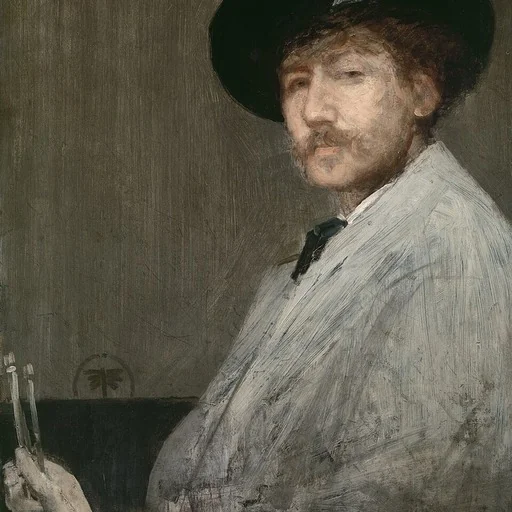
Artist
James Abbott McNeill Whistler was an American painter in oils and watercolor, and printmaker, active during the American Gilded Age and based primarily in the United Kingdom.

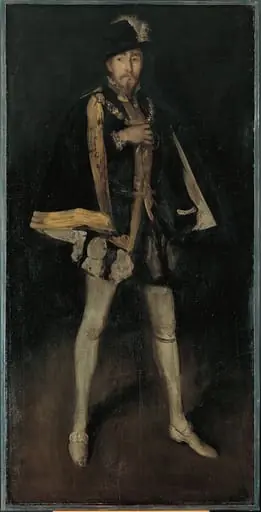 Arrangement in Black, No. 3: Sir Henry Irving as Philip II of Spain
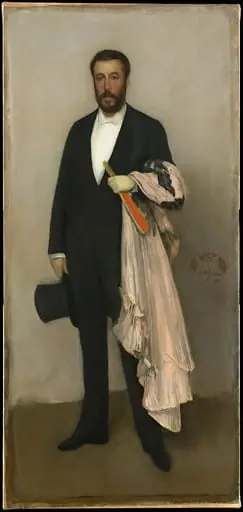 Arrangement in Flesh Colour and Black: Portrait of Theodore Duret
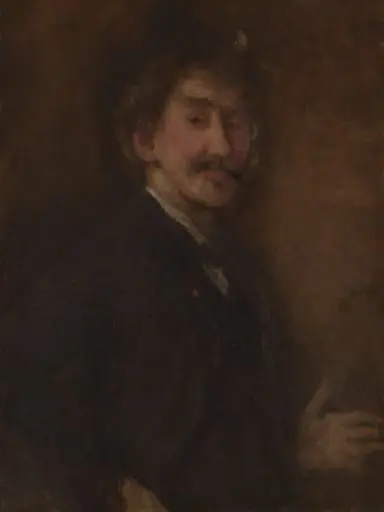 Gold and Brown: Self-Portrait
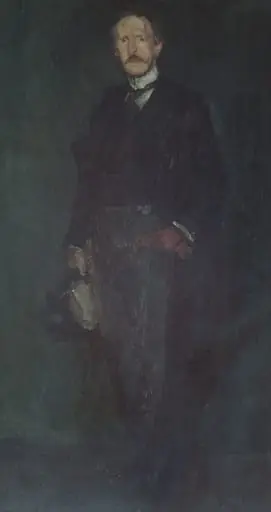 Edward Guthrie Kennedy
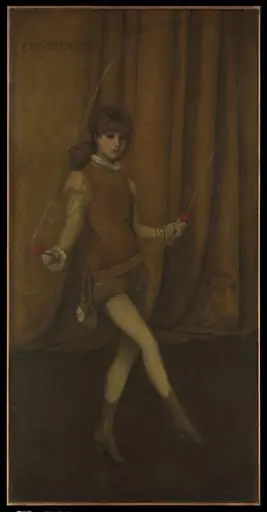 Harmony in Yellow and Gold: The Gold Girl—Connie Gilchrist
 George W. Vanderbilt
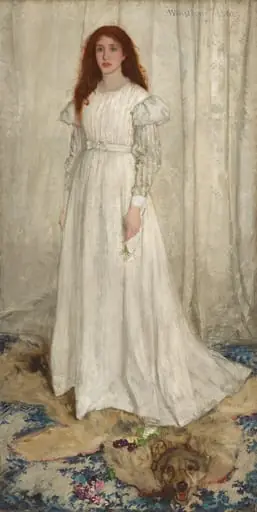 Symphony in White, No. 1: The White Girl
 Henry Irving as Philip II of Spain
![[Large Steamer Ship at Dock, Paris], by Auguste Lepère](https://artifactworldgallery.com/img/auguste-lepere--large-steamer-ship-at-dock-paris--ed31099e42153820-w320.webp)