Artwork
Murnau
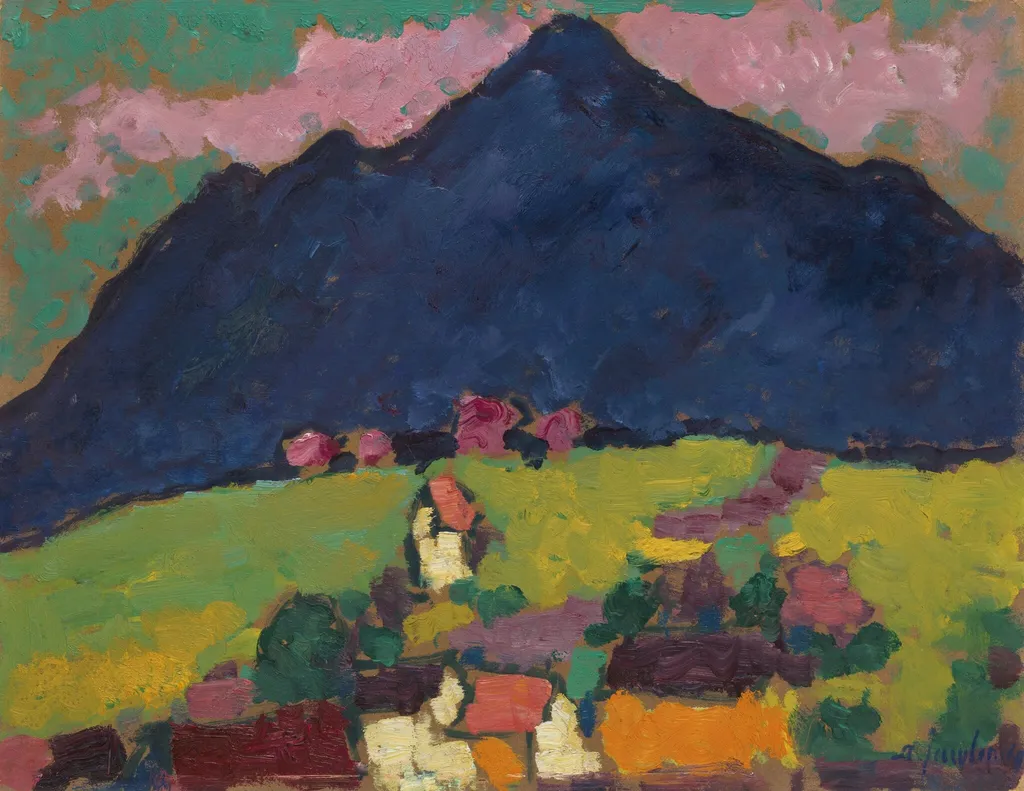
Murnau is an oil painting by the Post-Impressionist artist Alexej von Jawlensky. It dates from 1910 and is held in the collection of the National Gallery of Art.
About this work
Overview
Alexej von Jawlensky's 1910 painting, Murnau, is an oil on hardboard landscape. It depicts a mountain and village scene rendered with an expressive palette and energetic brushwork. The work exemplifies the artist's engagement with vibrant color and dynamic composition during this period, transforming a natural setting into a subjective visual experience.
Subject & Meaning
In the foreground, a village is rendered with striking hues of green, yellow, and red, contrasting with naturalistic expectations.
The composition of Murnau centers on a steep, dark blue mountain dominating the background. In the foreground, a village is rendered with striking hues of green, yellow, and red, contrasting with naturalistic expectations. Above, the sky is depicted in an unconventional blend of pink and green, suggesting an emotional or symbolic interpretation rather than a literal representation of the atmosphere.
Technique & Style
Jawlensky employed bold brushstrokes and a vivid color scheme in Murnau, contributing to a palpable sense of energy throughout the composition. The artist's distinctive application of color not only defines forms but also generates a perception of depth and dimensionality, inviting the viewer's engagement. This approach emphasizes the expressive potential of paint, moving beyond mere description to convey an emotional resonance.
Own this work as a print
Artist & collection