Artwork
Trompe l'oeil with Palettes and Miniature
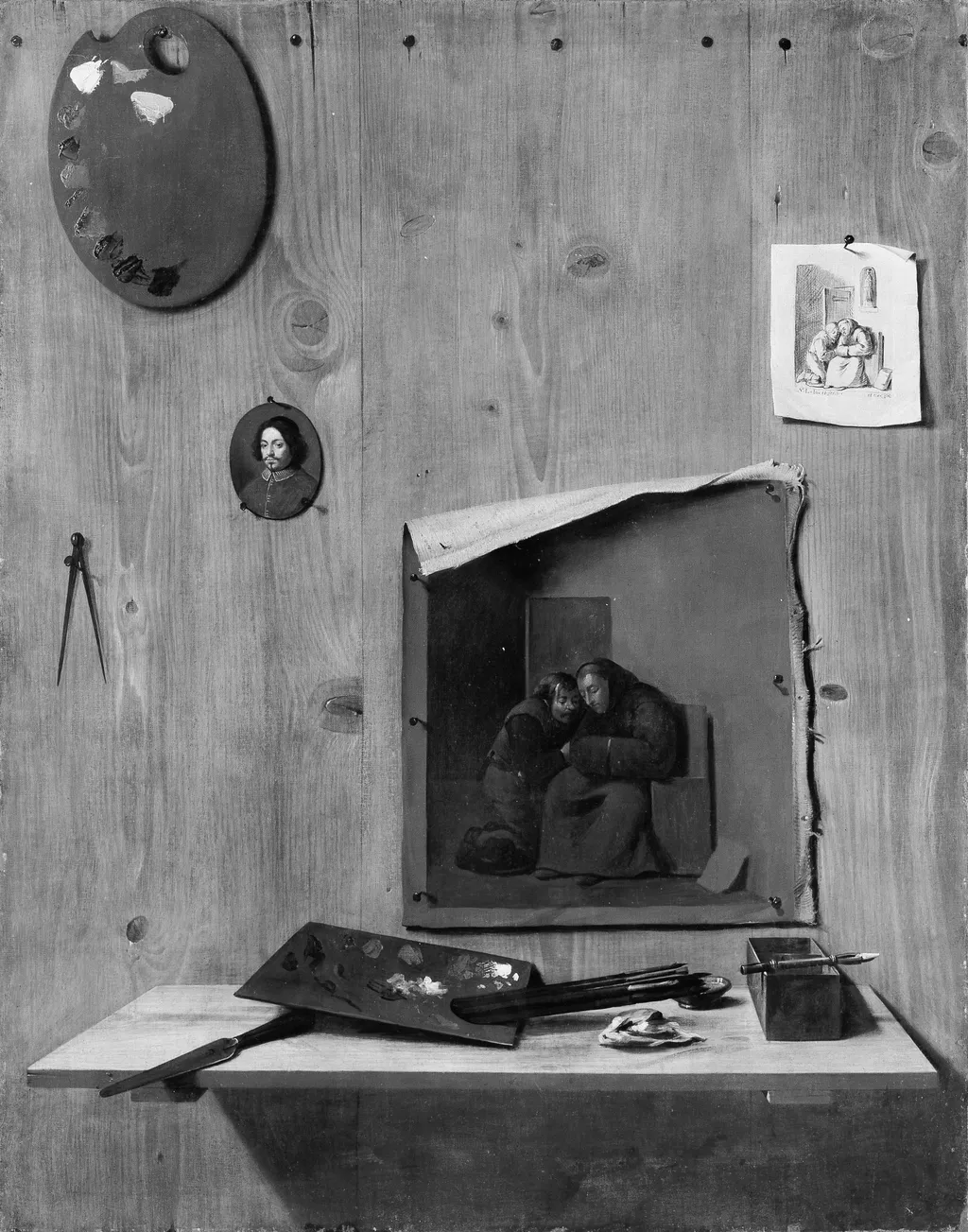
Trompe l'oeil with Palettes and Miniature is an oil painting by the Rococo painting artist Jean François de Le Motte. It is held in the collection of the Metropolitan Museum of Art.
About this work
Overview
This work, now part of The Metropolitan Museum of Art's collection, exemplifies the trompe l'oeil genre, which aims to deceive the viewer's eye.
Trompe l'oeil with Palettes and Miniature is an oil painting created in 1700 by Jean François de Le Motte. This work, now part of The Metropolitan Museum of Art's collection, exemplifies the trompe l'oeil genre, which aims to deceive the viewer's eye. The composition features an arrangement of artistic implements alongside a small portrait, all rendered with meticulous detail to create a powerful illusion of reality.
Subject & Meaning
The painting meticulously depicts what appears to be a weathered wooden wall, complete with simulated cracks and nails. Affixed to this surface are various objects associated with an artist: a paint palette, brushes, a small sketch, and a pair of dividers. A central element is a miniature portrait, framed and seemingly hanging, which shows two figures in close proximity. The entire arrangement is a carefully constructed visual deception, designed to make the painted objects seem physically present.
Technique & Style
De Le Motte utilized advanced painting techniques to achieve the work's compelling illusion. By skillfully manipulating light and shadow, a method known as chiaroscuro, he imparted a sense of depth and volume to the depicted items. This precise rendering of tonal contrasts makes the painted objects appear remarkably three-dimensional, enhancing the trompe l'oeil effect and blurring the distinction between the canvas and physical reality.
Artist & collection
Artist
Jean François de Le Motte (1635–1685) was an artist, born in Tournai.