Artwork
Napoleon in Egypt
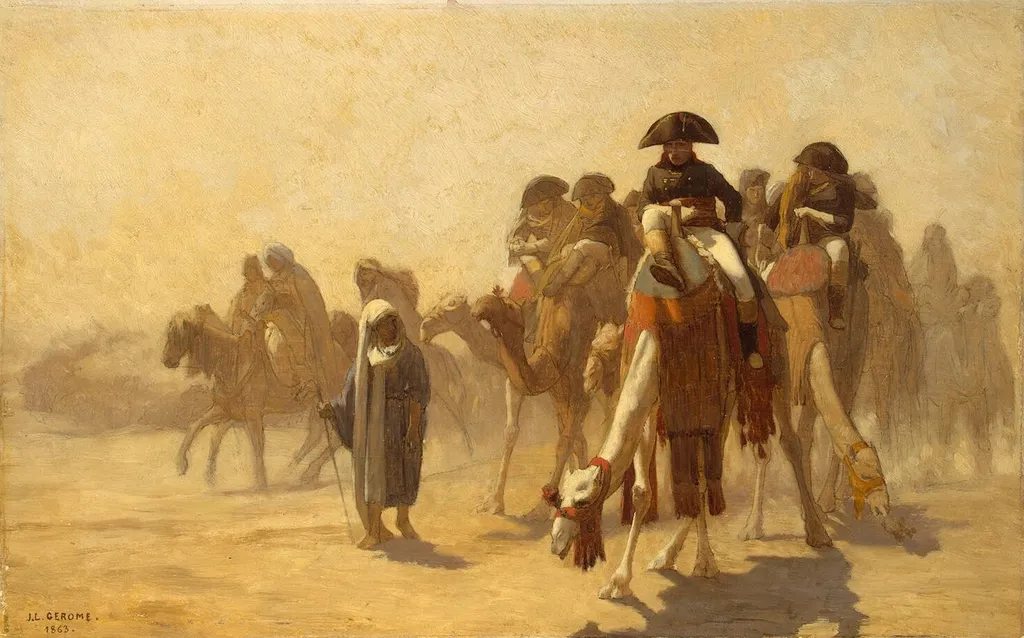
Napoleon in Egypt is an oil painting by Jean Léon Gérôme. It dates from 1863 and is held in the collection of the Hermitage Museum.
About this work
Overview
Jean‑Léon Gérôme’s 1863 oil painting, titled *Napoleon in Egypt*, presents a panoramic view of the French military expedition into Egypt and Syria. Executed in the academic style of the mid‑nineteenth century, the work now belongs to the collection of the State Hermitage Museum in St. Petersburg.
Subject & Meaning
The canvas captures a column of French soldiers and cavalry traversing a barren desert, evoking the early phase of Napoleon’s 1798 campaign. By portraying the troops as a unified mass rather than as individuals, Gérôme emphasizes the collective force of the invading army against an expansive, indifferent landscape.
Technique & Style
Gérôme employs a warm, muted palette of ochres and siennas to convey the oppressive heat of the desert. Soft atmospheric perspective renders distant riders and camels as hazy silhouettes, while the foreground figures are rendered with tighter brushwork, highlighting the contrast between immediacy and distance.
History & Provenance
Completed in 1863, the painting reflects contemporary French interest in the Egyptian campaign, a subject often revisited in nineteenth‑century historical art. It entered the State Hermitage Museum’s holdings in the early twentieth century, where it remains on display as part of the museum’s European paintings collection.
Context
The work belongs to a broader trend of Orientalist painting that romanticized North African and Middle Eastern settings for European audiences. Gérôme, a leading figure in this movement, combined meticulous archaeological research with dramatic composition to satisfy both scholarly and popular appetites for exotic history.
Artist & collection

Artist
Jean-Léon Gérôme was a French painter and sculptor in the style now known as academicism.