Artwork
Landscape with the temptation of St Antony
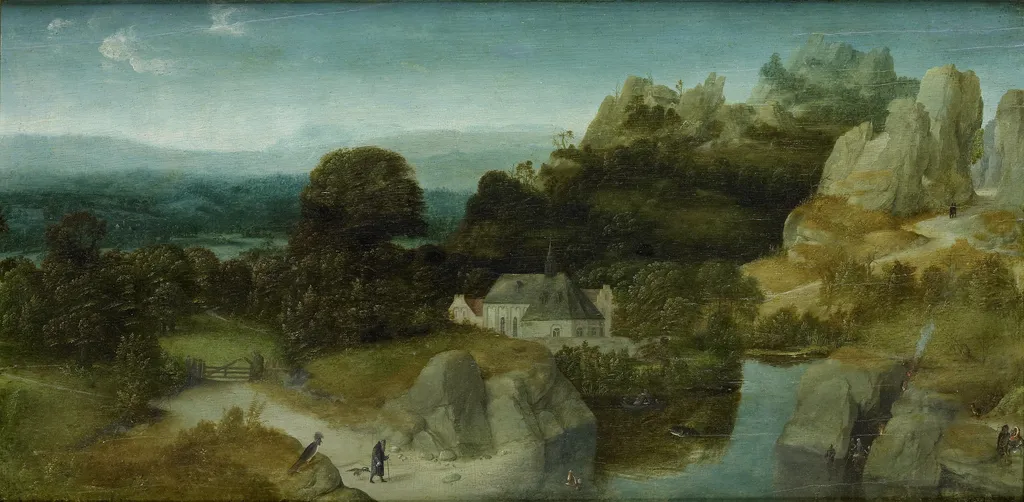
Landscape with the temptation of St Antony is an oil painting by the Northern Renaissance artist Joachim Patinir. It dates from 1515 and is held in the collection of the Rijksmuseum.
About this work
Overview
A small group of figures traverses the riverbank while a solitary individual sits near the water’s edge, creating a calm, contemplative atmosphere.
Joachim Patinir’s oil painting dated to 1515, titled Landscape with the Temptation of St Antony, presents a tranquil rural vista. The composition centers on a modest white dwelling beside a river, framed by towering trees and craggy hills beneath a muted sky. A small group of figures traverses the riverbank while a solitary individual sits near the water’s edge, creating a calm, contemplative atmosphere.
Subject & Meaning
The work references the legendary trials of Anthony the Great, an early Christian hermit whose spiritual battles were often set against expansive natural settings. In Patinir’s rendition, the saint is suggested rather than explicitly depicted, allowing the surrounding landscape—its isolation and subtle hazards—to serve as a visual metaphor for inner temptation and ascetic resolve.
Technique & Style
Patinir employs a palette of softened hues, applying multiple translucent layers to model the distant hills and atmospheric perspective. Delicate brushwork builds gradual tonal shifts, while the gentle illumination evokes the stillness of an afternoon. The artist’s handling of light and color creates depth without harsh contrasts, characteristic of early Netherlandish landscape traditions.
History & Provenance
Created in the early sixteenth century, the painting entered the collection of the Rijksmuseum in Amsterdam, where it remains on public display. Its acquisition reflects the museum’s focus on Northern Renaissance works and contributes to the broader understanding of Patinir’s role in developing panoramic landscape painting.
Context
Patinir, often regarded as a pioneer of the world landscape genre, frequently placed biblical narratives within vast, imagined terrains. This piece aligns with that practice, integrating a religious theme into a secular, topographical setting. The inclusion of everyday figures and a modest architecture underscores the period’s interest in merging devotional content with detailed observation of the natural world.
Own this work as a print
Artist & collection

Artist
Joachim Patinir, also called Patenier, was a Flemish Renaissance painter of history and landscape subjects.