Artwork
Jaque mate
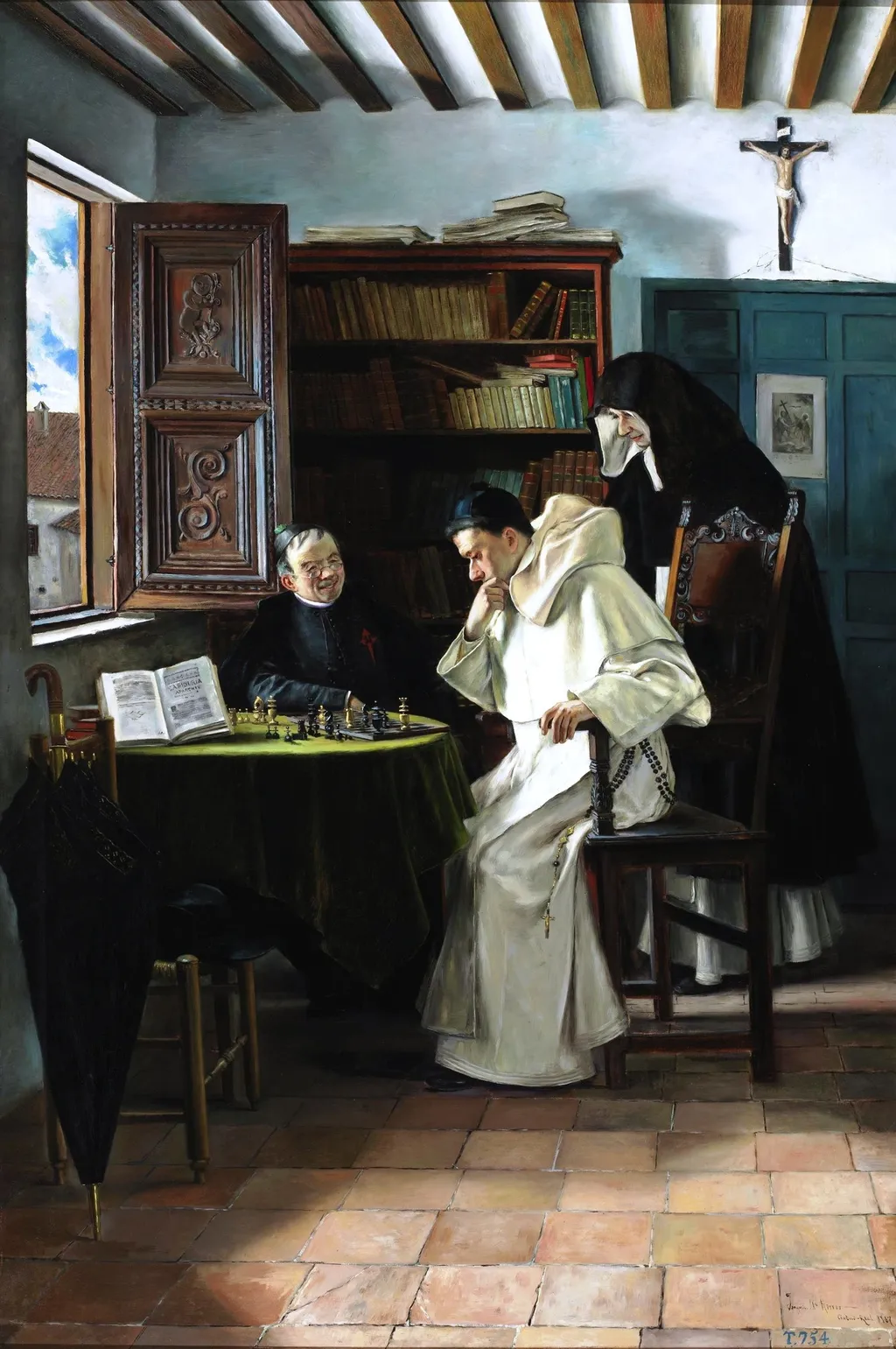
Jaque mate is an oil painting by the Post-Impressionist artist Joaquín María Herrer y Rodríguez. It dates from 1894 and is held in the collection of the Museo del Prado.
About this work
Overview
Jaque mate, executed in oil on canvas in 1894, is a work by Spanish painter Joaquín María Herrer y Rodríguez. The composition presents an intimate interior where two figures are engaged in a game of chess, surrounded by scholarly and religious objects. The painting is part of the permanent collection of the Museo del Prado, where it is displayed among other 19th‑century Spanish works.
Subject & Meaning
The scene unfolds in a modest study, its walls lined with shelves of aged volumes and a crucifix that hangs prominently. A man in a white robe leans over a table, moving a chess piece opposite a darker‑clad opponent. The juxtaposition of the intellectual pastime with symbols of faith and learning suggests a contemplation of strategy, morality, and the balance between reason and belief.
Technique & Style
Herrer y Rodríguez employs a restrained palette of muted earth tones, allowing the light from a nearby window to illuminate the wooden floor and furnishings.
Herrer y Rodríguez employs a restrained palette of muted earth tones, allowing the light from a nearby window to illuminate the wooden floor and furnishings. The brushwork is smooth, rendering the textures of fabric, wood, and metal with clarity. The careful modeling of the figures and the precise rendering of the chessboard convey a quiet realism characteristic of late‑19th‑century Spanish genre painting.
History & Provenance
Created in 1894, Jaque mate entered the Museo del Prado’s holdings through acquisition in the early 20th century, reflecting the institution’s interest in documenting domestic genre scenes of the period. The painting has remained in the museum’s collection, where it is occasionally featured in exhibitions exploring everyday life and intellectual pursuits in Spanish art.
Context
The work belongs to a broader tradition of interior genre paintings that depict scholarly environments, a motif popular among Spanish artists seeking to portray the cultural values of education and piety. The inclusion of a chess game aligns with contemporary symbolic uses of the game to represent strategic thought and moral decision‑making.
Own this work as a print
Artist & collection
Artist
Joaquín María Herrer y Rodríguez
Joaquín María Herrer y Rodríguez (1840–1917) was an artist, born in Madrid.