Artwork
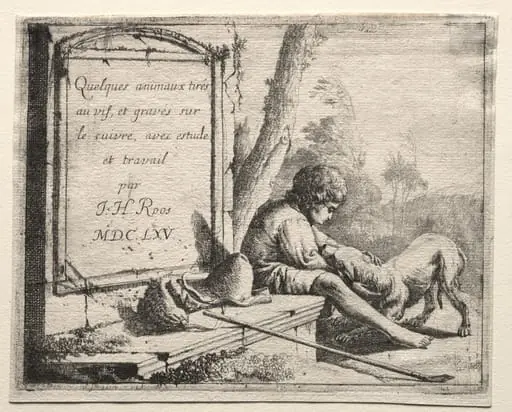
Title Page: Shepherd Petting his Dog
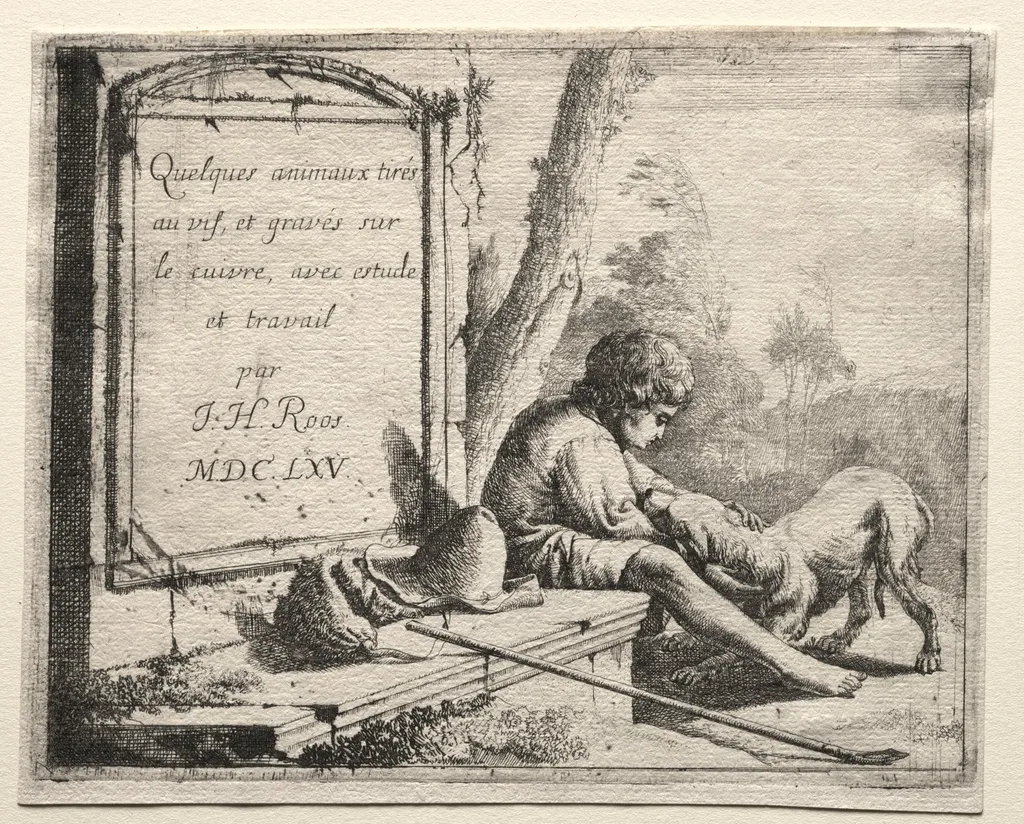
Title Page: Shepherd Petting his Dog is a print by the Baroque artist Johann Heinrich Roos. It dates from 1665 and is held in the collection of the Cleveland Museum of Art.
About this work
The title at the top reads *Shepherd Petting his Dog*, and the artist’s name, *J.
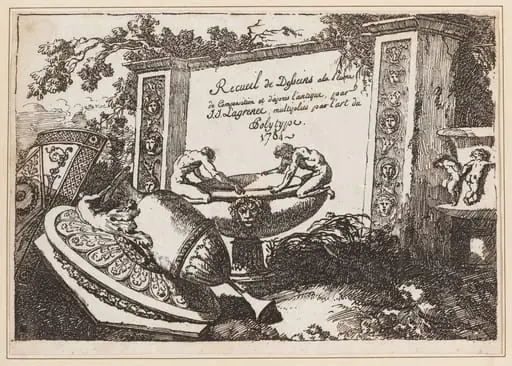
This is a black-and-white etching of a boy sitting on a rock, petting a dog. The boy looks relaxed, with one arm around the dog’s neck. Behind him, trees and a bridge stretch into the distance. The image is framed by a decorative border with text in French.
The title at the top reads *Shepherd Petting his Dog*, and the artist’s name, *J.H. Roos*, is signed below. The year *1665* is also noted.
Next, check out Baroque to see how this style used drama and everyday scenes.
Overview
This 1665 etching by Johann Heinrich Roos serves as a title page for a printed volume, combining imagery with textual framing. Rendered in monochrome, it depicts a young shepherd seated on a rock, gently stroking a dog at his side. The scene is enclosed within an ornamental border containing French inscriptions, including the title and artist’s signature. The composition balances intimate human-animal interaction with a distant landscape of trees and a bridge, suggesting depth and quiet rural life.
Subject & Meaning
The image portrays a moment of calm between a shepherd and his dog, emphasizing tenderness rather than labor. The boy’s relaxed posture and the dog’s trusting demeanor convey a quiet harmony between human and animal. This scene, devoid of overt drama, reflects an idealized view of pastoral life common in 17th-century Dutch and German art. It suggests values of simplicity, companionship, and harmony with nature, aligning with contemporary literary and moral themes of rural virtue.
Technique & Style
Executed as a fine-line etching, the work demonstrates Roos’s skill in rendering texture and spatial recession with minimal tonal variation. Delicate hatching defines the dog’s fur, the folds of the boy’s clothing, and the foliage in the background. The decorative border, with its French lettering, is meticulously engraved, contrasting with the naturalistic central scene. The style merges precise draftsmanship with a subdued, atmospheric perspective typical of Northern European printmaking of the period.
History & Provenance
Created in 1665, the print was likely produced as part of a published collection, possibly a book of pastoral scenes or moralizing engravings. It entered the collection of The Cleveland Museum of Art through documented acquisition, though its earlier ownership history remains largely unrecorded. As a print, multiple impressions were made, and this example is one of the surviving copies preserved in institutional collections, reflecting its role as a widely circulated image in its time.
Context
Roos worked during a period when Dutch and German artists increasingly turned to everyday rural subjects, influenced by the rise of print culture and middle-class patronage. While Baroque art often emphasized grandeur and movement, this etching reflects a quieter, more introspective current—valuing stillness and domestic intimacy. The inclusion of French text suggests an international audience, possibly targeting educated readers familiar with pastoral literature popular across Europe.
Legacy
Though not widely known today, this print exemplifies the broader trend of integrating fine art with printed literature in the 17th century. Roos’s ability to convey emotional nuance through subtle line work influenced later generations of printmakers focused on genre scenes. Its preservation in a major museum underscores its value as a representative artifact of early modern visual culture, where art served both aesthetic and narrative functions in domestic and scholarly settings.
Artist & collection