Artwork
Hyde Park
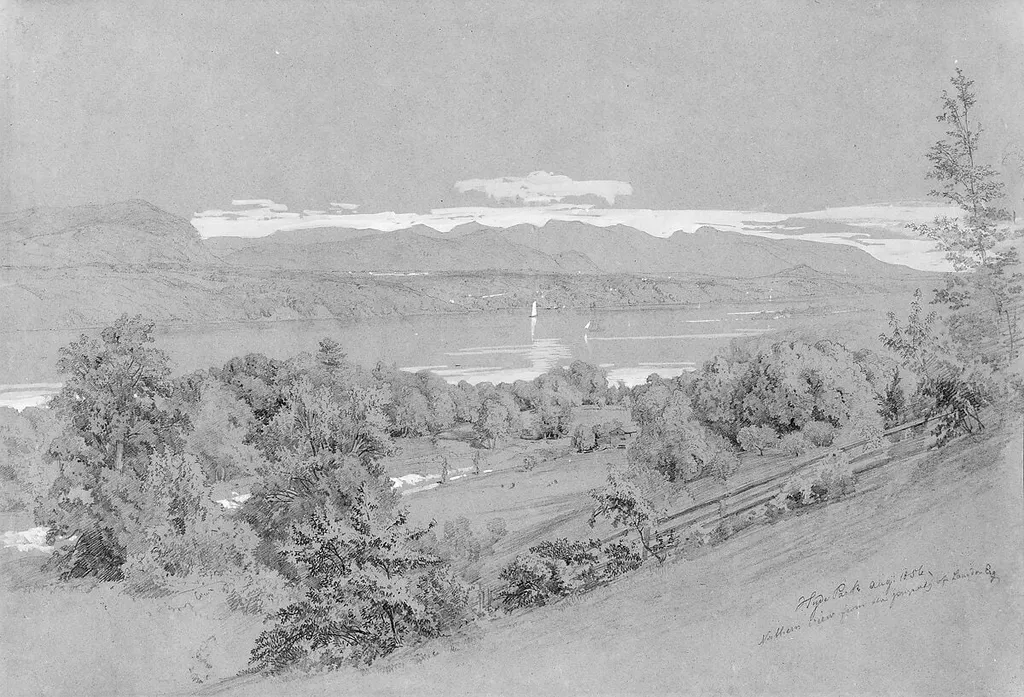
Hyde Park is a gouache drawing by the Impressionist artist Johann Hermann Carmiencke. It dates from 1856 and is held in the collection of the Metropolitan Museum of Art.
About this work
You see a quiet river winding through tall trees, with soft hills in the distance.
Carmiencke drew this in 1856, just as New York’s parks were being planned. The trees feel real—each leaf is a quick pencil stroke, while the river shines with white gouache, a thick, chalky paint. It’s like a snapshot of a place that’s about to change.
If you like this, look up the subject: landscapes.
Overview
White gouache is applied to the water's surface to create a luminous, chalky reflection, contrasting with the darker tones of the surrounding forest.
Johann Hermann Carmiencke's 'Hyde Park,' executed in 1856, is a landscape drawing rendered in graphite and white gouache on brown wove paper. The composition depicts a serene river winding through a dense grove of tall trees, with soft hills receding into the background. Carmiencke employs the brown paper as a mid-tone base, using graphite to define the foliage with quick, distinct strokes that suggest individual leaves rather than detailed realism. White gouache is applied to the water's surface to create a luminous, chalky reflection, contrasting with the darker tones of the surrounding forest. Created during a period of significant urban development in New York, the work reflects the artist's engagement with the American landscape tradition while retaining the technical sensibilities of his German training. As a member of the Hudson River School circle, Carmiencke captures the quietude of the natural world, focusing on the interplay of light and texture. This piece stands as a representative example of his mid-career output, bridging European academic drawing techniques with the emerging American interest in specific, observed landscapes.
Subject & Meaning
The drawing captures a quiet river winding through a forested landscape, suggesting a moment of calm before the encroachment of urban development. The inclusion of a solitary tree and distant hills evokes a sense of untouched nature, reflecting contemporary concerns about the preservation of green spaces amid expanding city planning.
Technique & Style
Carmiencke employed graphite for the detailed foliage, using swift pencil strokes to suggest individual leaves, while the river’s surface is highlighted with white gouache, a dense, opaque medium that creates a luminous, chalk‑like effect. The contrast between the delicate graphite and the bold gouache underscores the interplay of light and shadow in the scene.
History & Provenance
Created in the same year New York’s park system was being conceived, the work anticipates the transformation of natural landscapes into public recreational areas. The piece is part of the American Wing collection, where it remains as a historical document of mid‑19th‑century American attitudes toward nature and urban planning.
Context
Hyde Park belongs to the broader tradition of 19th‑century landscape drawing, a genre that often served both aesthetic and documentary purposes. By depicting a specific, yet unnamed, locale, Carmiencke contributes to the visual record of American wilderness before extensive alteration by infrastructure and park development.
Artist & collection

Artist
Johann Hermann Carmiencke (1810–1867) was an artist, born in Hamburg.
