Artwork
Drawing (mosaic format)
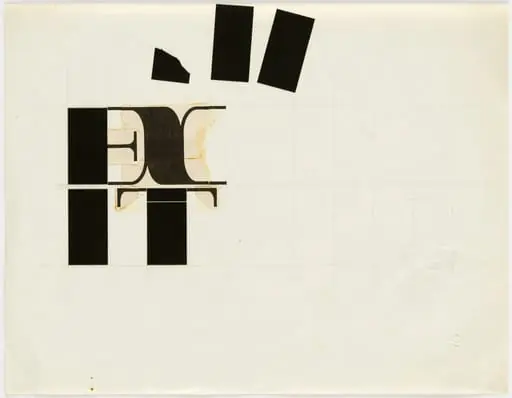
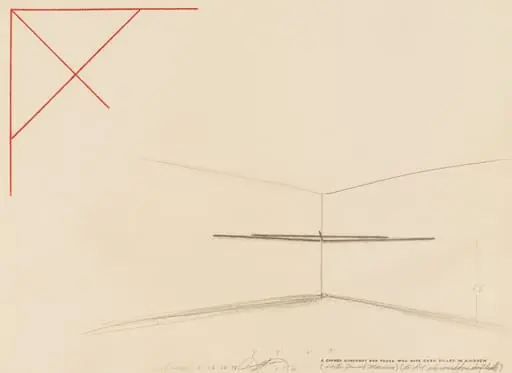
Drawing (mosaic format) is a drawing by John Ernest. It dates from 1968 and is held in the collection of the Victoria and Albert Museum.
About this work
Overview
It resides in the Victoria and Albert Museum’s collection, reflecting Ernest’s commitment to systematic composition and spatial clarity.
Created in 1968 by John Ernest, an American-born artist based in London, this drawing belongs to his exploration of geometric abstraction within the British Constructivist tradition. Executed in black and white, the work adopts a mosaic-like structure of fine lines to construct a single chair form. It resides in the Victoria and Albert Museum’s collection, reflecting Ernest’s commitment to systematic composition and spatial clarity.
Subject & Meaning
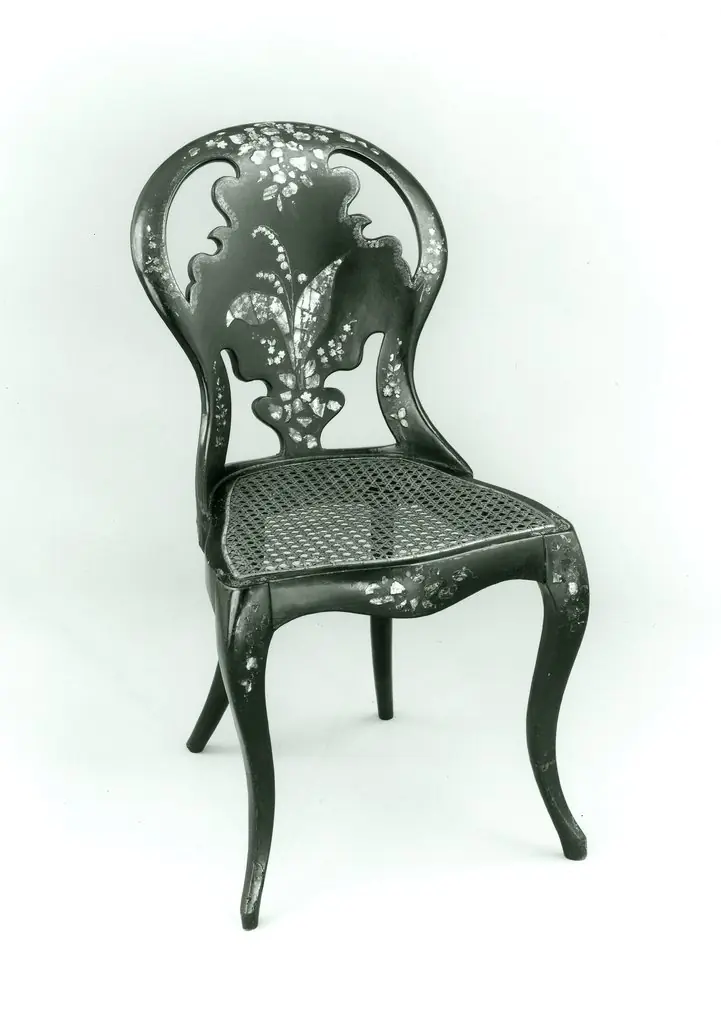
The subject is a minimalist representation of a chair, stripped of ornamentation and functional cues. Its floating posture and lack of contextual detail shift focus from utility to structure. The work invites contemplation of form and space rather than representation, aligning with Constructivist ideals that prioritize order, geometry, and the autonomy of the artwork over narrative or symbolism.
Technique & Style
Ernest employed precise, linear marks arranged in a grid-like pattern to suggest volume and depth. The seat appears as a smooth oval, while the legs are rendered as thin, angled lines. Beneath the seat, a dense crisscross of fine strokes implies a woven surface, enhancing the illusion of spatial recession. The entire composition is built through disciplined repetition, avoiding shading or texture in favor of structural clarity.
History & Provenance
John Ernest moved to London in 1951 after periods in Sweden and Paris, studying at Saint Martin’s School of Art under Victor Pasmore. By the 1960s, he was associated with the Systems Group, which emphasized algorithmic and modular approaches to art. This drawing, made in 1968, reflects his mature phase, where systematic methods governed form. It entered the Victoria and Albert Museum’s collection as part of its documentation of postwar British abstraction.
Context
Emerging from the British Constructivist movement, Ernest’s work responded to broader mid-century interests in rationality, industrial design, and mathematical order. His approach paralleled developments in architecture and design, rejecting expressive gesture in favor of impersonal, repeatable systems. This drawing situates itself within a wider cultural shift toward abstraction grounded in logic rather than emotion.
Legacy
Ernest’s work contributed to the institutional recognition of Constructivism in Britain, influencing later generations interested in systems-based art. While not widely known outside specialist circles, his drawings remain important examples of how geometric precision could convey spatial complexity without figuration. The piece continues to be referenced in studies of postwar British abstraction and the intersection of art and design.
Artist & collection
Artist
John Ernest (May 6, 1922 – July 21, 1994) was an American-born Constructivist abstract artist.