Artwork
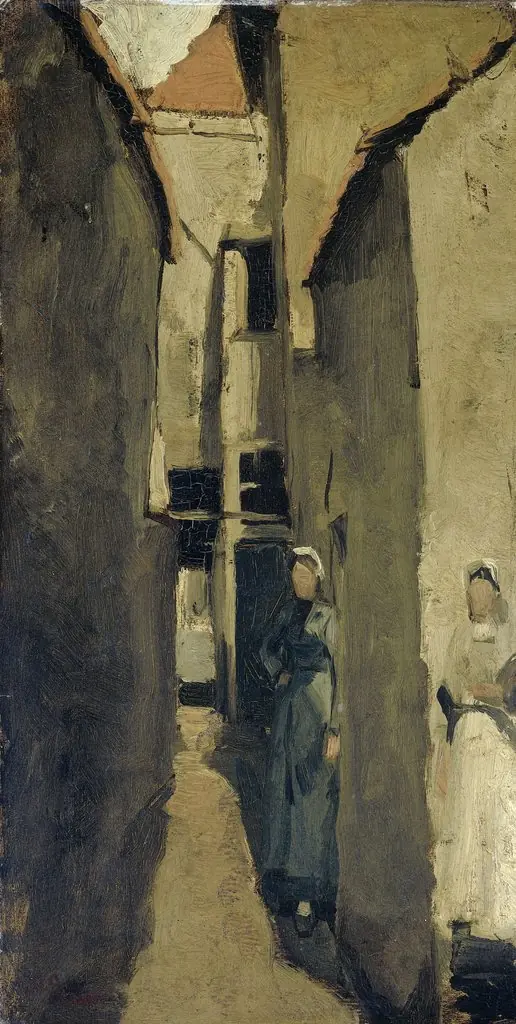
A Street in Venice
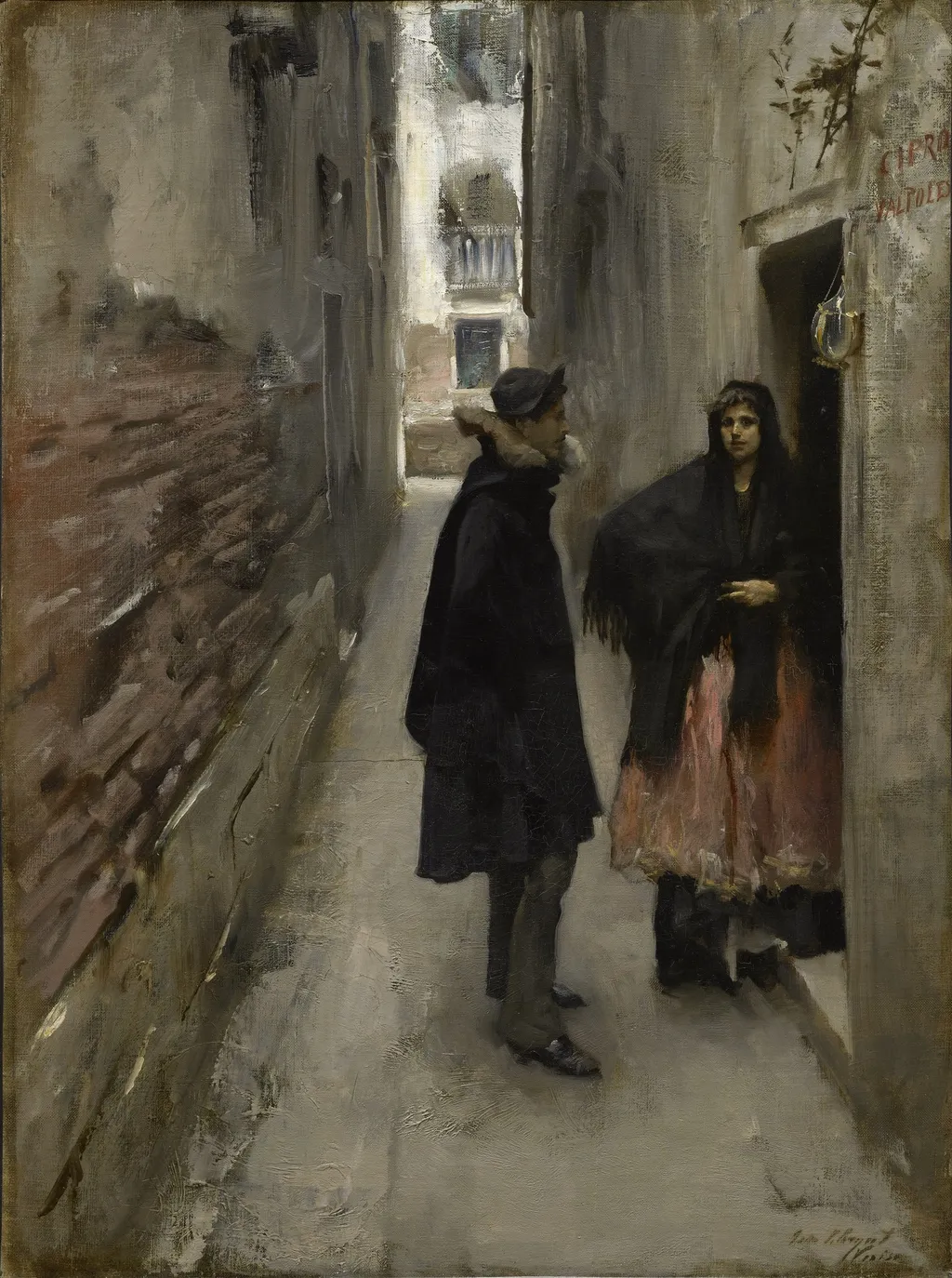
A Street in Venice is an oil painting by the Impressionist artist John Singer Sargent. It dates from 1891 and is held in the collection of the Nationalmuseum.
About this work
Overview
Painted in 1891, *A Street in Venice* is an oil work by American artist John Singer Sargent, created during one of his many travels through Europe.
Painted in 1891, *A Street in Venice* is an oil work by American artist John Singer Sargent, created during one of his many travels through Europe. Though best known for formal portraits, Sargent frequently turned his attention to urban scenes, capturing the quiet rhythms of everyday life. This piece exemplifies his interest in transient moments and atmospheric conditions, rendered with a painterly freedom that aligns with broader European trends of the time.
Subject & Meaning
The painting depicts a solitary man and woman standing in a narrow Venetian alley, their figures framed by weathered walls and the dim glow of a distant window. Dressed in modest, period-appropriate clothing, they appear absorbed in their own presence rather than engaged with the viewer. The scene conveys a sense of quiet solitude, emphasizing the intimacy and stillness of urban backstreets rather than the grandeur of Venice’s canals or piazzas.
Technique & Style
Sargent employed visible, fluid brushwork to suggest texture and movement, particularly in the rough stone surfaces and fabric folds. He used chiaroscuro to model form and direct attention, contrasting the deep shadows of the alley with the faint, cool light emanating from its far end. The composition avoids sharp detail, instead relying on tonal shifts and loose strokes to evoke mood, reflecting an affinity with Impressionist concerns for light and perception without strict adherence to the movement’s conventions.
History & Provenance
Created during Sargent’s extended stays in Italy, the painting entered the collection of the Nationalmuseum in Stockholm at some point in the 20th century. Its acquisition reflects the museum’s broader interest in international artists who engaged with Scandinavian and European visual traditions. Unlike many of Sargent’s commissioned portraits, this work was likely painted for personal exploration, preserving its unposed, observational character.
Context
In the late 19th century, many Western artists turned to Venice as a subject for its interplay of light, water, and decay. Sargent joined this tradition, but focused on lesser-seen corners rather than postcard vistas. His approach aligned with a growing interest in candid urban life, influenced by French Realism and Impressionism, while retaining a personal sensitivity to spatial depth and human presence that distinguished his work from his contemporaries.
Legacy
Though not among Sargent’s most widely exhibited works, *A Street in Venice* remains a quiet testament to his ability to transform ordinary scenes into evocative studies of light and solitude. It illustrates his versatility beyond portraiture and contributes to the understanding of how American artists engaged with European aesthetics. The painting continues to be studied for its nuanced handling of atmosphere and its restrained emotional tone.
Own this work as a print
Artist & collection

Artist
John Singer Sargent (; January 12, 1856 – April 15, 1925) was an American expatriate artist, considered the "leading portrait painter of his generation" for his evocations of Belle Époque and Edwardian-era luxury.