Artwork
Plums
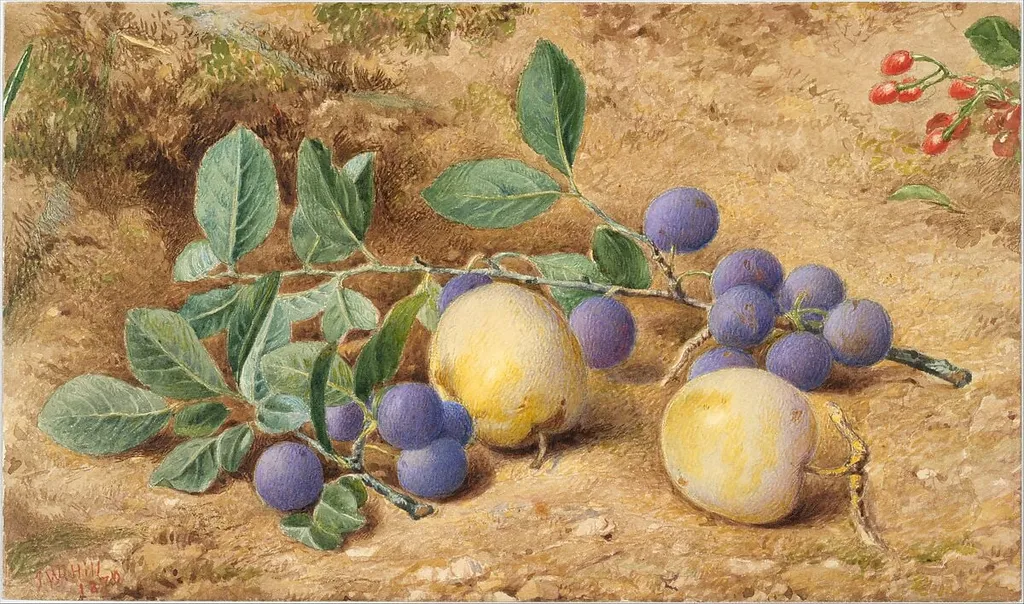
Plums is a graphite work on paper by the Impressionist artist John William Hill. It dates from 1870 and is held in the collection of the Metropolitan Museum of Art.
About this work
Overview
Plums is a watercolor, graphite, and gouache work on off-white Bristol board created by John William Hill in 1870, exemplifying his Realist approach to natural subjects.
Subject & Meaning
The piece depicts a simple still life of plums and foliage on a table, highlighting Hill's interest in naturalistic representation through everyday, carefully observed subjects.
Technique & Style
Hill employed glazing with watercolor to achieve fresh, layered colors, while the semi-transparent Bristol board contributes a soft, glowing effect to the composition.
History & Provenance
Created in 1870, Plums reflects Hill's shift, influenced by John Ruskin and the American Pre-Raphaelite movement in the 1850s, from technical illustration to detailed natural studies.
Context
Part of The American Wing collection, Plums situates Hill within the broader context of American Realism, emphasizing meticulous observation of the natural world.
Legacy
Through works like Plums, Hill contributed to the appreciation of everyday subjects in American art, encouraging a closer observation of nature's details.
Artist & collection

Artist
John William Hill or often J.W. Hill (January 13, 1812 – September 24, 1879) was a British-born American artist working in watercolor, gouache, lithography, and engraving. Hill's work focused primarily upon natural…
