Artwork
Waterfront
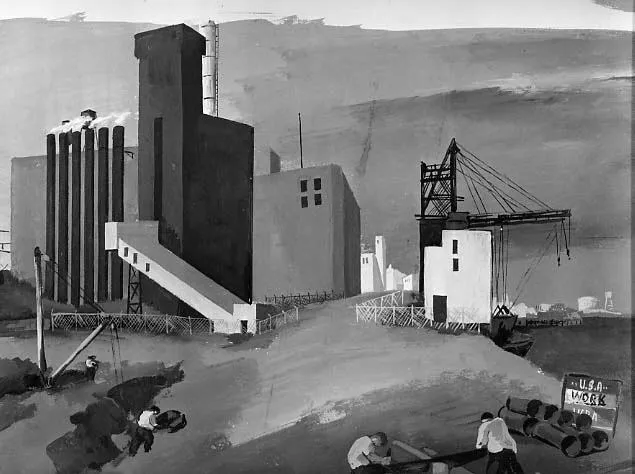
Waterfront is an unspecified painting by the American Impressionist artist Joseph Kaplan. It dates from 1940 and is held in the collection of the Metropolitan Museum of Art.
About this work
Overview
Joseph Kaplan's painting, Waterfront, completed in 1940, offers a depiction of an industrial landscape. The artwork captures a busy factory area situated alongside a body of water, characterized by its imposing structures and active labor force. This piece is part of the collection at The Metropolitan Museum of Art, providing insight into American industry during the early 1940s.
Subject & Meaning
The canvas portrays a dynamic industrial scene, featuring towering factory buildings and prominent smokestacks that dominate the horizon.
The canvas portrays a dynamic industrial scene, featuring towering factory buildings and prominent smokestacks that dominate the horizon. In the foreground, laborers in dark attire are engaged near a large crane and a docked ship, indicating ongoing activity. A visible sign proclaiming "U.S.A. WORK" emphasizes themes of national industry and labor, set against a bright sky and a mixed terrain of earth and water.
Technique & Style
Kaplan utilizes a direct and robust visual language in Waterfront. Architectural elements are rendered with stark simplicity and sharp linearity, minimizing intricate details to emphasize their structural strength. This approach contrasts the monumental scale of the machinery and buildings with the diminutive figures of the workers, conveying a sense of both the immense power of industry and the human effort within it. The overall impression is one of active stillness.
History & Provenance
Created in 1940, Joseph Kaplan's painting Waterfront is preserved within the extensive holdings of The Metropolitan Museum of Art. Its acquisition by this institution ensures its accessibility for study and public viewing, contributing to the museum's representation of American art from the mid-20th century.
Artist & collection
