Artwork
Liber Studiorum: Pembury Mill, Kent
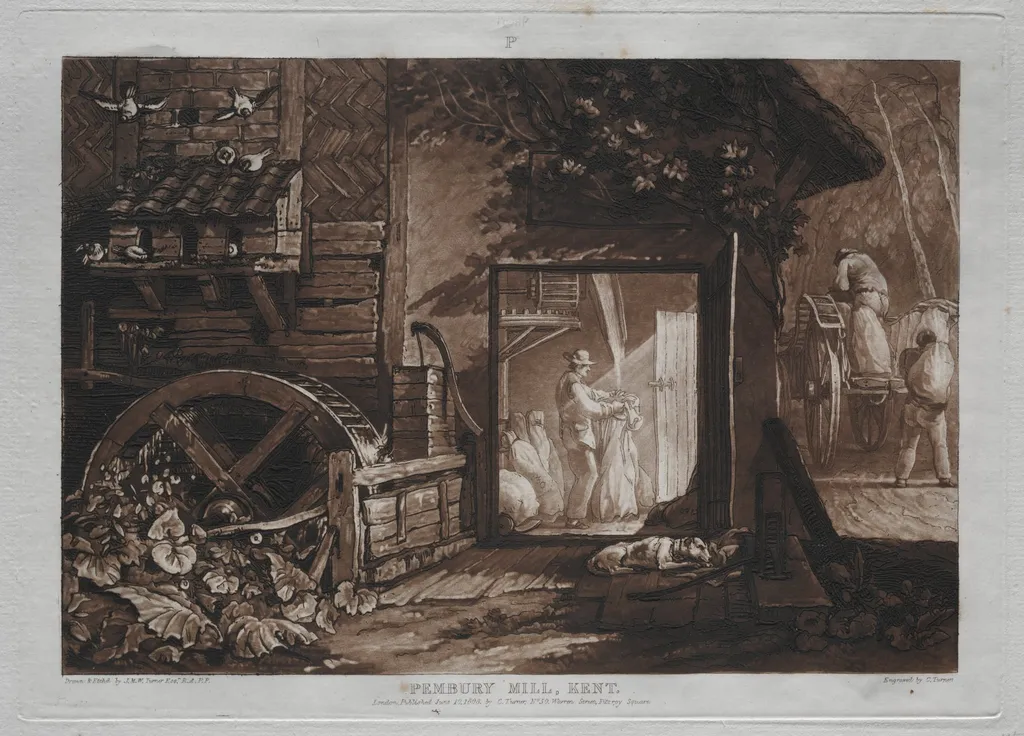
Liber Studiorum: Pembury Mill, Kent is a print by Joseph Mallord William Turner. It dates from 1823 and is held in the collection of the Cleveland Museum of Art.
About this work
The scene mixes daily life with the mechanics of the mill, showing how people and machines worked together.
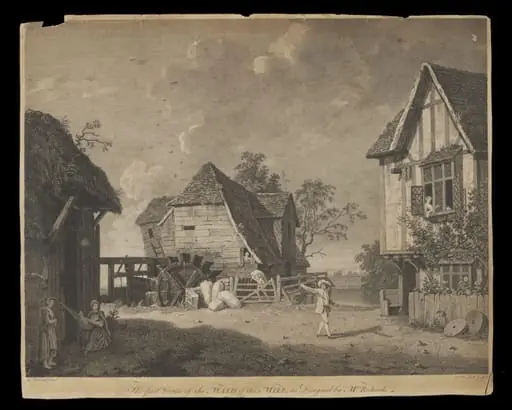
This print shows a busy old mill in Kent, England. A large water wheel turns on the left, churning up water and wood chips. Inside the mill, a man in a hat stands by an open door, holding something white. Outside, a woman leans on a cart pulled by a horse, while birds fly above a thatched roof.
The title at the bottom reads *Pembury Mill, Kent*, and it was published in London in 1808. The scene mixes daily life with the mechanics of the mill, showing how people and machines worked together.
Next, check out the technique: chiaroscuro to see how light and shadow create depth in prints like this.
Overview
Joseph Mallord William Turner’s *Liber Studiorum: Pembury Mill, Kent* is a print from his ambitious series documenting landscape types, produced around 1823. Executed in etching and mezzotint, it belongs to a body of work intended to elevate landscape art through systematic study. Unlike mere topographical records, these prints convey mood and structure, reflecting Turner’s interest in the relationship between nature and human activity.
Subject & Meaning
The scene portrays a working watermill in rural Kent, with a large wheel churning water and debris, suggesting active industry. Figures—a man at the mill door and a woman beside a horse-drawn cart—integrate human labor into the machinery’s rhythm. Birds in flight and a thatched roof ground the image in everyday life, framing the mill not as a monument but as a functional node in the local economy, where nature, technology, and routine coexist.
Technique & Style
Turner employed etching for fine lines and mezzotint for rich tonal gradations to evoke atmosphere. Light falls unevenly across the scene, enhancing depth through chiaroscuro—shadows cling to the wheel’s structure, while highlights catch the water’s surface and the woman’s dress. The texture of wood, fabric, and stone is suggested rather than detailed, relying on ink density and pressure to imply materiality without literalism.
History & Provenance
The print was published in London as part of Turner’s *Liber Studiorum*, a project begun in 1807 and completed in 1819, though some plates were reissued later. While the title references Pembury Mill, the date of publication cited in the visual note is inconsistent with the known timeline of the series. The plate was likely issued in the 1820s, aligning with Turner’s mature period and his efforts to establish landscape as a serious artistic genre.
Context
During the early 19th century, Britain’s rural economy was shifting under industrial pressures. Turner’s *Liber Studiorum* responded to this by documenting traditional scenes not as nostalgia, but as studies of form and function. The series was influenced by classical landscape theory and the Dutch tradition, yet Turner’s emphasis on light and movement broke from convention, positioning his work at the threshold of modern visual language.
Legacy
Turner’s *Liber Studiorum* influenced later artists by demonstrating how printmaking could convey emotional and atmospheric depth, not just detail. The series’ emphasis on light, texture, and composition prefigured concerns of 19th-century Impressionists and 20th-century abstract painters. Though not widely known in his lifetime, the *Liber* became a touchstone for those seeking to move beyond representation toward expressive interpretation of the natural world.
Artist & collection
Artist
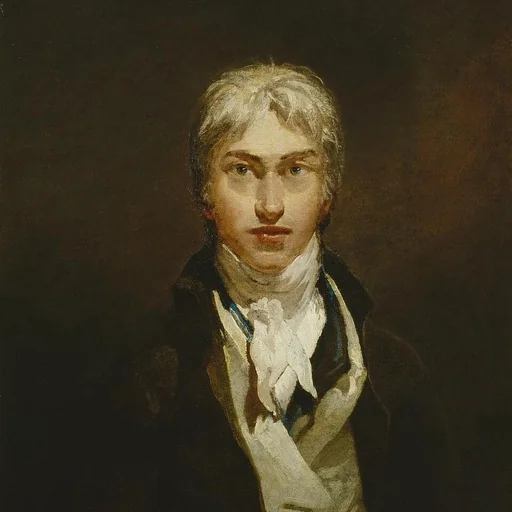
Joseph Mallord William Turner was born in 1775 at Maiden Lane, Covent Garden, where his father kept a barber and wig-making shop.