Artwork
Liber Studiorum: The Bridge and Cows
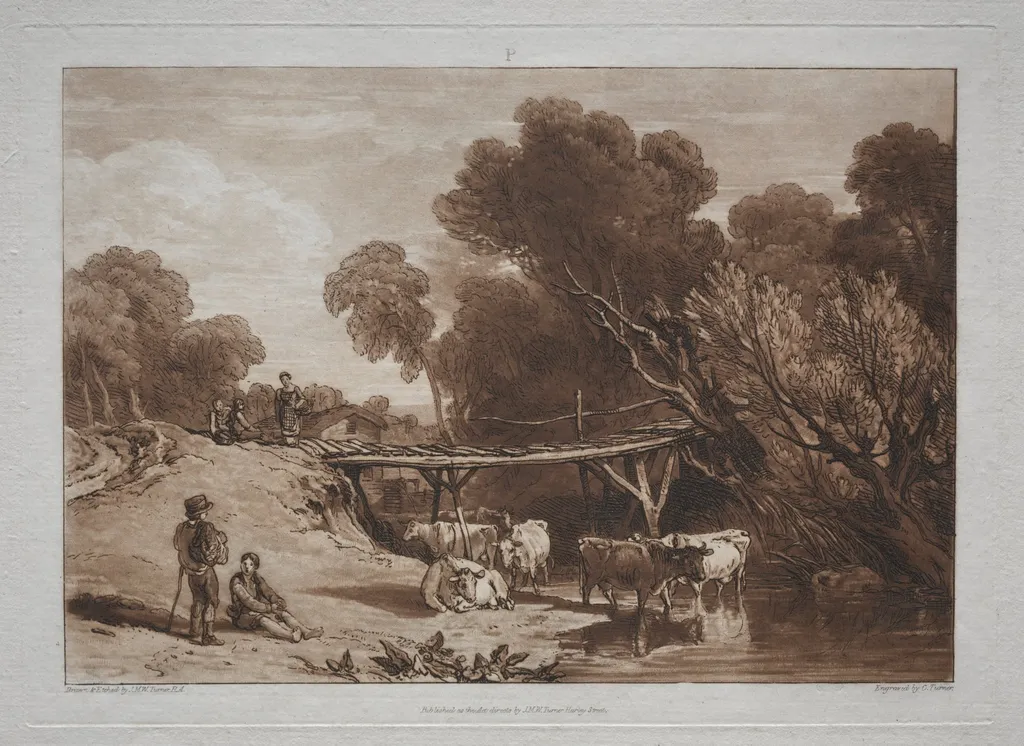
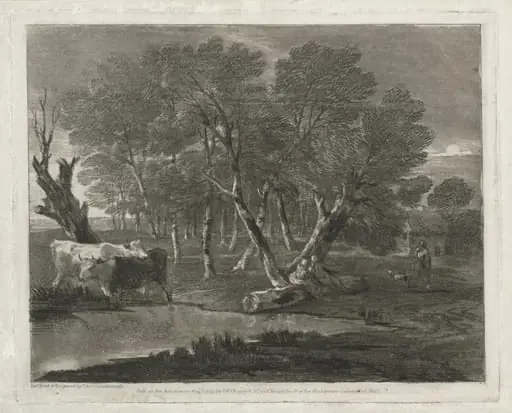
Liber Studiorum: The Bridge and Cows is a print by Joseph Mallord William Turner. It dates from 1823 and is held in the collection of the Cleveland Museum of Art.
About this work
Overview
Part of a larger series intended as a pedagogical guide, this work exemplifies Turner’s shift from topographical precision toward atmospheric suggestion.
Created around 1823, *Liber Studiorum: The Bridge and Cows* is one of seventy prints in Joseph Mallord William Turner’s ambitious project to classify landscape art through compositional types. Part of a larger series intended as a pedagogical guide, this work exemplifies Turner’s shift from topographical precision toward atmospheric suggestion. The Cleveland Museum of Art holds this etching and aquatint, a key example of his printmaking innovation.
Subject & Meaning
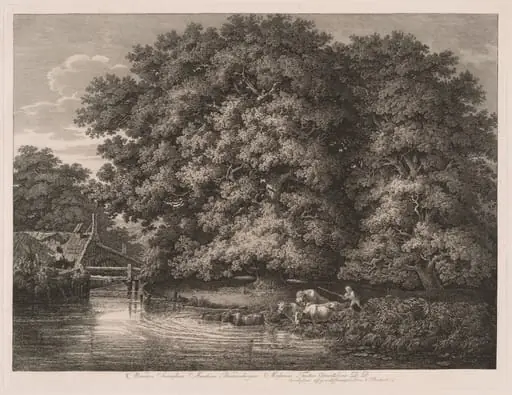
The scene depicts a quiet rural moment: cows near a wooden bridge crossing a stream, with figures dispersed along its banks. No narrative is imposed; instead, Turner emphasizes harmony between animals, land, and human presence. The composition invites contemplation of daily life within nature, avoiding drama in favor of subtle observation. It reflects his interest in the pastoral as a structured, enduring form of landscape.
Technique & Style
Turner employed etching and aquatint to achieve nuanced tonal gradations, using ink washes to model light across the water, bridge, and pasture. Chiaroscuro is applied not for theatrical effect but to suggest spatial depth and the soft diffusion of daylight. His brushwork in the watercolor underdrawing remains visible, revealing the immediacy of his process and his move away from rigid draftsmanship toward expressive abstraction.
History & Provenance
The *Liber Studiorum* series was published in parts between 1807 and 1819, with additional proofs like this one produced later. This impression likely dates to the 1820s, when Turner continued refining and reissuing plates. It entered the Cleveland Museum of Art’s collection through established acquisition channels in the 20th century, valued for its role in documenting Turner’s printmaking evolution and his influence on later generations.
Context
Turner developed the *Liber Studiorum* in response to the Royal Academy’s hierarchy of genres, seeking to elevate landscape to the status of history painting. He categorized his prints into six themes—marine, mountainous, pastoral, architectural, etc.—to systematize his artistic philosophy. This work belongs to the pastoral category, aligning with contemporary interest in agrarian life and the sublime in ordinary scenes.
Legacy
Though not widely recognized in his lifetime as a printmaker, Turner’s *Liber Studiorum* later became a touchstone for artists exploring light and atmosphere. His loose handling and emphasis on mood over detail anticipated Impressionist concerns, while his structural simplifications resonated with early modernists. The series remains a critical reference in the study of 19th-century British print culture and the transition toward abstract representation.
Own this work as a print
Artist & collection
Artist
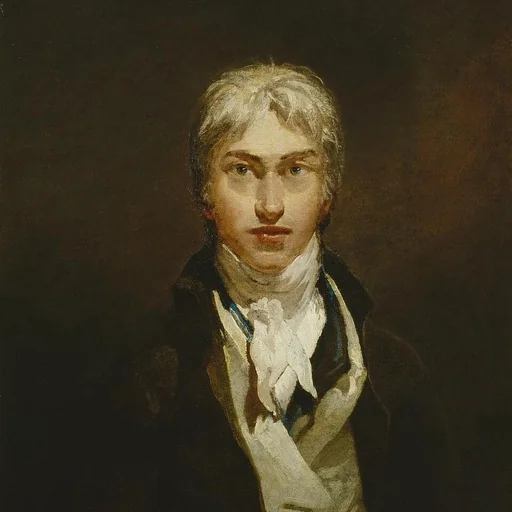
Joseph Mallord William Turner was born in 1775 at Maiden Lane, Covent Garden, where his father kept a barber and wig-making shop.