Artwork
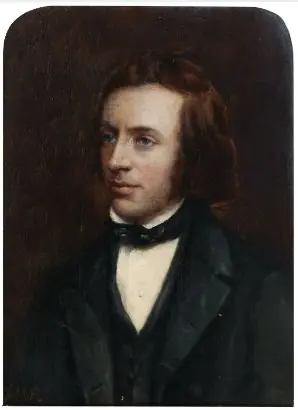
Portrait of Richard Robert Madden (1798-1886), Author
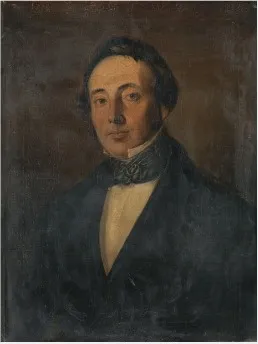
Portrait of Richard Robert Madden (1798-1886), Author is an oil painting by Joseph Patrick Haverty. It dates from 1839 and is held in the collection of the National Gallery of Ireland. This oil painting, dated around 1839, presents a formal portrait of Richard Robert Madden, an Irish writer and historian.
About this work
The subject's attire and the style of the painting suggest a formal setting, possibly from the 19th century.
This portrait depicts a man in a dark suit, white shirt, and black bow tie. His dark hair is neatly styled, and he looks directly at the viewer with a serious expression.
The subject's attire and the style of the painting suggest a formal setting, possibly from the 19th century. The artist's use of oil paint adds depth and texture to the image.
To learn more about the artist's techniques, explore the use of chiaroscuro in his work.
Overview
This oil painting, dated around 1839, presents a formal portrait of Richard Robert Madden, an Irish writer and historian. Executed by Joseph Patrick Haverty, it is part of the National Gallery of Ireland’s collection. The composition adheres to 19th-century conventions of portraiture, emphasizing dignity and restraint through controlled lighting and subdued color.
Subject & Meaning
Madden, known for his work on Irish history and abolitionist writings, is depicted with a composed, direct gaze that conveys intellectual seriousness. His attire—a dark suit, white shirt, and black bow tie—reflects the formal dress of a professional man in the early Victorian era. The portrait avoids embellishment, focusing instead on the subject’s presence and character rather than status symbols.
Technique & Style
Haverty employed oil paint to achieve subtle tonal transitions and a sense of volume in the figure. The lighting is even but directional, modeling the face and hands with quiet precision. While not overtly dramatic, the use of chiaroscuro lends depth to the form, grounding the subject in space without theatricality. Brushwork remains controlled, favoring clarity over expressive flourish.
History & Provenance
The painting was completed during Haverty’s active period in Dublin, where he was a prominent portraitist. It entered the National Gallery of Ireland’s collection in the 19th century, likely through donation or acquisition from the sitter’s circle. Its continuous presence in the gallery underscores its role as a record of Irish cultural figures of the time.
Context
In the 1830s, Irish portraiture often served to document intellectual and civic leaders amid rising nationalist sentiment. Madden’s work on the Irish language and anti-slavery advocacy aligned with broader reformist currents. This portrait reflects a period when visual culture increasingly valued the representation of educated, morally engaged individuals over aristocratic grandeur.
Legacy
The portrait remains a key visual reference for Madden’s public identity. It exemplifies the quiet, earnest style of Irish portraiture in the early 19th century, distinguishing itself from more ornate British traditions. As one of Haverty’s documented works, it contributes to the understanding of provincial artistic practice in pre-Famine Ireland.
Artist & collection

 Portrait of Sir Charles Gavan Duffy (1816-1903), Politician
 Portrait of the Mining Engineer Nikolay Teplov
 Eulogio Florentino Sanz y Sánchez
 The Right Honourable Benjamin Disraeli (1804–1881), MP, Later Earl of Beaconsfield
 Portrait of Jan Pabudziński
 Consilierul aulic Josef Bedeus von Scharberg
 Andrew Ure (1778–1857), MD, FRS
 Portrait of a man
 Προσωπογραφία του Frederick North
 Portretul lui Ludwig Neugeboren