Artwork
Después del baile
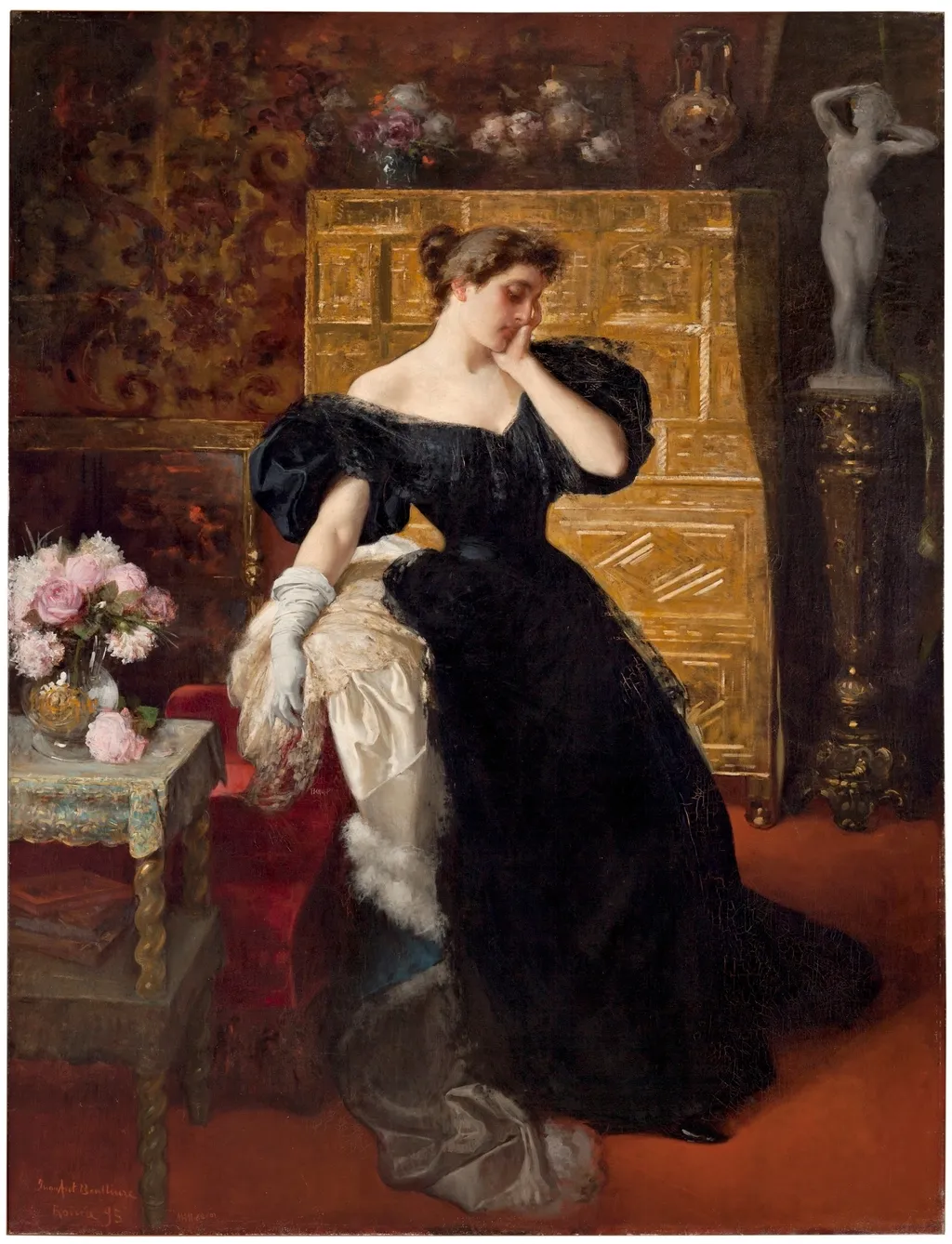
Después del baile is an oil painting by the Post-Impressionist artist Juan Antonio Benlliure. It dates from 1898 and is held in the collection of the Museo del Prado.
About this work
The woman's attire and the room's decor suggest a formal setting, possibly from the late 19th century.
This painting depicts a woman in a black dress with a white shawl, seated in a red chair. Her right hand rests on her face, and she wears white gloves. The background features a gold dresser and a statue of a nude woman on a pedestal to the right. The room is adorned with flowers and a vase on a table.
The woman's attire and the room's decor suggest a formal setting, possibly from the late 19th century. The painting's use of color and lighting creates a sense of elegance and refinement.
To learn more about the artist's use of chiaroscuro, explore the technique further.
Overview
Juan Antonio Benlliure’s 1898 oil canvas, titled “Después del baile,” presents an interior scene rendered with careful attention to detail. A woman in a black dress with a white shawl sits in a red chair, her right hand supporting her face, while white gloves rest on her lap. The composition includes a gold‑finished dresser, a vase of flowers, and a sculpted nude figure on a pedestal to the right.
Subject & Meaning
The work captures a moment of quiet after a social gathering, suggested by the title. The seated figure’s contemplative pose, combined with the surrounding objects—a lavish dresser, decorative flowers, and a classical statue—evokes themes of refinement, femininity, and the lingering intimacy of private spaces following public performance.
Technique & Style
Benlliure employs a restrained palette of deep blacks, bright whites, and rich reds, balanced by the warm gold of the furniture. Subtle chiaroscuro models the forms, allowing light to fall on the woman’s face and gloves while casting softer shadows on the surrounding décor. The brushwork remains smooth, emphasizing the polished surfaces of the interior.
History & Provenance
Created in 1898, the painting entered the collection of Spain’s Museo del Prado, where it remains on display. Its acquisition reflects the museum’s interest in late‑19th‑century Spanish genre painting and the artist’s reputation for capturing domestic elegance.
Context
The late nineteenth century in Spain saw a fascination with interior genre scenes that combined realism with idealized domesticity. Benlliure’s choice of a solitary female figure amidst opulent surroundings aligns with contemporary trends that celebrated bourgeois leisure and the nuanced psychological states of women after social events.
Own this work as a print
Artist & collection