Artwork
Saints Gregory, Sebastian and Thyrsus
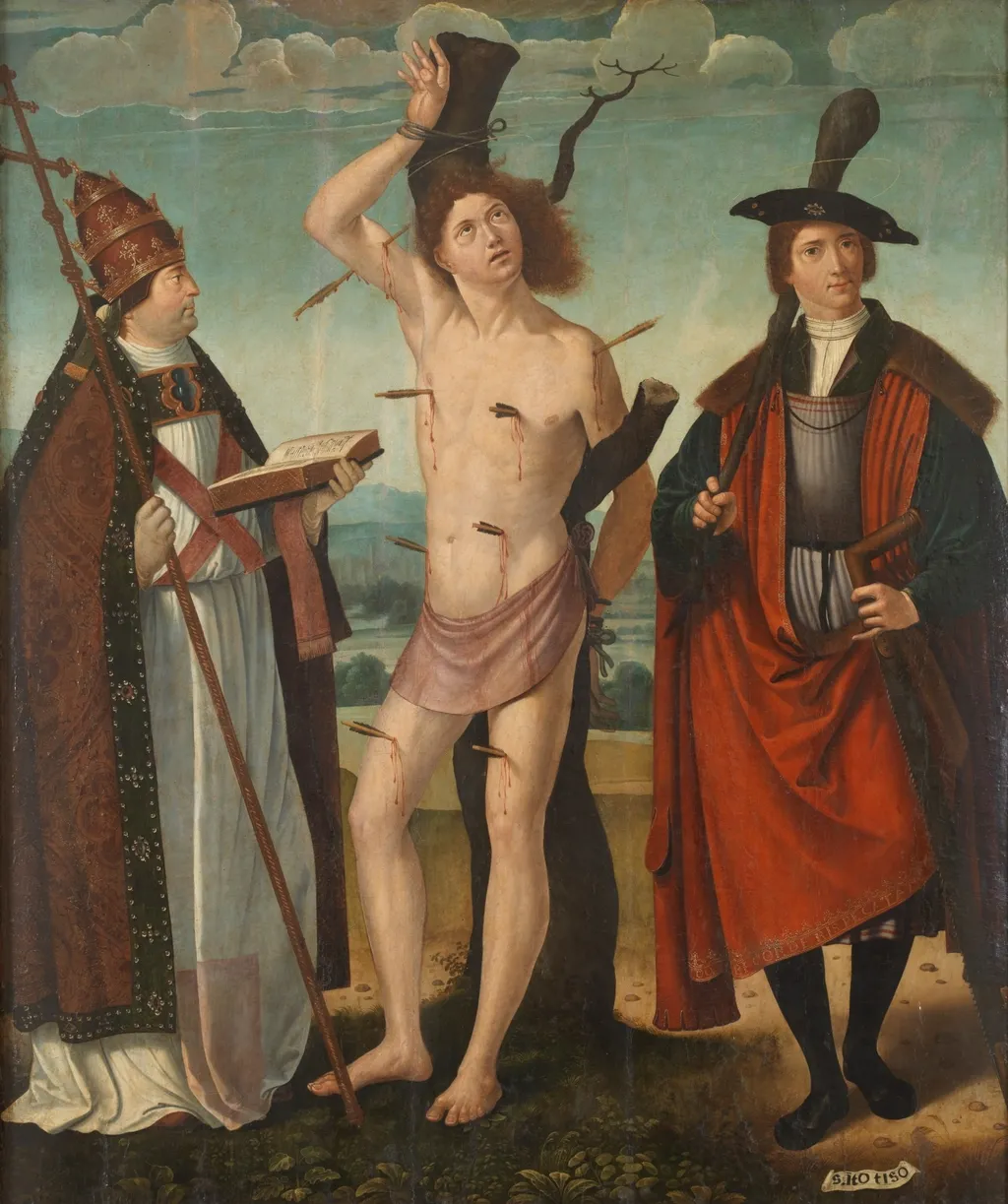
Saints Gregory, Sebastian and Thyrsus is an oil painting by the Early Renaissance artist Juan de Borgoña the Younger. It dates from 1501 and is held in the collection of the Museo del Prado.
About this work
Overview
The work is part of the Museo del Prado’s collection and measures the typical dimensions of early‑sixteenth‑century devotional panels.
Juan de Borgoña the Younger’s 1501 oil painting, titled Saints Gregory, Sebastian and Thyrsus, brings together three Christian figures on a modestly detailed landscape. The work is part of the Museo del Prado’s collection and measures the typical dimensions of early‑sixteenth‑century devotional panels. Its composition balances a central martyr with two accompanying saints, set against a sky dotted with clouds.
Subject & Meaning
The leftmost figure is Pope Gregory I, identifiable by his white habit, richly embroidered red and black cloak, and the book and staff he holds, symbols of his papal authority and theological scholarship. In the centre stands Saint Sebastian, depicted nude with a red sash, his right arm raised and his body pierced by arrows, recalling his legendary martyrdom. To the right, Saint Thyrsus of Apollonia appears in a red robe and black hat, clutching a sword that alludes to his role as a patron of soldiers.
Technique & Style
Executed in oil on canvas, the painting shows the gradual adoption of Renaissance naturalism in Spain. Light falls softly across the figures, modelling their forms with subtle chiaroscuro, while the background sky and distant landscape provide a shallow spatial setting. The artist’s handling of drapery and anatomical detail reflects the influence of Italian models, yet retains a distinctly Iberian decorative sensibility.
History & Provenance
Created in 1501, the work was likely commissioned for a private chapel or ecclesiastical setting, though its early ownership remains undocumented. It entered the national collection of Spain in the 19th century and has been displayed at the Museo del Prado since that time, where it contributes to the museum’s representation of early Spanish Renaissance painting.
Context
During the early 1500s, Spanish art was transitioning from Gothic conventions toward the humanist ideals of the Renaissance. Juan de Borgoña the Younger, working in the Castilian court’s artistic circles, incorporated Italian compositional principles while maintaining local iconographic traditions. The inclusion of Pope Gregory I alongside military saints reflects contemporary devotional practices that emphasized intercession for both spiritual guidance and protection in turbulent times.
Own this work as a print
Artist & collection
Artist
Juan de Borgoña the Younger (1500–1565) was an artist, born in Toledo.