Artwork
The marriage at Cana
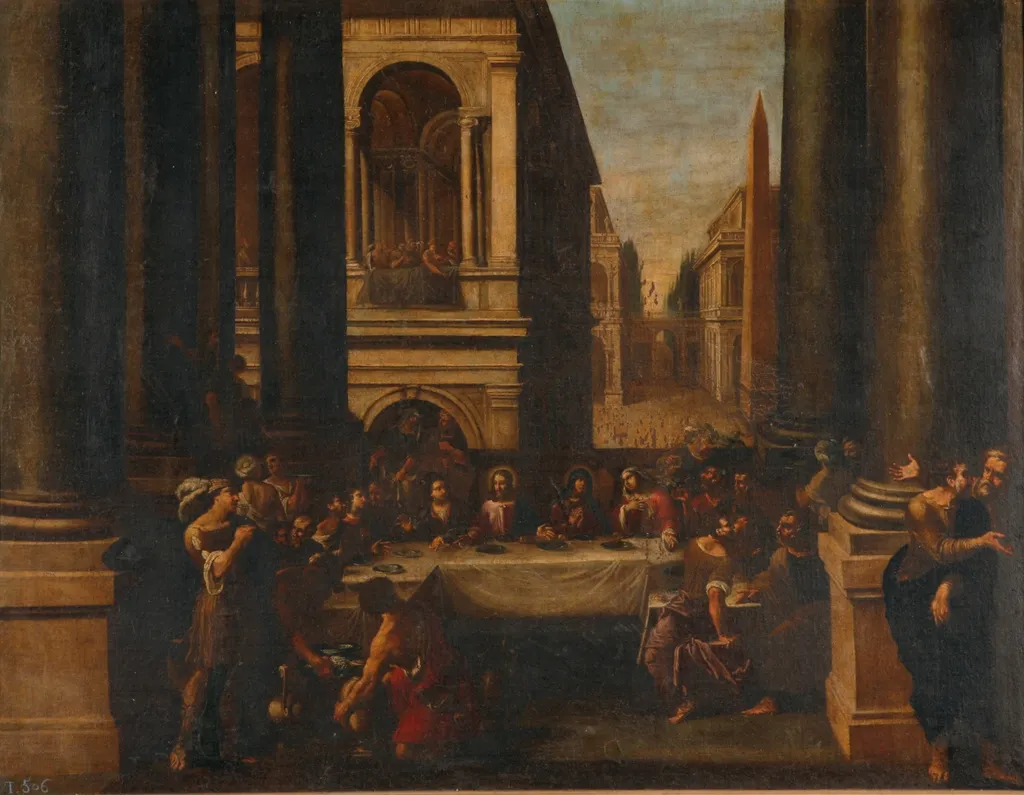
The marriage at Cana is an oil painting by the Early Baroque Italian artist Juan García de Miranda. It dates from 1701 and is held in the collection of the Museo del Prado.
About this work
Overview
The canvas presents a bustling banquet hall where guests sit, stand, and serve, while a distant arch opens onto a courtyard featuring an obelisk.
Juan García de Miranda, a Madrid‑born painter of Asturian descent, completed an oil work in 1701 that portrays the biblical wedding at Cana. The canvas presents a bustling banquet hall where guests sit, stand, and serve, while a distant arch opens onto a courtyard featuring an obelisk. The composition balances a crowded interior with a glimpse of an exterior space, creating a narrative tableau of the miracle.
Subject & Meaning
The scene illustrates the moment from the Gospel of John when Jesus turns water into wine, rendered as a lively feast. Figures are arranged around a long table laden with food and drink, emphasizing communal celebration. The inclusion of a broken wine vessel and a visibly annoyed participant may hint at the tension preceding the miracle, underscoring themes of transformation and divine intervention within ordinary settings.
Technique & Style
Miranda employed the Baroque chiaroscuro technique, juxtaposing deep shadows with illuminated highlights that model faces and garments. The dramatic lighting draws attention to central actions while the surrounding darkness adds depth. Despite being born without a right hand, the artist adapted his brushwork, achieving a fluid handling of oil that conveys texture in fabrics, metalware, and the reflective surfaces of the banquet.
History & Provenance
After its creation, the painting entered the royal collection, reflecting Miranda’s role as Painter to the King. It later became part of the Museo del Prado’s holdings, where it remains on display. The work’s provenance traces a path from court patronage to public museum, illustrating the transition of royal artworks into national heritage institutions.
Context
Executed during the Spanish Baroque period, the canvas aligns with contemporary devotional art that combined religious narrative with opulent domestic settings. Miranda, a follower of Juan Delgado and uncle to Pedro Rodríguez de Miranda, worked within a network of court painters who emphasized theatricality and emotional engagement, situating this biblical episode within a familiar, festive environment for early‑18th‑century viewers.
Own this work as a print
Artist & collection
Artist
Juan García de Miranda (1677–1749), was a Spanish painter of the baroque period, a disciple of Juan Delgado and the uncle of Pedro Rodríguez de Miranda.
