Artwork
Still Life with Game Fowl,Vegetables and Fruits
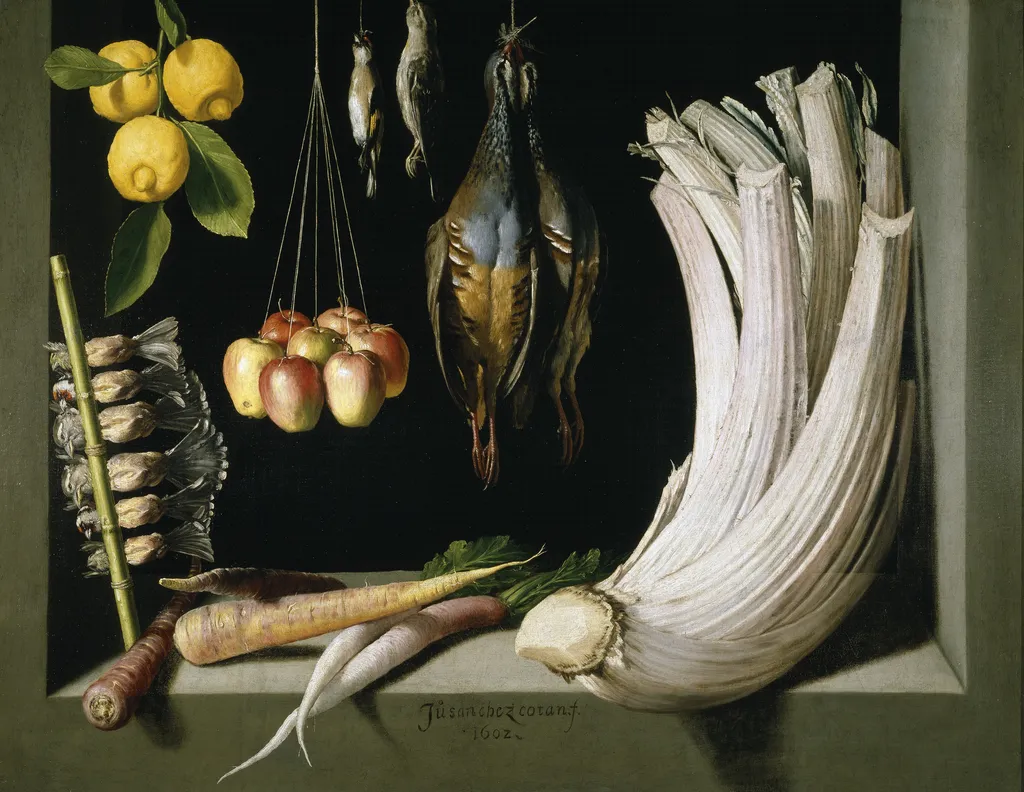
Still Life with Game Fowl,Vegetables and Fruits is an oil painting by the Early Baroque Italian artist Juan Sánchez Cotán. It dates from 1602 and is held in the collection of the Museo del Prado.
About this work
Overview
Juan Sánchez Cotán’s 1602 oil painting, *Still Life with Game Fowl, Vegetables and Fruits*, presents a modest arrangement of everyday items on a darkened tabletop. The composition includes a suspended cluster of lemons, hanging red and green apples, a lifeless bird with outstretched wings, and a handful of root vegetables—carrots and a large white onion—set against an unadorned, shadowy backdrop.
Subject & Meaning
The work juxtaposes the vitality of fresh fruit with the stillness of a dead fowl, inviting contemplation of life’s transience and the abundance of the natural world. The inclusion of humble vegetables further emphasizes a sober, almost ascetic approach to materiality, reflecting the Counter‑Reformation’s preference for moralizing simplicity in still‑life imagery.
Technique & Style
Cotán employs a stark chiaroscuro, rendering deep shadows that isolate each object and a crisp, directional light that defines their forms with near‑tactile clarity. The precise modeling and restrained palette heighten the illusion of three‑dimensionality, while the minimal background eliminates distraction, focusing the viewer’s attention on texture and volume.
History & Provenance
Created in the early seventeenth century, the painting entered the collection of the Museo del Prado, where it remains on display. Its attribution to Cotán, a leading figure of Spanish Baroque still life, has been consistently affirmed by scholarly catalogues and museum records.
Artist & collection
