Artwork
Ondine
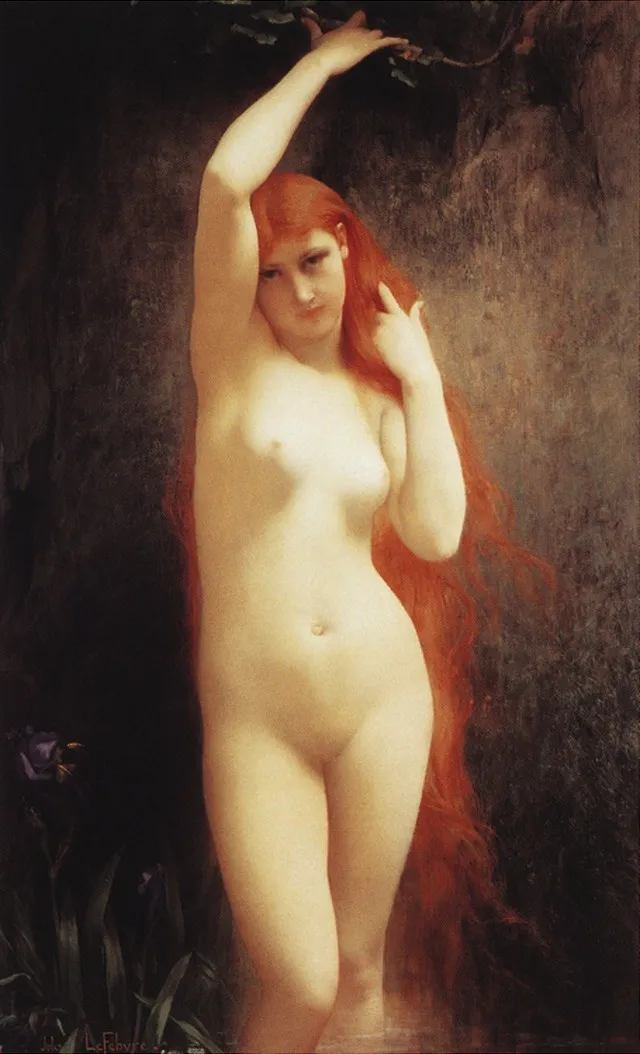
Ondine is an oil painting by Jules Lefebvre. It dates from 1892 and is held in the collection of the Hungarian National Gallery.
About this work
Overview
Lefebvre employs a dark, indistinct background to isolate the figure, allowing the warm, luminous tones of her skin to emerge with dramatic clarity.
Jules Lefebvre's 'Ondine' (1892) depicts the water nymph from Germanic folklore, rendered in the artist's signature Academic style. The composition centers on a female figure with vibrant red hair, standing in a contrapposto pose with her body angled slightly toward the viewer while her head turns to meet the gaze directly. One arm is raised behind her head, a gesture that elongates the torso and emphasizes the classical idealization of the human form. Lefebvre employs a dark, indistinct background to isolate the figure, allowing the warm, luminous tones of her skin to emerge with dramatic clarity. This technique highlights the artist's renowned mastery of flesh tones and his ability to create a sense of tactile realism. Painted during the height of his career, the work exemplifies the French Academic tradition's focus on mythological subjects executed with precise draftsmanship and polished finish. The painting reflects Lefebvre's consistent exploration of female beauty and his role as a leading instructor at the Académie Julian, where he influenced generations of artists. The specific choice of Ondine, a spirit often associated with the dangers of water and unrequited love, adds a layer of narrative ambiguity to the otherwise serene presentation.
Subject & Meaning
The title references the water‑nymph of European folklore, yet the figure is depicted as a terrestrial woman rather than an aquatic being. She stands in a contrapposto pose, one arm lifted behind her head, her gaze directed calmly toward the viewer. The juxtaposition of the mythic name with a grounded, human form invites contemplation of the boundary between myth and reality.
Technique & Style
Lefebvre employs a refined chiaroscuro, using smooth, blended brushstrokes to render the flesh with a soft, almost tactile quality. The bright red hair and the illuminated torso are highlighted against a muted, blurred backdrop, creating a strong contrast that draws attention to the face and waist. The handling of light and shadow reflects the academic training of the artist and the influence of French salon painting.
History & Provenance
Painted in 1892, *Ondine* entered the Budapest Museum of Fine Arts’ holdings during the early 20th century, though the precise acquisition date is not recorded in the available sources. The work has remained in the museum’s permanent collection, where it is displayed as part of the institution’s representation of French academic art from the Belle Époque.
Context
Created at a time when mythological subjects were popular in academic circles, the painting reflects the era’s fascination with idealized beauty and classical themes. Lefebvre, a frequent exhibitor at the Paris Salon, often portrayed elegant female nudes, and *Ondine* exemplifies his consistent approach to composition, anatomy, and the nuanced rendering of light.
Artist & collection