Artwork
Hiroshige and the Goldfish
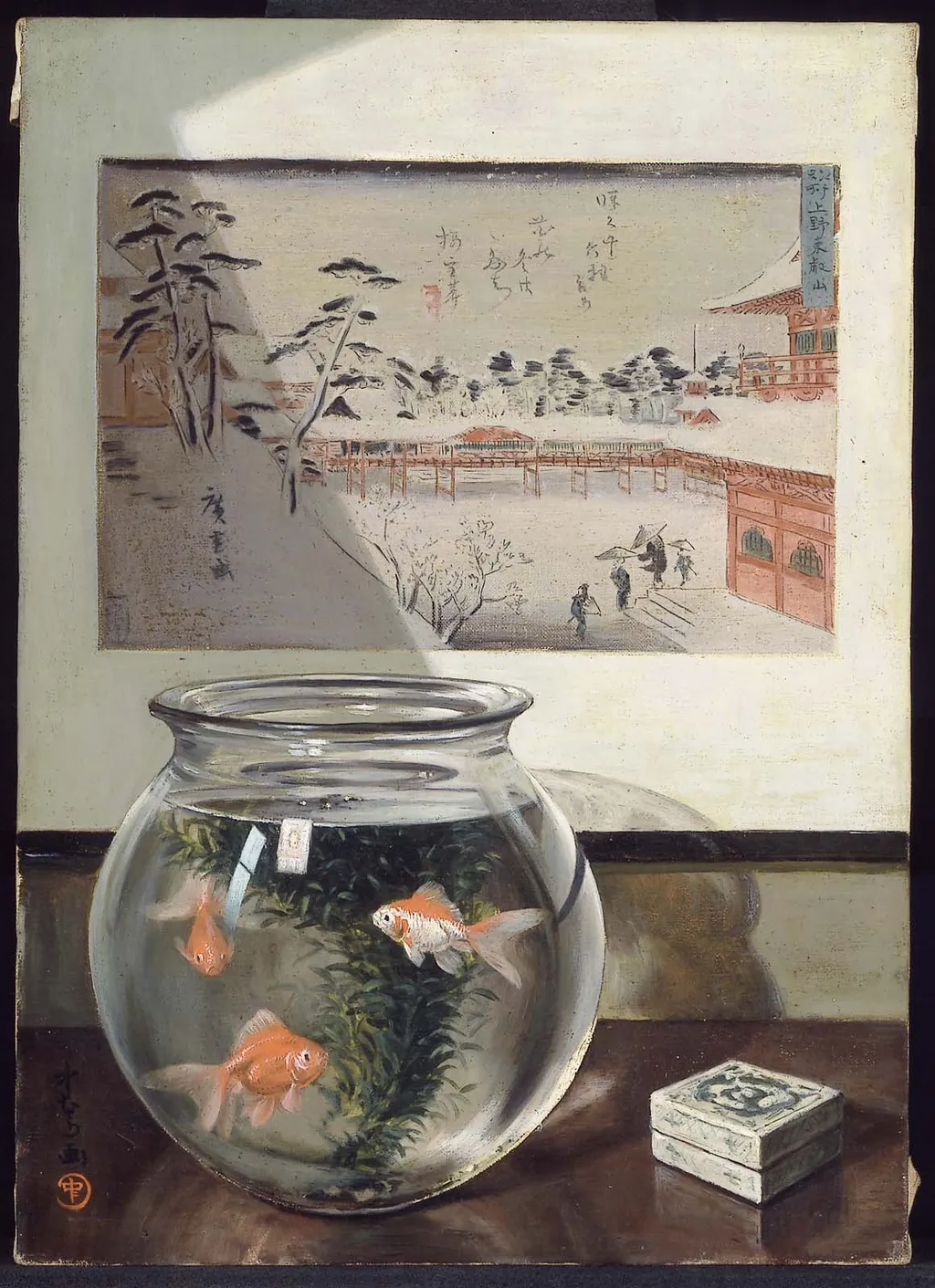
Hiroshige and the Goldfish is an oil painting by the Ukiyo-e artist Kanji Nakamura. It dates from 1926 and is held in the collection of the Museum of Fine Arts Boston.
About this work
Overview
Kanji Nakamura's 1926 painting, Hiroshige and the Goldfish, is a canvas work housed at the Museum of Fine Arts, Boston. The composition centers on a glass fishbowl with three orange and white goldfish, set against a backdrop that blends Eastern and Western elements.
Subject & Meaning
The primary subject is the fishbowl, containing three goldfish amidst green plants, placed on a dark wooden table alongside a small white box. A framed, Japanese-style snowy landscape hangs behind, introducing depth and cultural nuance.
Technique & Style
While specific techniques are not detailed, the integration of a Western-style still life (fishbowl on a table) with a traditional Japanese landscape in the background suggests a blend of artistic influences, characteristic of early 20th-century Japanese modernization in art.
History & Provenance
Created in 1926 by Kanji Nakamura, the painting is part of the collection at the Museum of Fine Arts, Boston, indicating its recognition within the global art historical canon.
Context
The work reflects the cultural exchange and modernization trends of 1920s Japan, where artists often merged traditional themes with contemporary, Western-inspired techniques and subjects.
Legacy
As part of the MFA Boston's collection, Hiroshige and the Goldfish contributes to the museum's holdings on early 20th-century Japanese art, offering insight into the era's artistic fusion. Its specific influence or broader impact on the art world is not widely highlighted in available information.
Artist & collection