Artwork
Women Distracting a Child whose Kite is caught in a Tree
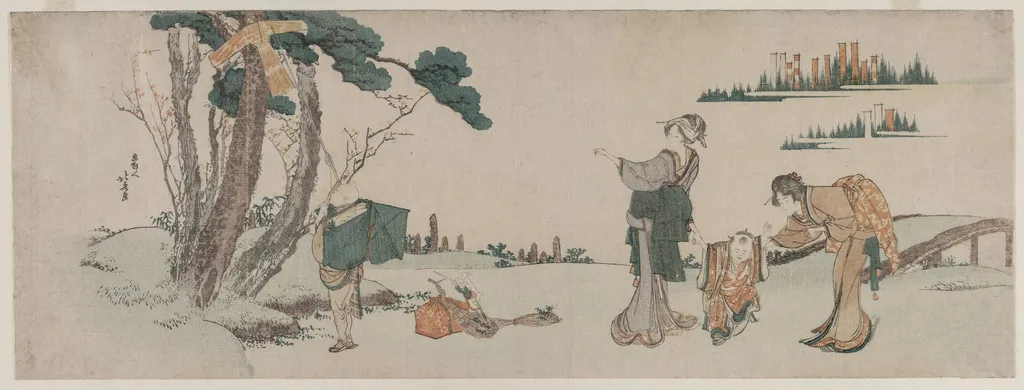
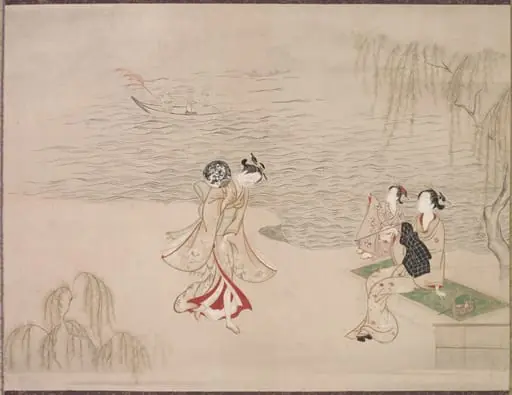
Women Distracting a Child whose Kite is caught in a Tree is a print by the Romanticist artist Katsushika Hokusai. It dates from 1800 and is held in the collection of the Cleveland Museum of Art.
About this work
Overview
It resides in the collection of The Cleveland Museum of Art, where it is preserved as an example of Hokusai’s observational precision and narrative restraint.
Created around 1800 by Katsushika Hokusai, this print depicts a quiet moment in a suburban landscape. Three women and a child are engaged in a subtle, unspoken interaction centered on a kite lodged in a tree. The scene is rendered in ink and color on paper, characteristic of early 19th-century Japanese ukiyo-e. It resides in the collection of The Cleveland Museum of Art, where it is preserved as an example of Hokusai’s observational precision and narrative restraint.
Subject & Meaning
The image captures a domestic, everyday scene rather than a mythological or dramatic event. The women’s coordinated gestures—pointing, crouching, holding—suggest a shared, unspoken effort to divert the child’s attention from the lost kite. The composition implies a gentle lesson in patience or distraction, reflecting a cultural emphasis on social harmony and quiet emotional management in daily life.
Technique & Style
Hokusai employs fine linework and layered washes to define the figures and landscape. The women’s robes vary in tone and flow, distinguishing their postures and movements. The tree’s trunk is rendered with sinuous, rope-like contours, contrasting with the kite’s flat, vivid shape. Background elements—fence, buildings, hills—are simplified, emphasizing the human interaction while suggesting depth without perspective.
History & Provenance
The print was produced during Hokusai’s early mature period, before his famous Thirty-Six Views of Mount Fuji. It likely circulated as a single-sheet print, common in urban Edo. Acquired by The Cleveland Museum of Art in the 20th century, it entered their collection as part of a broader effort to document Japanese printmaking traditions, preserving its original condition and paper integrity.
Context
This work reflects the ukiyo-e tradition’s focus on fleeting, ordinary moments of urban and suburban life. During the Edo period, such scenes were popular among the merchant class, who valued depictions of daily routines over aristocratic or religious themes. The inclusion of women as active participants, rather than passive figures, aligns with evolving portrayals of gender roles in popular art.
Legacy
Though less known than Hokusai’s landscapes, this print exemplifies his ability to convey narrative nuance through minimal composition. It influenced later artists interested in intimate, non-dramatic storytelling. Today, it remains a quiet testament to the artist’s skill in capturing human behavior with clarity and restraint, offering insight into Edo-period social dynamics.
Artist & collection

Artist
Katsushika Hokusai spent his life in Edo, now Tokyo, where he drew and carved prints for a living.

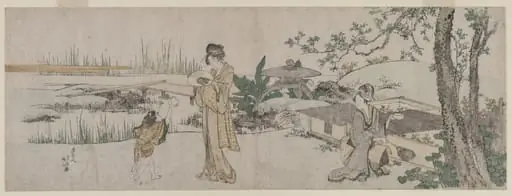 Two Women and a Child Beside a Goldfish Tank
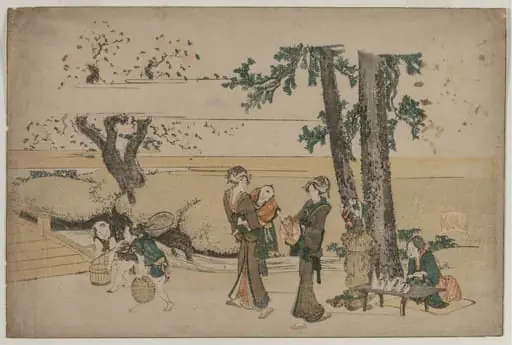 Woman Passing a Roadside Shop Near Oji
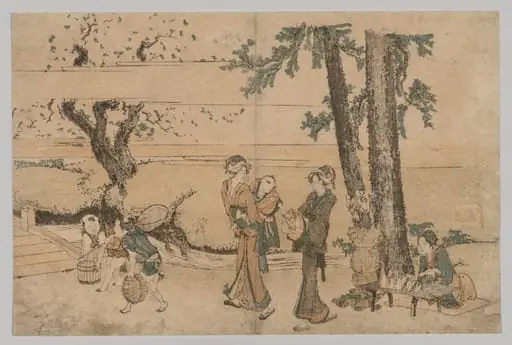 Group of Figures near a Brook
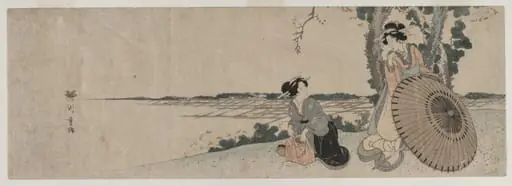 Two Women on a Hilltop
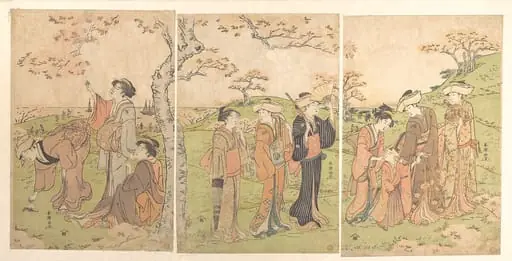 Untitled
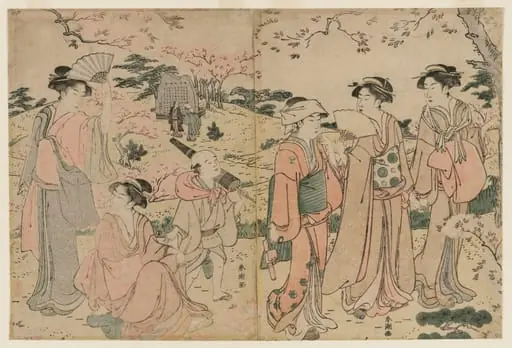 Women Viewing Cherry Blossoms at Asukayama
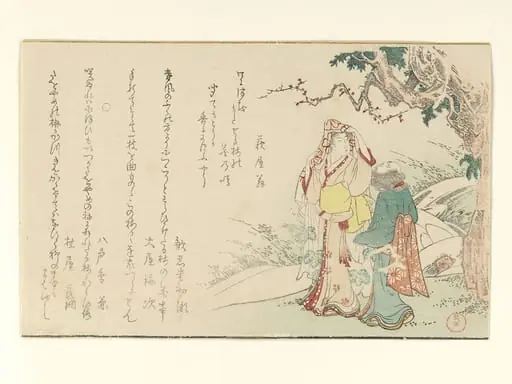 Untitled
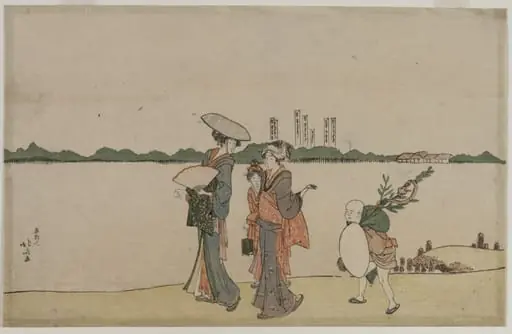 Women and Children Walking Along the Sumida River
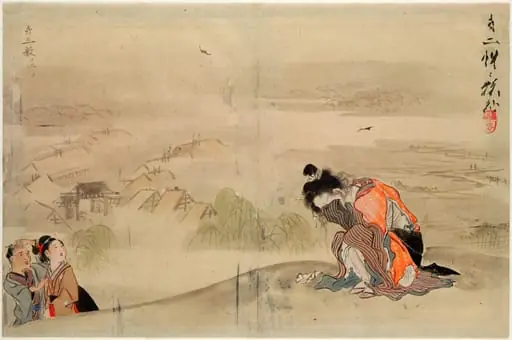 An Unfortunate Tale, II
 Untitled
 Untitled
 Beauties at the Seashore