Artwork
Untitled
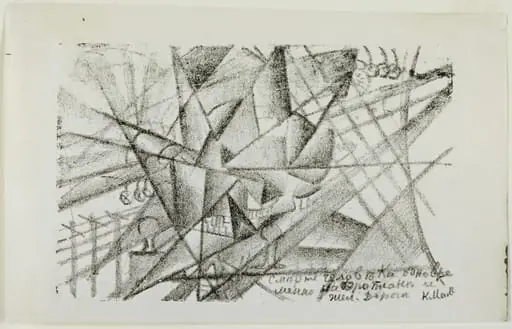
Untitled is an ink print by Kazimir Malevich. It dates from 1914 and is held in the collection of the Museum of Modern Art.
About this work
Overview
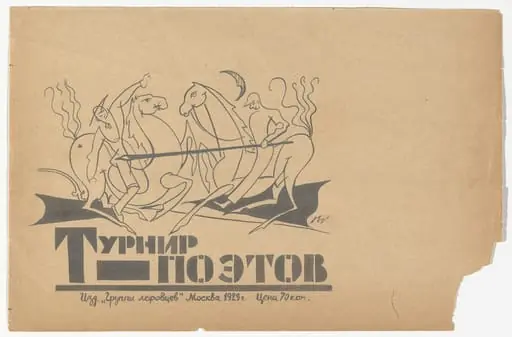
Kazimir Malevich’s 1914 lithograph, untitled, presents a composition of geometric forms—triangles, rectangles, and irregular lines—rendered in stark black ink on paper. A brief Russian caption runs along the lower edge, giving the piece a textual element reminiscent of early 20th‑century popular prints.
Subject & Meaning
The work juxtaposes abstract shapes with a playful, almost cartoonish sensibility, suggesting a visual dialogue between avant‑garde abstraction and the folk‑art tradition of the Russian lubok. The inclusion of text hints at a narrative or satirical intent, aligning the image with contemporary experiments in visual poetry.
Technique & Style
Executed as a lithograph, the image relies on the direct transfer of inked designs from stone or metal plates, allowing crisp, high‑contrast lines. The flat black areas and simplified geometry anticipate Malevich’s later Suprematist language while retaining a loose, improvisational quality typical of cheap booklet illustrations.
History & Provenance
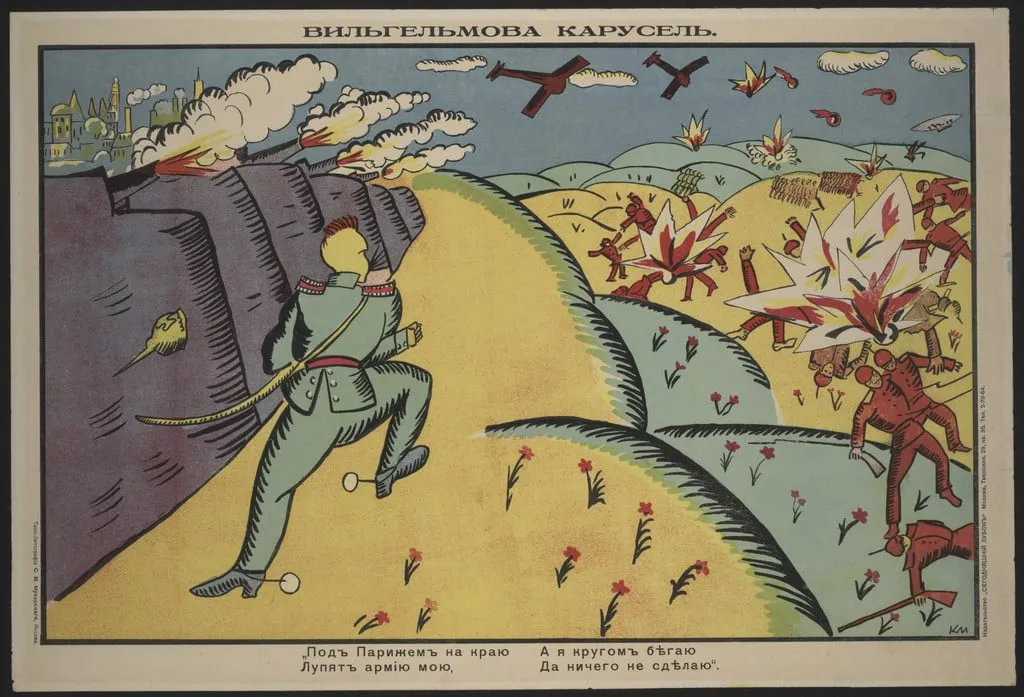
The print appeared in the 1914 pamphlet *Segodniashnii lubok*, a mass‑produced booklet co‑created by Malevich and poet Vladimir Mayakovsky. Designed for rapid circulation, the booklet was intended for casual reading and disposal, reflecting the artists’ interest in reaching a broad, non‑elite audience.
Context
Created during a transitional phase in Malevich’s career, the lithograph predates his formal articulation of Suprematism in 1915. It illustrates his engagement with modernist experimentation and his collaboration with fellow avant‑garde figures, situating the piece within the broader Russian avant‑garde movement of the early 1910s.
Artist & collection
Artist
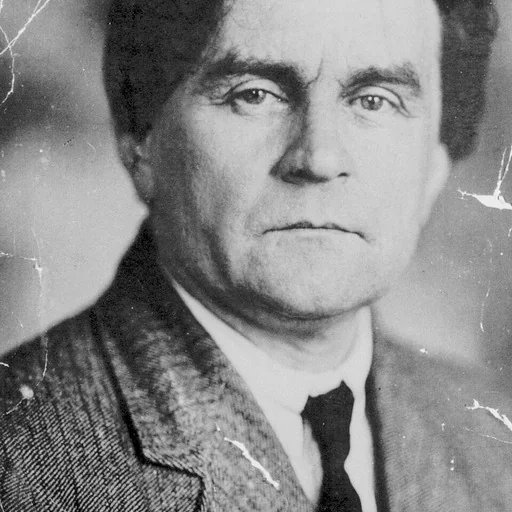
Kazimir Severinovich Malevich (23 February 1879 – 15 May 1935) was a Russian avant-garde artist and art theorist, whose work and writings pioneered the development of abstract painting in the 20th century.