Artwork
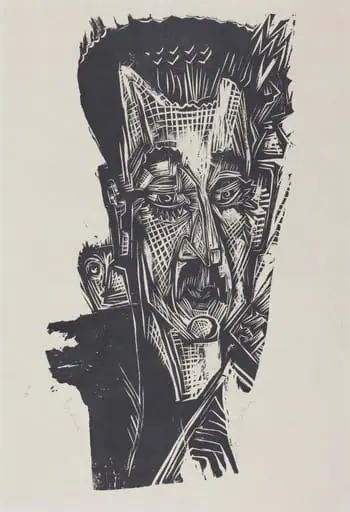
Head Study (Kopfstudie)
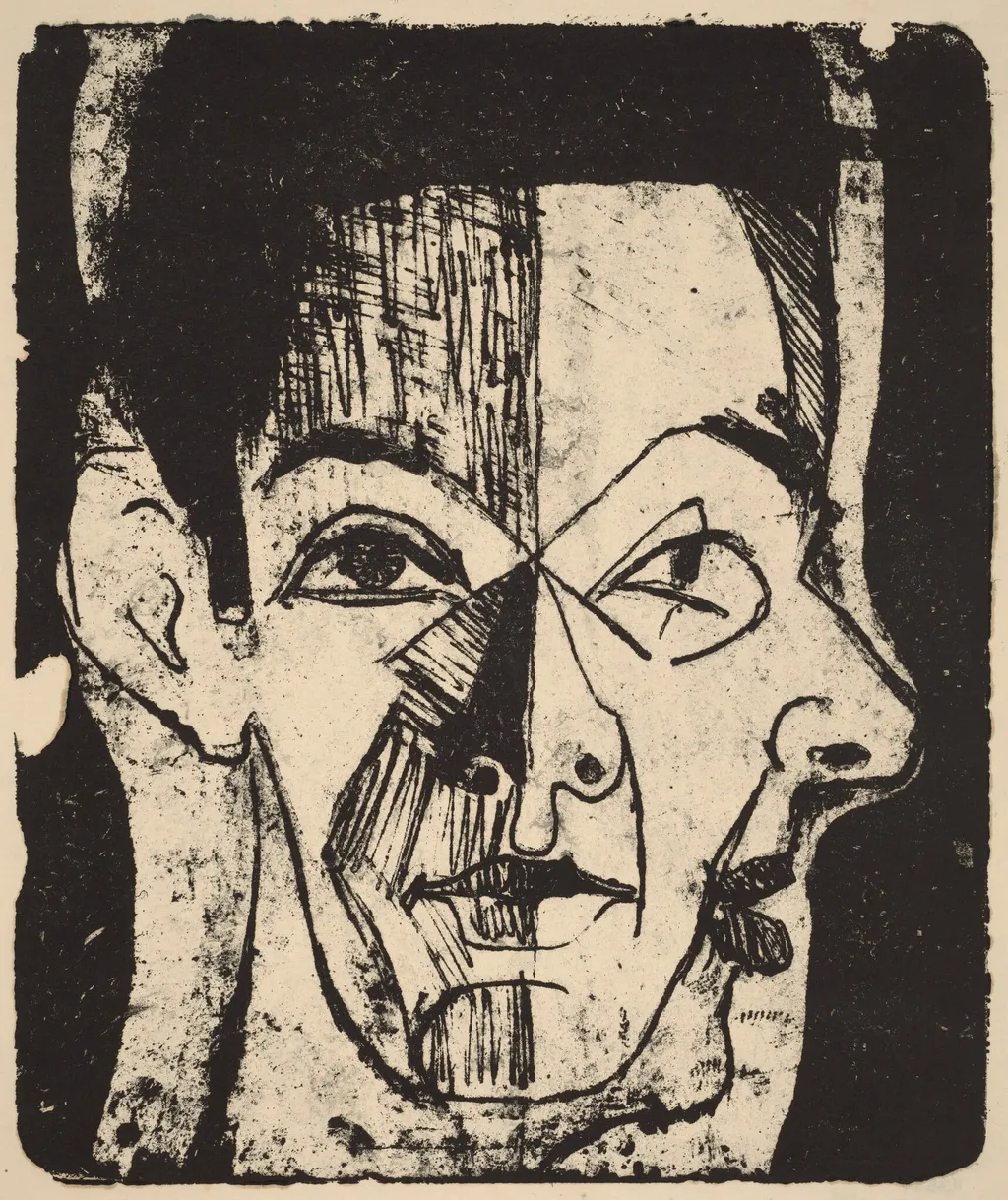
Head Study (Kopfstudie) is an ink print by Ernst Ludwig Kirchner. It dates from 1924 and is held in the collection of the National Gallery of Art.
About this work
Overview
As a key figure in the German Expressionist movement Die Brücke, Kirchner turned to printmaking to explore psychological depth.
Created in 1924, Head Study (Kopfstudie) is a lithograph by Ernst Ludwig Kirchner, executed on wove paper. As a key figure in the German Expressionist movement Die Brücke, Kirchner turned to printmaking to explore psychological depth. This work emerged after his traumatic service in World War I and reflects a shift toward fragmented, introspective imagery. The medium allowed him to refine his expressive language through the tactile qualities of stone-based printing.
Subject & Meaning
The portrait depicts a face divided vertically into two distinct textures: one side appears carved and rigid, like stone or mask, while the other suggests organic, living skin. The wide-open mouth and large, dark eyes convey an intense, ambiguous emotion—neither purely anguish nor joy. This duality may reflect inner conflict, the fracture of identity after war, or the tension between societal performance and inner reality.
Technique & Style
Kirchner employed lithography, a process where ink is drawn onto a limestone surface and transferred to paper. He exploited the medium’s capacity for contrast, using sharp, angular lines on one half and softer, smudged tones on the other. The rough and smooth areas were achieved through varying pressure and chemical treatments on the stone, enhancing the psychological dissonance of the image without relying on color or shading.
History & Provenance
Produced in 1924, during Kirchner’s period of recovery and reorientation after military discharge, the work belongs to a series of introspective prints from his time in Davos, Switzerland. It reflects his ongoing engagement with the human form under psychological strain. The print was likely circulated among collectors and artists familiar with Expressionist circles, though its early ownership remains undocumented in public records.
Context
In the early 1920s, Kirchner moved away from the vibrant urban scenes of his Die Brücke years toward more solitary, inward-looking subjects. The fragmentation of the face in this print aligns with broader postwar European anxieties about identity and trauma. Lithography, favored by Expressionists for its immediacy, became a vehicle for conveying emotional states without narrative detail, distancing his work from naturalism.
Legacy
Head Study exemplifies Kirchner’s mature approach to printmaking, where technical control served psychological expression. The work influenced later artists exploring identity through fragmentation and material contrast. While not widely exhibited during his lifetime, it remains a significant example of how print media could convey inner turmoil with minimal means, securing its place in studies of early 20th-century psychological art.
Artist & collection
Artist
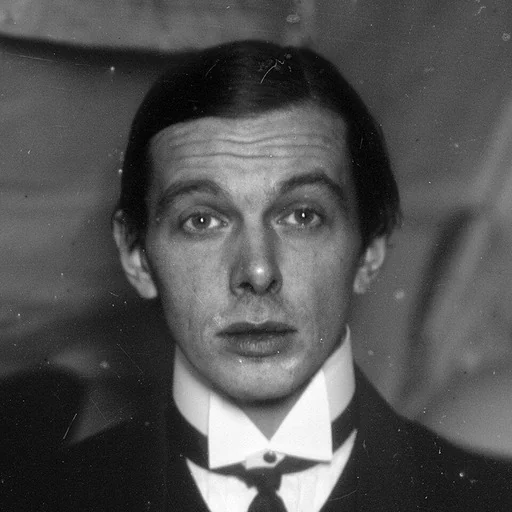
Ernst Ludwig Kirchner (6 May 1880 – 15 June 1938) was a German expressionist painter and printmaker.

![Dance Hall Bellevue [obverse], by Ernst Ludwig Kirchner](https://artifactworldgallery.com/img/ernst-ludwig-kirchner--dance-hall-bellevue-obverse--d1e14aac4297c69e-w320.webp)
![Nude Figure [reverse], by Ernst Ludwig Kirchner](https://artifactworldgallery.com/img/ernst-ludwig-kirchner--nude-figure-reverse--4b135f0364753e98-w320.webp)
![Two Nudes [obverse], by Ernst Ludwig Kirchner](https://artifactworldgallery.com/img/ernst-ludwig-kirchner--two-nudes-obverse--eb3914183f0bc96d-w320.webp)
![Dancing Couple in the Snow [reverse], by Ernst Ludwig Kirchner](https://artifactworldgallery.com/img/ernst-ludwig-kirchner--dancing-couple-in-the-snow-reverse--87ca007d7c05b553-w320.webp)
 Dr. Ludwig Binswanger (Kopf Dr. Ludwig Binswanger)
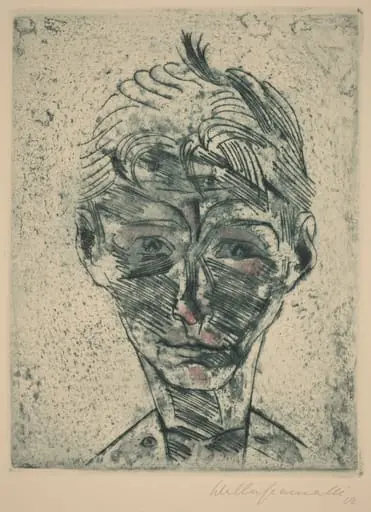 Bust of a Young Man, Self-portrait (Knabenkopf, Selbstporträt)
 Untitled
 Composer Klemperer
 Girl with Hand
 Head of a Fisherman
 Untitled
 Smiling Head, Self-portrait (Lächelnder Kopf, Selbstporträt)
 Bildnis Dr. Gr.
 Untitled
 Gloomy Face, Self-portrait (Dunkles Gesicht, Selbstporträt)
 Woman with a Veil