Artwork
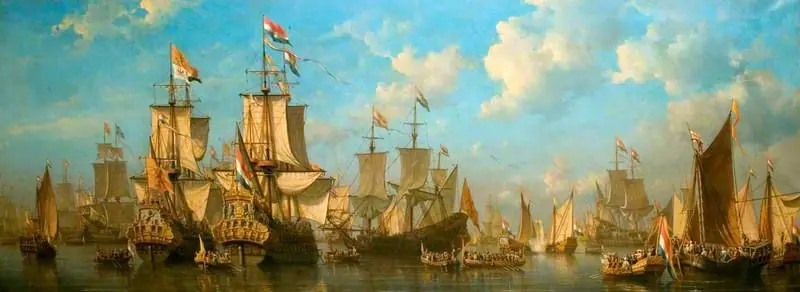
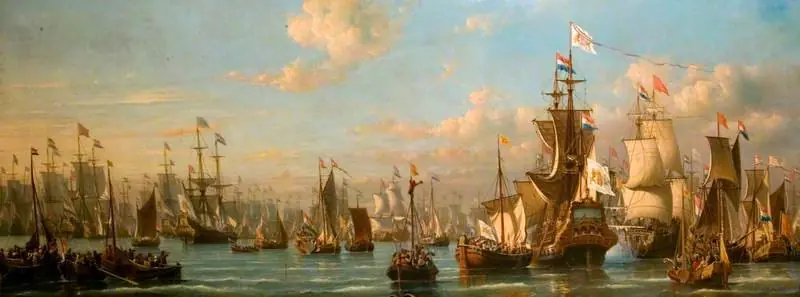
The Prince of Orange, afterwards King William III, Embarking at Hellevoetsluis for England in 1688
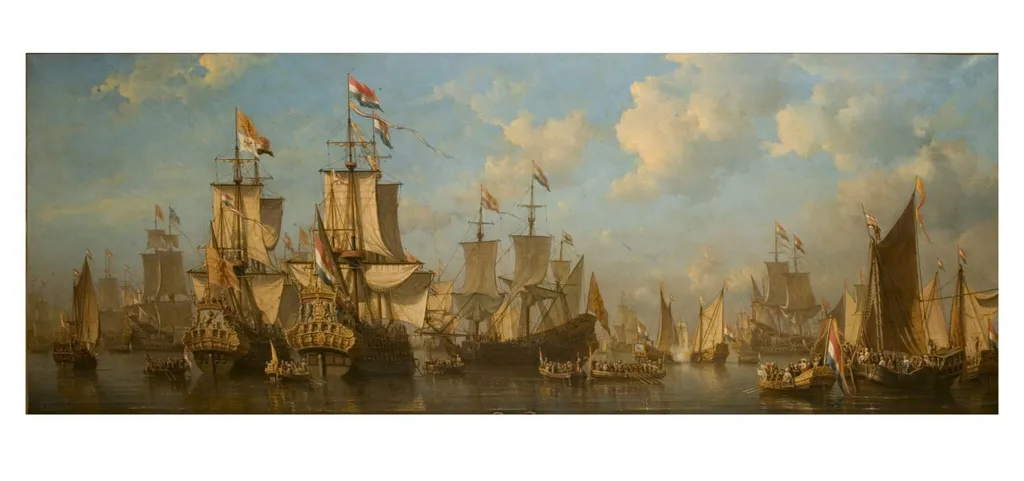
The Prince of Orange, afterwards King William III, Embarking at Hellevoetsluis for England in 1688 is an oil painting by the Biedermeier artist Everhardus Koster. It dates from 1859 and is held in the collection of the Victoria and Albert Museum.
About this work
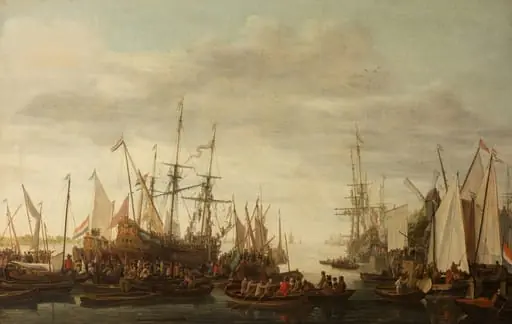
You see a large sailing ship crowded with men in old-fashioned coats.
You see a large sailing ship crowded with men in old-fashioned coats. The scene is busy but orderly. One man in a bright red coat stands out near the ship’s rail.
This painting shows William III leaving the Netherlands in 1688. It’s a dramatic moment in history. Koster painted it before losing his right eye in 1859.
See how the waves and sky frame the action. It feels like a real event, not just a story.
Look up Koster, Everhardus to see more of his work.
Overview
Painted by Everhardus Koster in the mid-19th century, this oil work depicts William III, Prince of Orange, departing from Hellevoetsluis in 1688 aboard a large vessel bound for England. Though created nearly two centuries after the event, the painting draws on 17th-century Dutch marine traditions to commemorate a pivotal political transition. Koster, known for seascapes and river scenes, rendered the moment with careful attention to naval detail and atmospheric depth, reflecting his training and later curatorial experience.
Subject & Meaning
The scene captures William III’s departure during the Glorious Revolution, a bloodless coup that led to his ascension to the English throne alongside his wife Mary. His embarkation symbolized the transfer of Protestant leadership and the shift in European power dynamics. The orderly crowd and prominent figure in red—likely William himself—convey authority amid movement, emphasizing the historical gravity of the moment without overt dramatization.
Technique & Style
Koster employed a broad, balanced composition with layered skies and rolling waves to frame the vessel, echoing the grand marine traditions of the Dutch Golden Age. Brushwork is precise yet fluid, capturing the texture of sails and water with restrained realism. The use of light and color directs focus to the central figure, while the scale of the ship anchors the narrative. The painting reflects Koster’s skill in rendering maritime environments before his vision declined after 1859.
History & Provenance
Created before Koster’s eye injury in 1859, the painting was likely completed in the 1850s or early 1860s. It was acquired as a pendant to another work in the Haarlem museum collection, suggesting intentional pairing within a curated narrative. Koster’s role as director of the Museum of Modern Art in Haarlem from 1876 may have influenced its institutional placement, aligning the painting with national historical themes promoted by the museum.
Context
Koster worked in a period when Dutch artists revisited 17th-century subjects to reinforce national identity. The Glorious Revolution remained a potent symbol of Protestant succession and constitutional change. By adopting the monumental scale and compositional rigor of earlier marine painters, Koster linked his work to a legacy of maritime triumph, even as his own era was defined by industrial and political transformation.
Legacy
Though Koster is less known today than his 17th-century predecessors, this painting exemplifies 19th-century Dutch historicism—where past events were reimagined through contemporary technique. His role as a teacher and curator helped preserve and contextualize such works within public collections. The painting endures as a visual record of how later generations interpreted pivotal moments in Dutch and British history.
Artist & collection
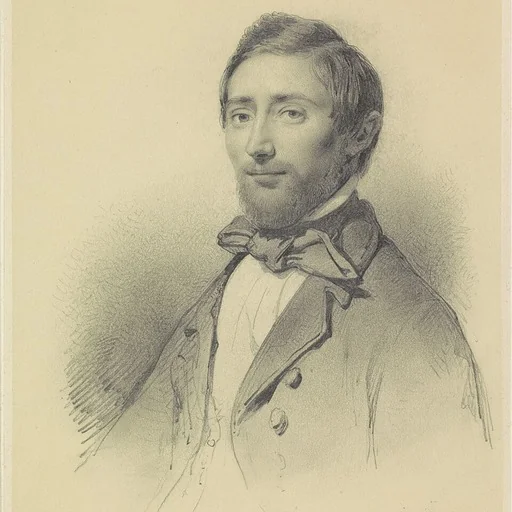
Artist
Everhardus Koster (17 February 1817, The Hague – 8 January 1892, Dordrecht) was a Dutch painter who specialized in sea and river scenes.