Artwork
Untitled
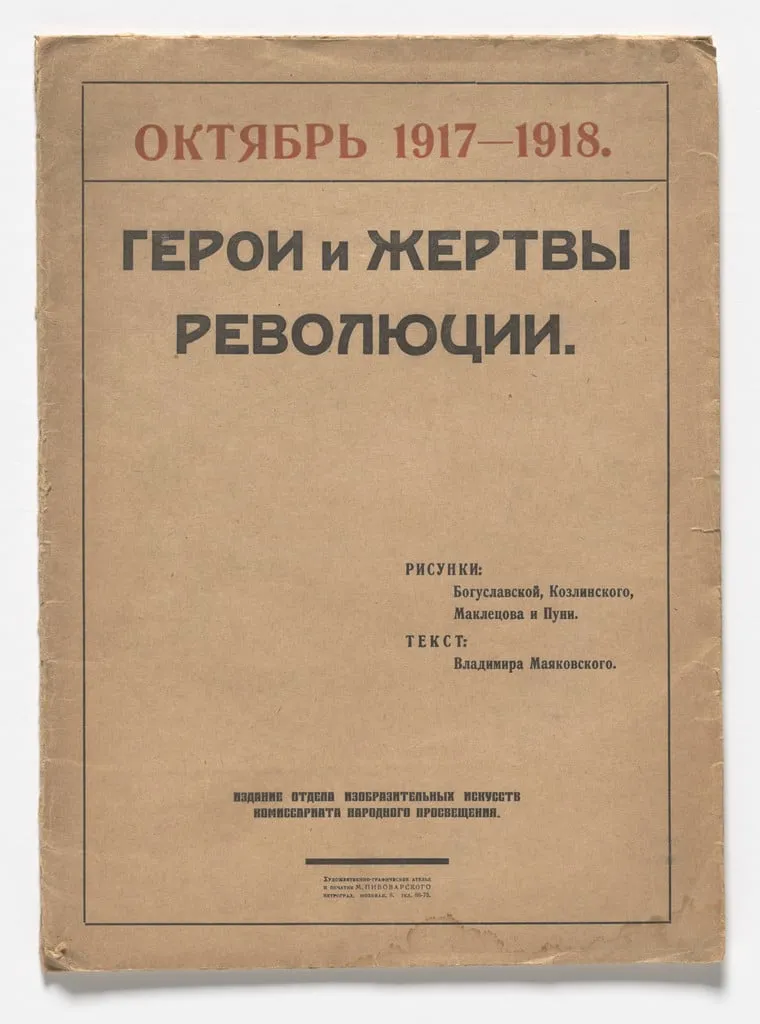
Untitled is an ink print by Vladimir Kozlinskii, Sergei Makletsov, Jean Pougny (Ivan Puni), Various Artists Kseniia Boguslavskaia. It dates from 1918 and is held in the collection of the Museum of Modern Art.
About this work
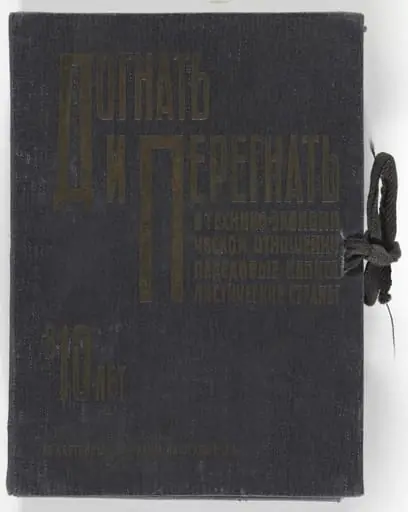
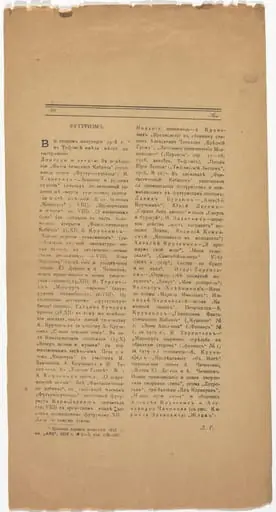
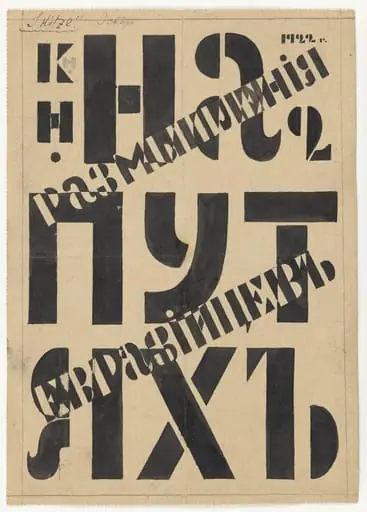
This is a cover for a booklet with a plain, aged look. The paper is brownish and worn, like old paper. Big black text in Russian says "October 1917–1918" and "Heroes and Victims of the Revolution."
The names listed are artists and a writer, all working together. The text at the bottom says it’s from a government department handling art.
Look up lithography to see how these images were made.
Overview
The cover, printed on aged brown paper, features bold black Russian lettering that anchors the work in the immediate aftermath of the revolution.
This portfolio comprises eighteen lithographs produced in 1918 by a collective of Russian artists, including Kseniia Boguslavskaia, Vladimir Kozlinskii, Sergei Makletsov, and Jean Pougny. Issued as a bound booklet, it bears no individual titles, instead presenting a unified visual and textual statement. The cover, printed on aged brown paper, features bold black Russian lettering that anchors the work in the immediate aftermath of the revolution.
Subject & Meaning
The cover explicitly references the period from October 1917 to 1918, labeling its subjects as 'Heroes and Victims of the Revolution.' The inclusion of artists' names alongside the state-affiliated imprint suggests a deliberate alignment with revolutionary ideals. Rather than depicting events, the work frames the creators themselves as participants in a cultural transformation, blurring the line between art and political testimony.
Technique & Style
Each image was produced via lithography, a method allowing multiple impressions from a stone surface. The portfolio’s aesthetic is restrained, favoring stark typographic elements and minimal graphic intervention on the cover. The use of worn, brown paper and unadorned text reflects a deliberate rejection of ornamental design, aligning with the era’s emerging utilitarian and collectivist artistic values.
History & Provenance
Created under the auspices of a Soviet government arts department, the portfolio was likely distributed as part of early revolutionary cultural outreach. Its survival into the 20th century, and eventual acquisition by The Museum of Modern Art, indicates its significance as a rare artifact of post-revolutionary artistic collaboration. The physical condition of the cover—faded, worn—suggests active circulation before institutional preservation.
Context
Produced during a period of intense political and cultural reorganization, the portfolio emerged as the Soviet state sought to harness art for ideological purposes. Artists, previously independent, were now enlisted into state-sponsored collectives. This work exemplifies the transitional phase where creative labor was redefined as public service, with typography and collective authorship replacing individual expression.
Legacy
Though little known outside specialist circles, the portfolio stands as an early example of state-commissioned graphic collectivism in revolutionary Russia. It prefigures later Soviet propaganda efforts and offers insight into how artists navigated the shift from autonomy to institutional alignment. Its preservation in MoMA underscores its role as a document of artistic adaptation amid radical societal change.
Artist & collection
Artist
Kseniia Boguslavskaia, Vladimir Kozlinskii, Sergei Makletsov, Jean Pougny , Various Artists (1892–1972) was a Russian artist.