Artwork
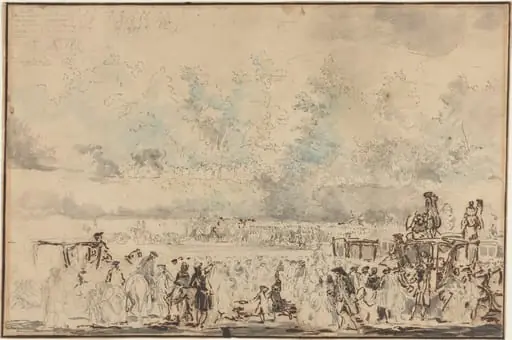
Garden Party at a Country House
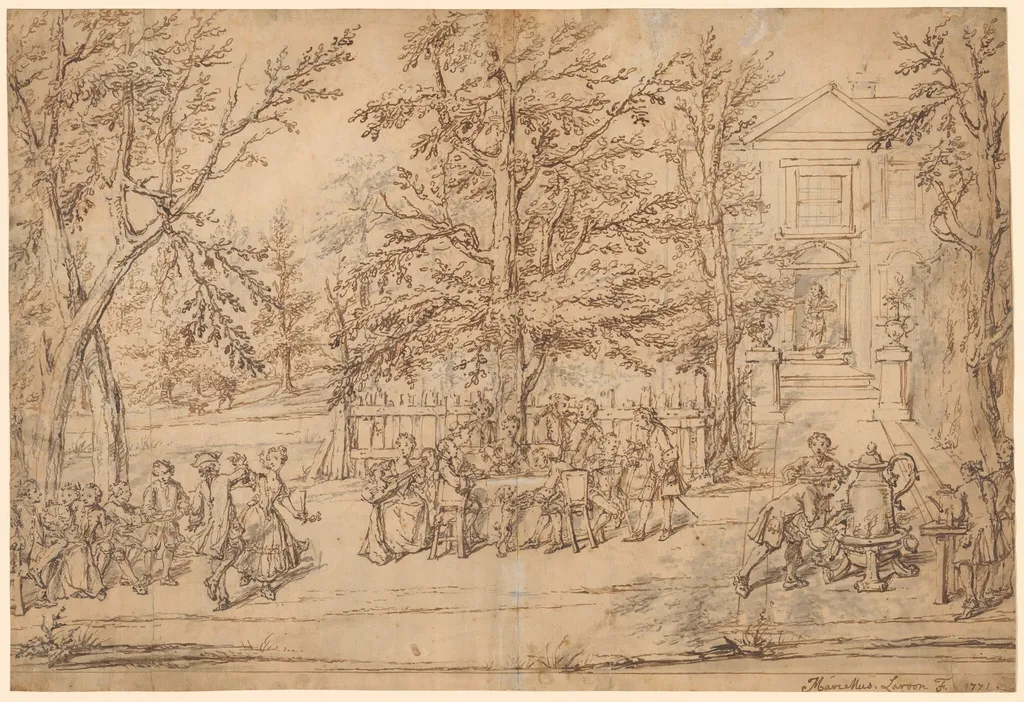
Garden Party at a Country House is an ink drawing by the Romanticist artist Marcellus Laroon II. It dates from 1771 and is held in the collection of the National Gallery of Art.
About this work
Overview
Garden Party at a Country House is a pen-and-brown‑ink drawing with a gray wash applied over graphite, executed on two joined sheets of laid paper. Marcellus Laroon II completed the work in 1771. The composition captures an outdoor social gathering set before a substantial country residence, rendered in a monochrome palette that emphasizes line and tone over color.
Subject & Meaning
The scene depicts a convivial assembly in a garden, with figures positioned near the façade of a grand house. Some participants stand, others sit, and a small group appears to be playing music. The barren trees and damp ground suggest a transitional season—perhaps early spring or late winter—underscoring the fleeting nature of leisure against a backdrop of architectural splendor.
Technique & Style
Laroon employs fine, controlled lines to delineate figures, foliage, and architectural details, while cross‑hatching builds the illusion of shadow and volume.
Laroon employs fine, controlled lines to delineate figures, foliage, and architectural details, while cross‑hatching builds the illusion of shadow and volume. A subtle gray wash over the graphite underdrawing unifies the composition, lending a sense of atmospheric depth. The rendering of the house’s columns and statuary reflects a taste for classical motifs, rendered here with a slightly nostalgic, antiquated sensibility.
History & Provenance
Created in the late eighteenth century, the drawing reflects the period’s interest in documenting aristocratic entertainments. It has remained within the documented oeuvre of Marcellus Laroon II, a noted English draughtsman of the era. The work’s provenance traces through several private collections before entering a public institution, where it serves as a visual record of eighteenth‑century country‑house culture.
Artist & collection


![A Stand of Trees [recto], by John Varley](https://artifactworldgallery.com/img/john-varley--a-stand-of-trees-recto--88424b951e70bc89-w320.webp)