Artwork
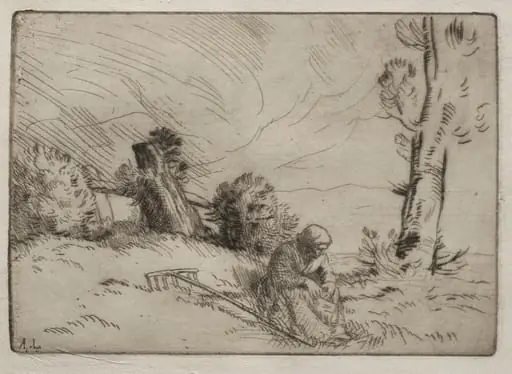
Along the Top of the Hill (Sur le haut de la colline)
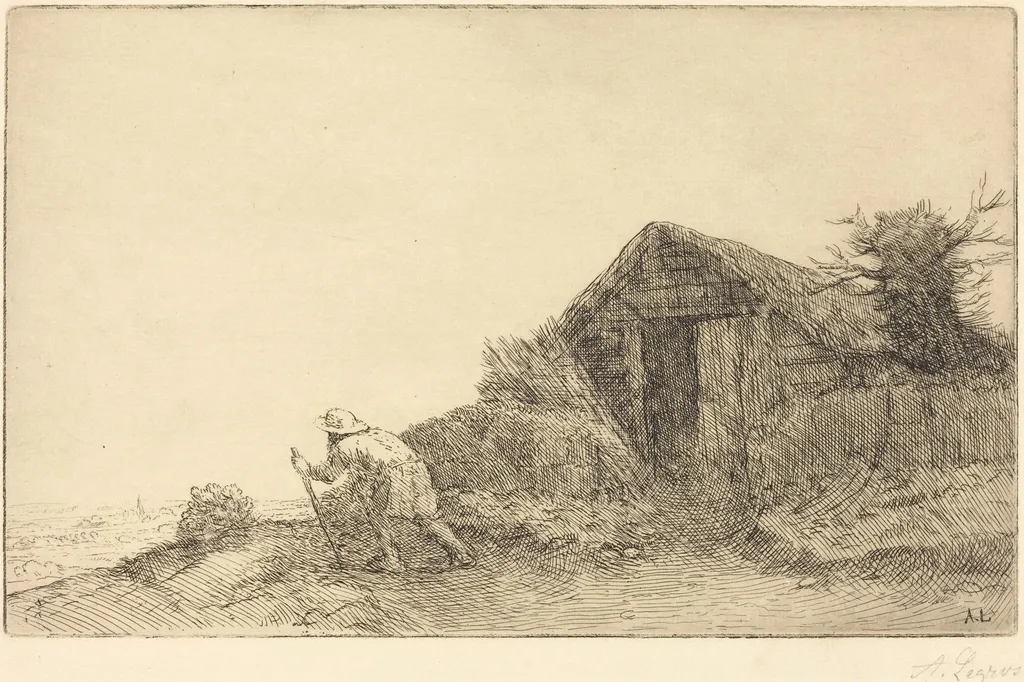
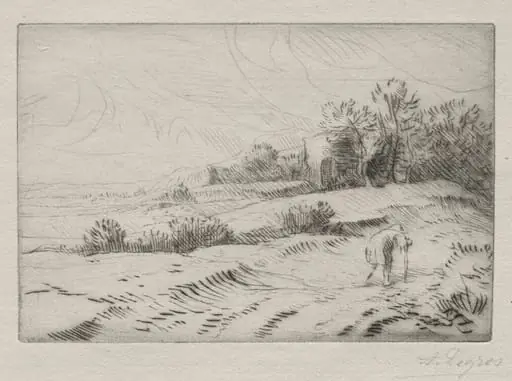
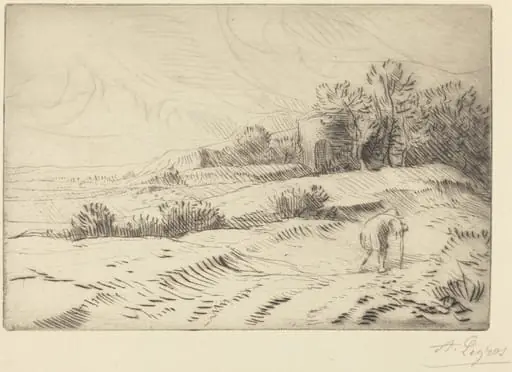
Along the Top of the Hill (Sur le haut de la colline) is an ink print by the Romanticist artist Alphonse Legros. It dates from 1874 and is held in the collection of the National Gallery of Art.
About this work
Overview
The work belongs to a period when Legros actively contributed to the revival of etching as a serious artistic medium in England.
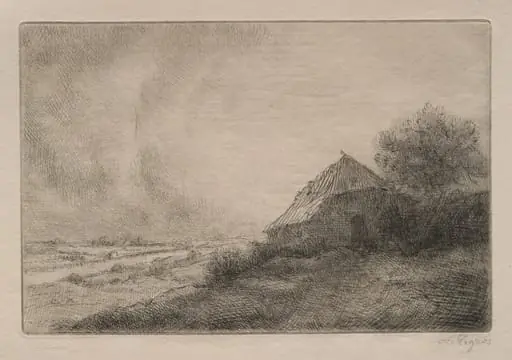
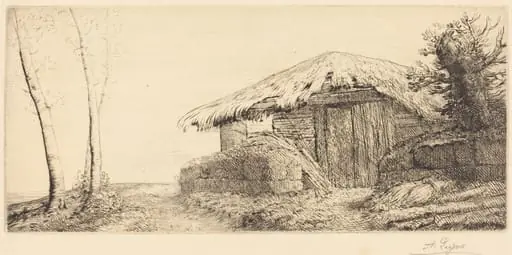
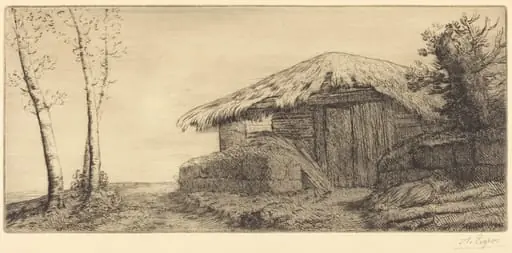
Created in 1874, *Along the Top of the Hill* is an etching by Alphonse Legros, a French artist who settled in Britain in 1863. The work belongs to a period when Legros actively contributed to the revival of etching as a serious artistic medium in England. Executed in monochrome, the print captures a quiet, contemplative scene with minimal detail, emphasizing the tactile qualities of line and texture over narrative or color.
Subject & Meaning
The image depicts a solitary figure seated on a hillside, facing a vast, undulating landscape. Dressed in simple attire and wearing a hat, the person appears absorbed in observation, their posture suggesting introspection. The surrounding terrain—rocky, uneven, and textured—frames the figure without overwhelming it. The scene conveys solitude and quiet communion with nature, typical of Legros’s interest in everyday, unidealized moments.
Technique & Style
Legros employed traditional etching methods, using acid to bite lines into a metal plate, which was then inked and pressed onto paper. The composition relies entirely on fine, intersecting lines to model form and suggest depth. The hillside and rocky outcrop are rendered with dense hatching and cross-hatching, creating a sense of roughness and volume. No tonal gradations or color are used, underscoring the medium’s reliance on line alone.
History & Provenance
Legros, naturalized as a British citizen in 1881, produced this work during his early years in London, a time when he was deeply involved in printmaking circles. The etching reflects his commitment to reviving the craft, influenced by both French realism and British artistic traditions. While specific early ownership records are sparse, the work is documented within his broader print oeuvre and was likely circulated among collectors and institutions interested in renewed printmaking practices.
Context
In the 1870s, etching experienced a resurgence in Britain, partly due to artists like Legros who rejected mass-produced illustrations in favor of handcrafted, expressive prints. His work aligned with broader European trends favoring direct, observational art over academic idealism. *Along the Top of the Hill* exemplifies this shift—its modest scale and unadorned subject matter contrast with the grand historical themes dominant in painting at the time.
Legacy
Legros’s etchings, including this one, helped reestablish etching as a legitimate fine art form in Britain. His technical precision and focus on naturalistic texture influenced a generation of printmakers. Though less widely known today than his contemporaries, his contributions to printmaking pedagogy and practice at the Slade School of Art ensured his lasting impact on British artistic education.
Artist & collection

Artist
Alphonse Legros (French pronunciation: ; 8 May 1837 – 8 December 1911) was a French, later British, painter, etcher, sculptor, and medallist.