Artwork
West George Street, Glasgow
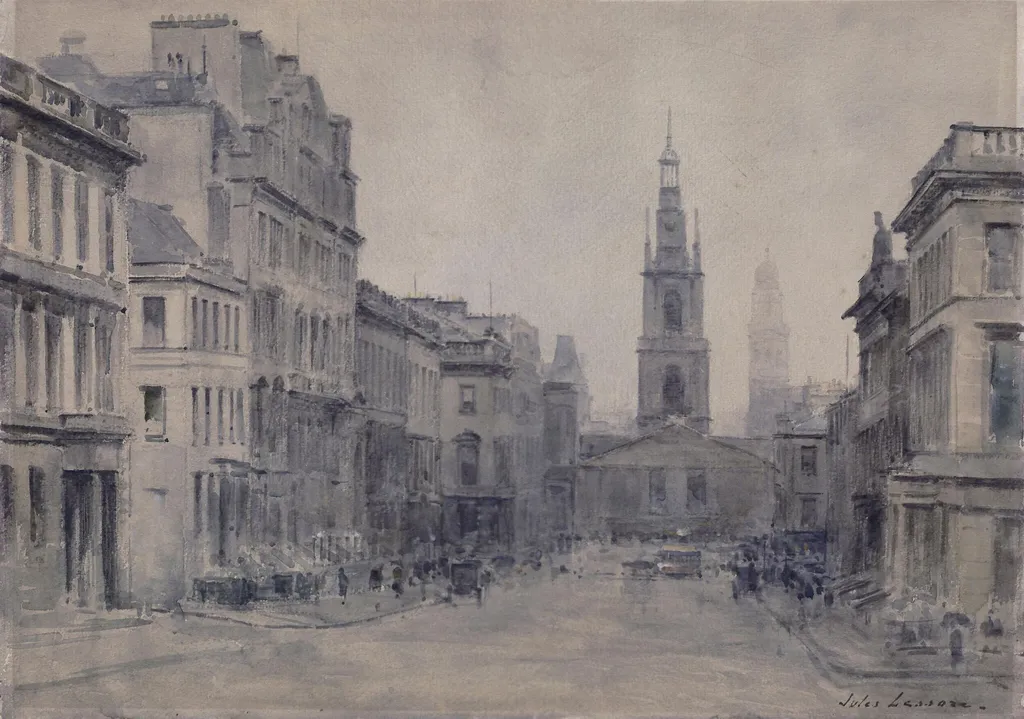
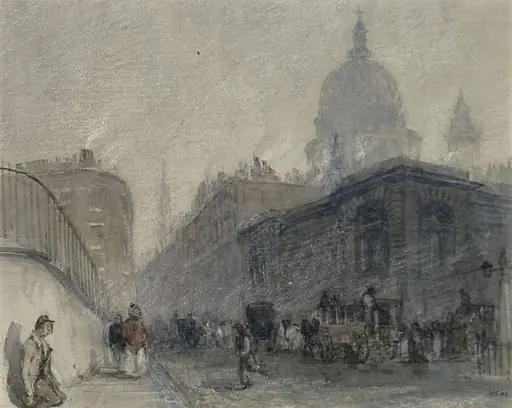
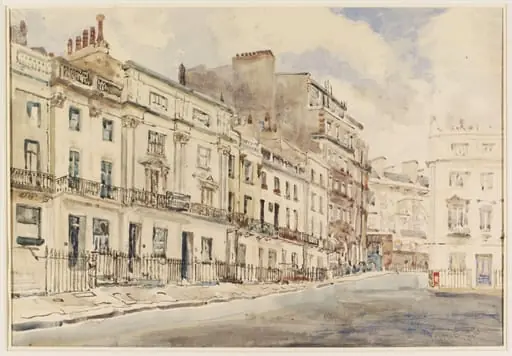
West George Street, Glasgow is a watercolor work on paper by the Impressionist artist Jules Lessore. It dates from 1850 and is held in the collection of the Victoria and Albert Museum. This watercolour captures a quiet stretch of West George Street in Glasgow, rendered with delicate brushwork and restrained tones.
About this work
Overview
The scene balances urban activity with stillness, as figures and horse-drawn vehicles move along cobbled pavement beneath closely spaced tenements.
This watercolour captures a quiet stretch of West George Street in Glasgow, rendered with delicate brushwork and restrained tones. The scene balances urban activity with stillness, as figures and horse-drawn vehicles move along cobbled pavement beneath closely spaced tenements. The composition draws attention upward, where a church spire breaks the horizontal line of rooftops, anchoring the view in architectural gravity.
Subject & Meaning
The painting presents an ordinary urban moment without overt narrative, emphasizing the rhythm of daily life in late 19th-century Glasgow. St George’s Church, prominently positioned, serves as both landmark and silent witness to the street’s commerce and movement. Its elevation above surrounding buildings suggests spiritual or civic centrality within the city’s fabric.
Technique & Style
The artist employed loose, fluid watercolour strokes to suggest texture and light without precise definition. Muted greys, browns, and soft blues dominate, creating a hazy atmospheric effect. Buildings recede into the background through tonal gradation, while the church tower, rendered with slightly sharper edges and brighter highlights, becomes the visual anchor.
History & Provenance
The work is part of a body of urban watercolours produced in Glasgow during the late 1800s, reflecting a growing interest in documenting everyday cityscapes. Its provenance traces to private Scottish collections before entering institutional holdings, though specific acquisition details remain unrecorded in public archives.
Context
During this period, Glasgow was expanding rapidly as an industrial hub, yet artists continued to record its quieter, older quarters. Watercolour was favored for its portability and immediacy, allowing artists to capture transient effects of light and movement. This piece aligns with a broader trend of civic documentation rather than grand historical representation.
Legacy
The painting contributes to a modest but persistent tradition of Scottish urban watercolours that prioritize observation over drama. It reflects a shift in artistic focus from idealized landscapes to the nuanced reality of city life, influencing later generations interested in the social texture of urban environments.
Artist & collection
Artist
Jules Lessore drew the everyday edges of towns and ports in France and Scotland during the late 1800s.