Artwork
Judgement of Midas

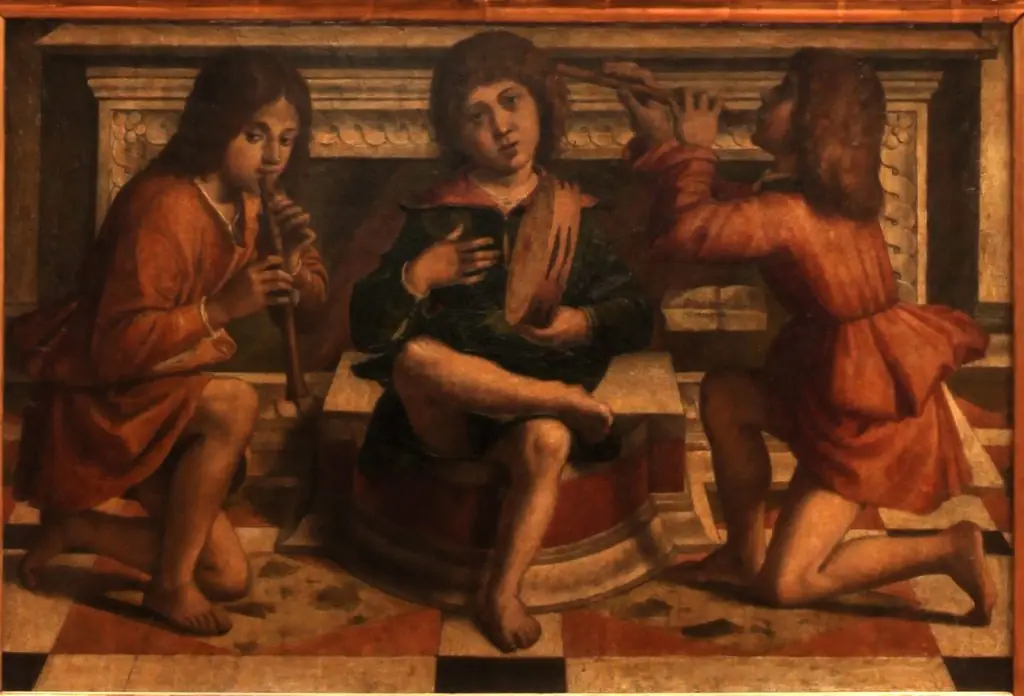
Judgement of Midas is a paint painting by the Mannerist artist Lorenzo Leonbruno. It dates from 1513 and is held in the collection of the Gemäldegalerie Berlin.
About this work
Overview
Lorenzo Leonbruno painted *Judgement of Midas* in 1513 during his tenure as a court artist for the Gonzaga family in Mantua. Created in the early 16th century, the work reflects the transitional style between High Renaissance and Mannerism. It is now held in the Gemäldegalerie, Berlin, as part of a small but significant group of surviving panel paintings from Leonbruno’s career.
Subject & Meaning
The nude figure on the left represents Midas, identified by his attributes—the cloth and instrument—while the clothed men are likely Apollo and two attendants.
The painting illustrates the mythological episode in which King Midas is judged by the god Apollo for preferring the rustic music of Pan over Apollo’s lyre. The nude figure on the left represents Midas, identified by his attributes—the cloth and instrument—while the clothed men are likely Apollo and two attendants. The scene captures the moment of divine verdict, emphasizing the tension between earthly taste and celestial authority.
Technique & Style
Leonbruno employed delicate brushwork and subtle shading to model forms within a muted palette of earth tones. The soft, diffused lighting enhances the naturalism of the wooded setting, while the textured surfaces and careful rendering of fabric and skin suggest attention to tactile detail. Though influenced by Mantuan Renaissance traditions, the composition’s elongated figures and quiet tension hint at emerging Mannerist tendencies.
History & Provenance
Commissioned by the Gonzaga court, the painting likely adorned a private chamber or study within the Ducal Palace in Mantua. It remained in the family’s collection until the 18th century, after which it entered broader European collections. Its presence in Berlin since the 19th century reflects 19th-century acquisitions of Italian Renaissance works by Prussian collectors.
Context
Leonbruno worked alongside artists like Giulio Romano in Mantua, where humanist themes and classical mythology were favored by patrons like Isabella d’Este. His role as court painter placed him within a network of intellectual and artistic circles that valued narrative clarity and refined technique. *Judgement of Midas* aligns with contemporary interests in moral allegory and the tension between art forms.
Legacy
Though Leonbruno’s oeuvre is limited and largely overshadowed by his more famous contemporaries, *Judgement of Midas* remains a key example of provincial Renaissance painting with Mannerist inflections. It offers insight into the tastes of minor courts and the diffusion of classical themes beyond major centers like Florence or Rome.
Artist & collection
Artist
Lorenzo Leonbruno (10 March 1489 – 1537), also known as Lorenzo de Leombeni, was an Italian painter during the early Renaissance period.