Artwork
La Crucifixión
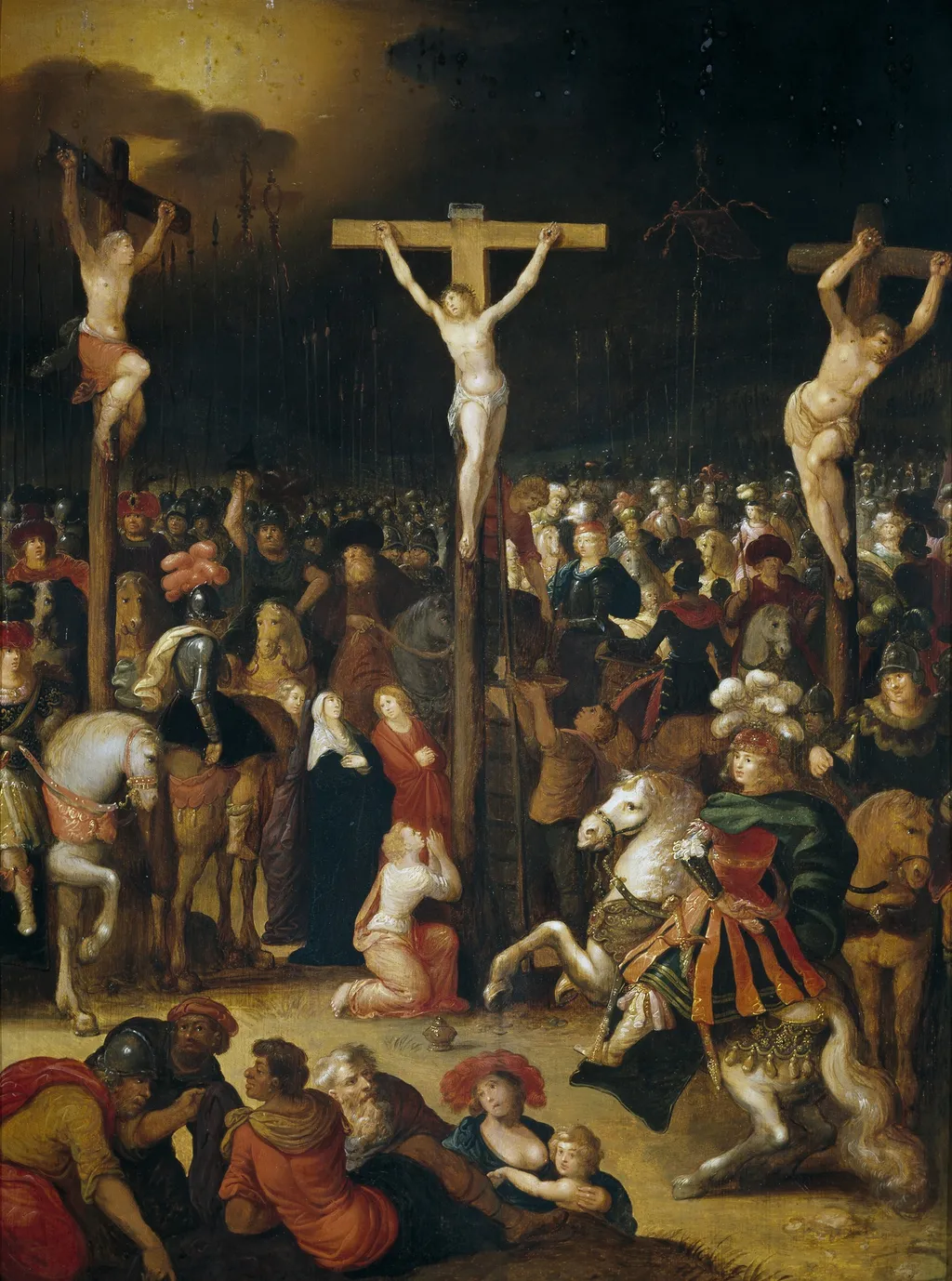
La Crucifixión is an oil painting by the Early Baroque Italian artist Louis de Caullery. It dates from 1601 and is held in the collection of the Museo del Prado.
About this work
Overview
Created in 1601 by the Flemish painter Louis de Caullery, this oil on canvas presents a dramatic interpretation of the crucifixion. Executed in the early Baroque manner that was then prevalent in Italy, the work belongs to the religious genre and is presently part of the Museo del Prado’s collection.
Subject & Meaning
The composition centers on three crucified figures, with the central Christ depicted naked and with arms outstretched. Surrounding them is a tumultuous assemblage of onlookers in period dress—kneeling devotees, pointing spectators, and a mounted soldier—each reacting to the scene in a range of gestures that underscore the event’s emotional intensity.
Technique & Style
De Caullery employs a stark chiaroscuro, contrasting deep shadows with illuminated highlights that carve the figures from a somber background. The luminous skin of the central figure stands out against the dark timber of the crosses, while selective light catches faces and armor, enhancing the three‑dimensional effect typical of early Baroque visual drama.
History & Provenance
Louis de Caullery, active between roughly 1580 and 1621, produced this work during a period of cross‑cultural exchange between Flemish and Italian art. After its creation, the painting entered the Spanish royal collection and eventually was transferred to the Museo del Prado, where it remains on display for public viewing.
Own this work as a print
Artist & collection
Artist
Louis de Caullery, Caulery or Coulery (ca.1580–1621) was a Flemish painter who is known for his architectural scenes, city views, genre scenes, allegorical compositions, religious and history paintings.
