Artwork
Venus Giving Arms to Aeneas
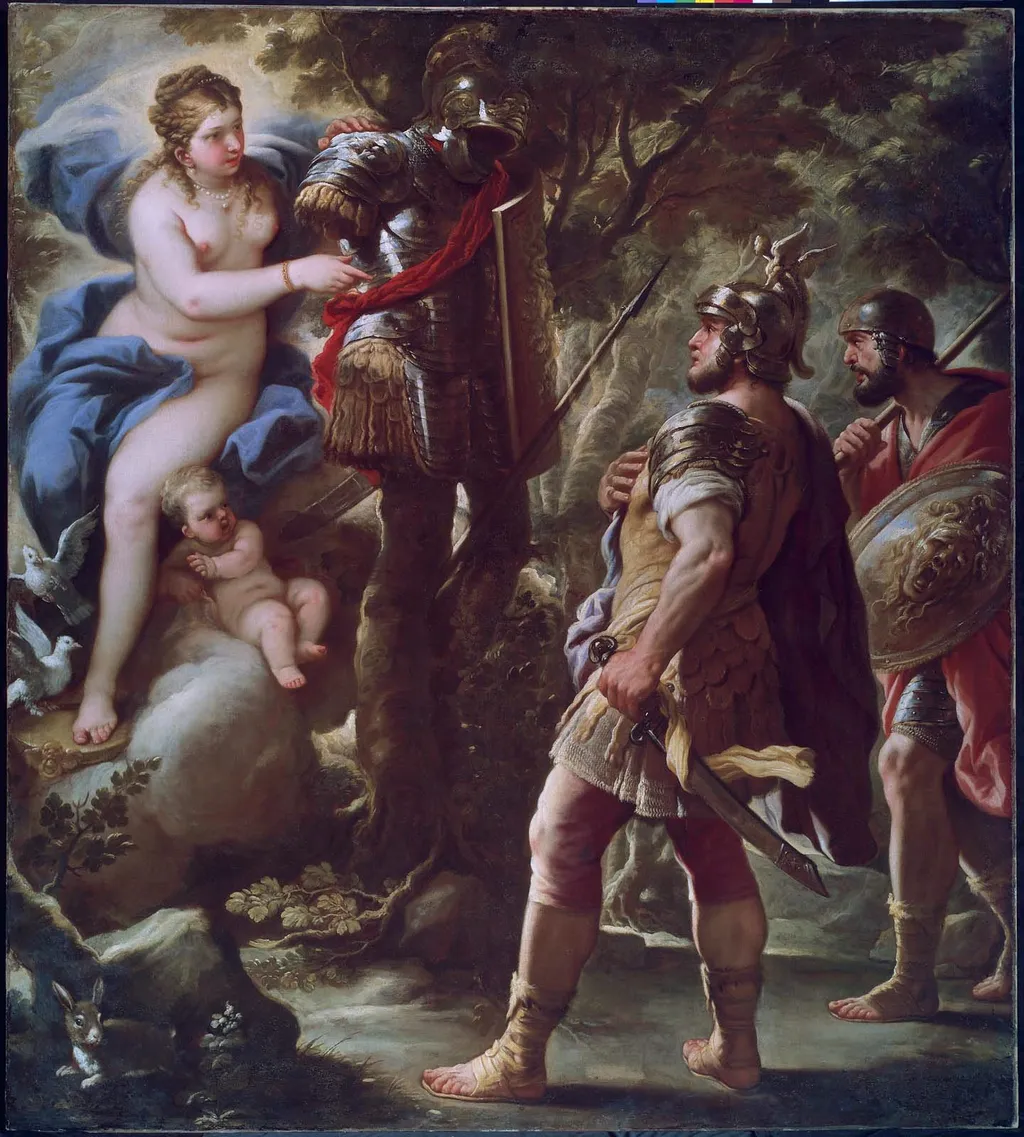
Venus Giving Arms to Aeneas is an oil painting by the Early Baroque Italian artist Luca Giordano. It dates from 1700 and is held in the collection of the Museum of Fine Arts Boston.
About this work
Overview
Luca Giordano’s oil painting Venus Giving Arms to Aeneas, executed around 1700, is part of the Museum of Fine Arts, Boston’s collection. The work portrays a moment from the Aeneid in which the goddess Venus assists the Trojan hero Aeneas, set against a wooded landscape. The composition balances figures and foliage, using a restrained palette of warm earth tones punctuated by vivid blues and reds.
Subject & Meaning
The gesture implies divine guidance and the transfer of martial support, echoing the epic’s theme of destiny guided by the gods.
The central narrative shows Venus, identifiable by her flowing curls and blue mantle, handing a red cloth to the armored Aeneas, who stands poised with sword, shield, and helmet. To his right, a secondary warrior in a red cloak grips a spear, suggesting a military escort. The gesture implies divine guidance and the transfer of martial support, echoing the epic’s theme of destiny guided by the gods.
Technique & Style
Giordano employs the fluid brushwork characteristic of late Baroque painting, allowing the figures to emerge from a softly modeled forest backdrop. The contrast between the cool blue of Venus’s drapery and the warm ochres of the trees creates depth, while the red accents draw attention to the narrative objects. The rendering of armor and fabric demonstrates a keen attention to texture and light.
History & Provenance
Created at the turn of the 18th century, the canvas entered the Museum of Fine Arts, Boston, through acquisition in the early 20th century, though exact purchase details remain sparse. Its presence in a major American institution reflects the broader European collecting trends that brought Baroque works to the United States during that period.
Context
Giordano, a prolific Neapolitan painter, often tackled classical and mythological subjects for aristocratic patrons. This work aligns with the era’s fascination with antiquity, where scenes from Virgil’s Aeneid were popular motifs for illustrating heroic virtue and divine intervention. The forest setting, a common Baroque device, provides a natural stage that underscores the interplay between human endeavor and celestial influence.
Own this work as a print
Artist & collection

Artist
Luca Giordano was an Italian late-Baroque painter and printmaker in etching. Giordano was one of the most celebrated artists of the Neapolitan Baroque, whose vast output included altarpieces, mythological paintings and…