Artwork
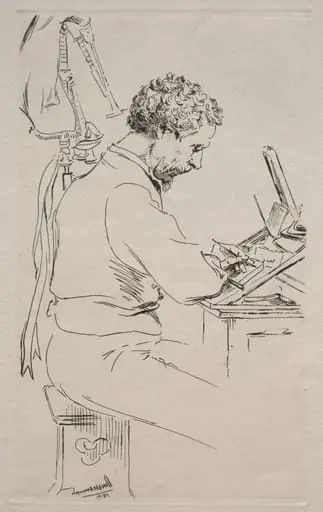
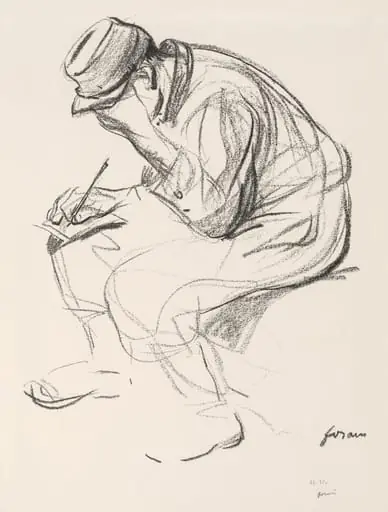
Portret al pictorului Pavel Codiță, din profil, spre stânga. Redat până la brâu, așezat, desenând. Lucia Cosmescu (1916-1969) a fost pictoriță și graficiană româncă, Născută în Galați, a făcut studii de pictură la Academia de Arte Frumoase din București.
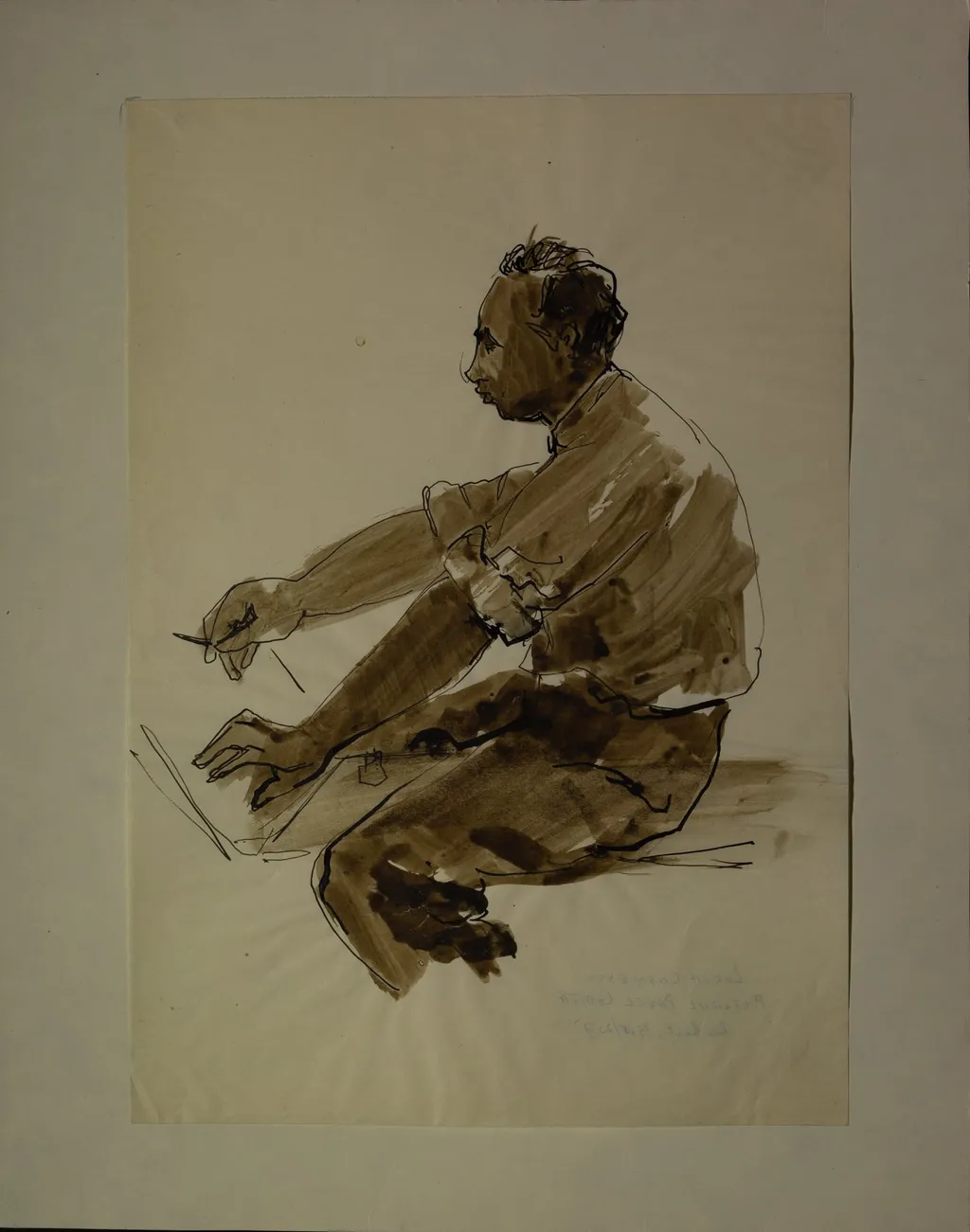
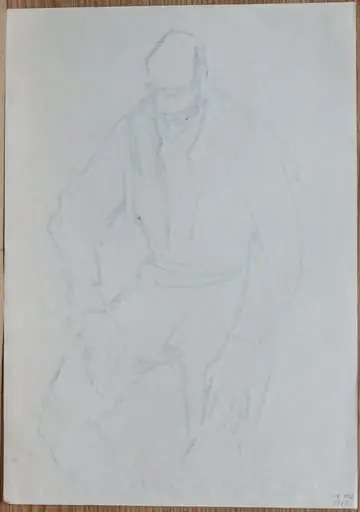
Portret al pictorului Pavel Codiță, din profil, spre stânga. Redat până la brâu, așezat, desenând. Lucia Cosmescu (1916-1969) a fost pictoriță și graficiană româncă, Născută în Galați, a făcut studii de pictură la Academia de Arte Frumoase din București. is a print by artistă Lucia Cosmescu. It is held in the collection of the National Museum of Romanian History. This pencil sketch by Lucia Cosmescu depicts Pavel Codiță seated in profile, facing left, engaged in the act of drawing.
About this work
Overview
The paper bears a soft yellow hue and a faint handwritten annotation in one corner, hinting at its private, working nature.
This pencil sketch by Lucia Cosmescu depicts Pavel Codiță seated in profile, facing left, engaged in the act of drawing. Rendered from the waist up, the figure is captured mid-motion, one arm resting on the knee, the other holding a pencil. The drawing emphasizes gesture over detail, with loose, fluid lines and subtle tonal shifts to suggest fabric folds. The paper bears a soft yellow hue and a faint handwritten annotation in one corner, hinting at its private, working nature.
Subject & Meaning
The subject, Pavel Codiță, is portrayed not as a formal portrait but as an artist in the midst of creation. His posture conveys quiet concentration, turning the act of drawing into the central theme. By focusing on his hands and the immediacy of his motion, Cosmescu elevates the mundane ritual of sketching into a moment of artistic introspection. The image reflects a mutual understanding between artist and subject—both engaged in the quiet labor of making.
Technique & Style
Cosmescu employs a rapid, economical pencil technique, favoring expressive lines over polished finish. Shading is applied sparingly to indicate volume and texture, particularly in the folds of clothing, while edges remain deliberately unfinished. The absence of rigid contours and the openness of the composition suggest spontaneity, aligning with the sketchbook tradition. The paper’s slight discoloration and marginal note reinforce the work’s function as a private observation rather than a public artifact.
History & Provenance
Created during Cosmescu’s time as a student or early practitioner in Bucharest, the sketch likely originated in the informal circles of the Academy of Fine Arts. It may have served as a study of a fellow artist or a personal record of creative exchange. Its survival suggests it was retained within her personal archive, possibly among other drawings made in the company of peers, offering insight into the unrecorded dynamics of Romania’s interwar art community.
Context
In 1930s Romania, women artists like Cosmescu navigated a male-dominated field with limited institutional recognition. Sketches such as this one reveal a quieter, yet vital, aspect of artistic life: the documentation of colleagues and daily practice. Unlike formal portraits, these intimate studies were rarely exhibited but formed the backbone of artistic dialogue among peers, preserving the rhythms of studio culture beyond official narratives.
Legacy
Though Cosmescu’s public output was modest, her sketches offer a window into the unpolished, collaborative nature of artistic development in mid-20th-century Romania. This drawing, like others in her oeuvre, resists grandeur in favor of authenticity, capturing the quiet dignity of artistic labor. It endures not as a celebrated work, but as a testament to the unseen networks and daily rituals that sustained a generation of artists.
Artist & collection
Artist

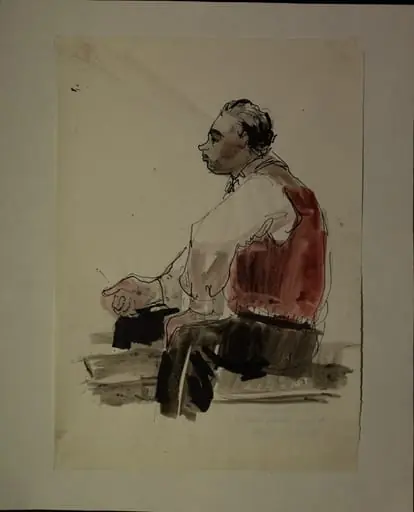 Portret al pictorului Pavel Codiță (1916-2000), până la brâu, așezat, din profil, spre stânga. la pian. Lucia Cosmescu (1916-1969) a fost pictoriță și grafician român, Născută în Galați, a făcut studii de pictură la Academia de Arte Frumoase din București.
![Portret al artistei Ligia Macovei, din semiprofil, spre stânga. Ligia Macovei (1916 - 1998) a fost o graficiană, pictoriță și colecționară de artă. Ligia Macovei a fost deputat în Marea Adunare Națională în sesiunea 1952 -1957.[2] Ligia Macovei a fost căsătorită cu arhitectul și demnitarul comunist Pompiliu Macovei (1911 - 2008). Lucia Cosmescu (1916-1969) a fost pictoriță și graficiană româncă, Născută în Galați, a făcut studii de pictură la Academia de Arte Frumoase din București., by artistă Lucia Cosmescu](https://artifactworldgallery.com/img/artista-lucia-cosmescu--portret-al-artistei-ligia-macovei-din-semiprofil-spre-stanga--17cc37a9b485ecad-w320.webp) Portret al artistei Ligia Macovei, din semiprofil, spre stânga. Ligia Macovei (1916 - 1998) a fost o graficiană, pictoriță și colecționară de artă. Ligia Macovei a fost deputat în Marea Adunare Națională în sesiunea 1952 -1957.[2] Ligia Macovei a fost căsătorită cu arhitectul și demnitarul comunist Pompiliu Macovei (1911 - 2008). Lucia Cosmescu (1916-1969) a fost pictoriță și graficiană româncă, Născută în Galați, a făcut studii de pictură la Academia de Arte Frumoase din București.
Portret al artistei Ligia Macovei, din semiprofil, spre stânga. Ligia Macovei (1916 - 1998) a fost o graficiană, pictoriță și colecționară de artă. Ligia Macovei a fost deputat în Marea Adunare Națională în sesiunea 1952 -1957.[2] Ligia Macovei a fost căsătorită cu arhitectul și demnitarul comunist Pompiliu Macovei (1911 - 2008). Lucia Cosmescu (1916-1969) a fost pictoriță și graficiană româncă, Născută în Galați, a făcut studii de pictură la Academia de Arte Frumoase din București.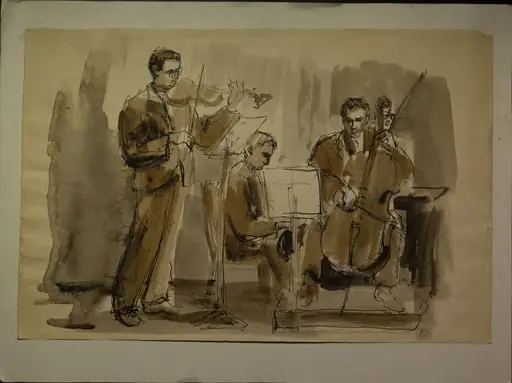 Desen în tuș și acuarelă redând o performanță muzicală a trioului compus din Valentin Gheorghiu (pian), Ștefan Gheorghiu (vioară) și Radu Aldulescu (violoncel). Lucia Cosmescu (1916-1969) a fost pictoriță și grafician român, Născută în Galați, a făcut studii de pictură la Academia de Arte Frumoase din București. A doua jumătate a sec. XX
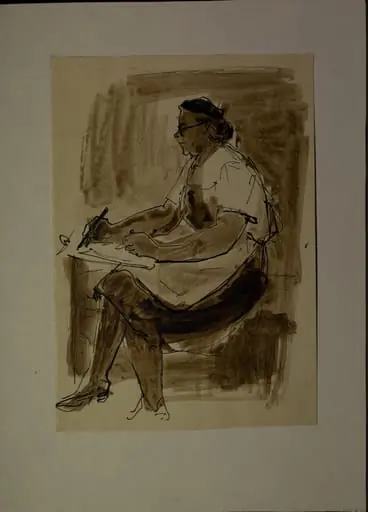 Portret în acuarelă al Mariei Borșanu, așezată, din profil, spre stânga. Desenând. Maria Borșanu a fost membră a Uniunii Artiștilor Plastici. Lucia Cosmescu (1916-1969) a fost pictoriță și graficiană româncă, Născută în Galați, a făcut studii de pictură la Academia de Arte Frumoase din București.