Artwork
Saint Nicholas of Tolentino
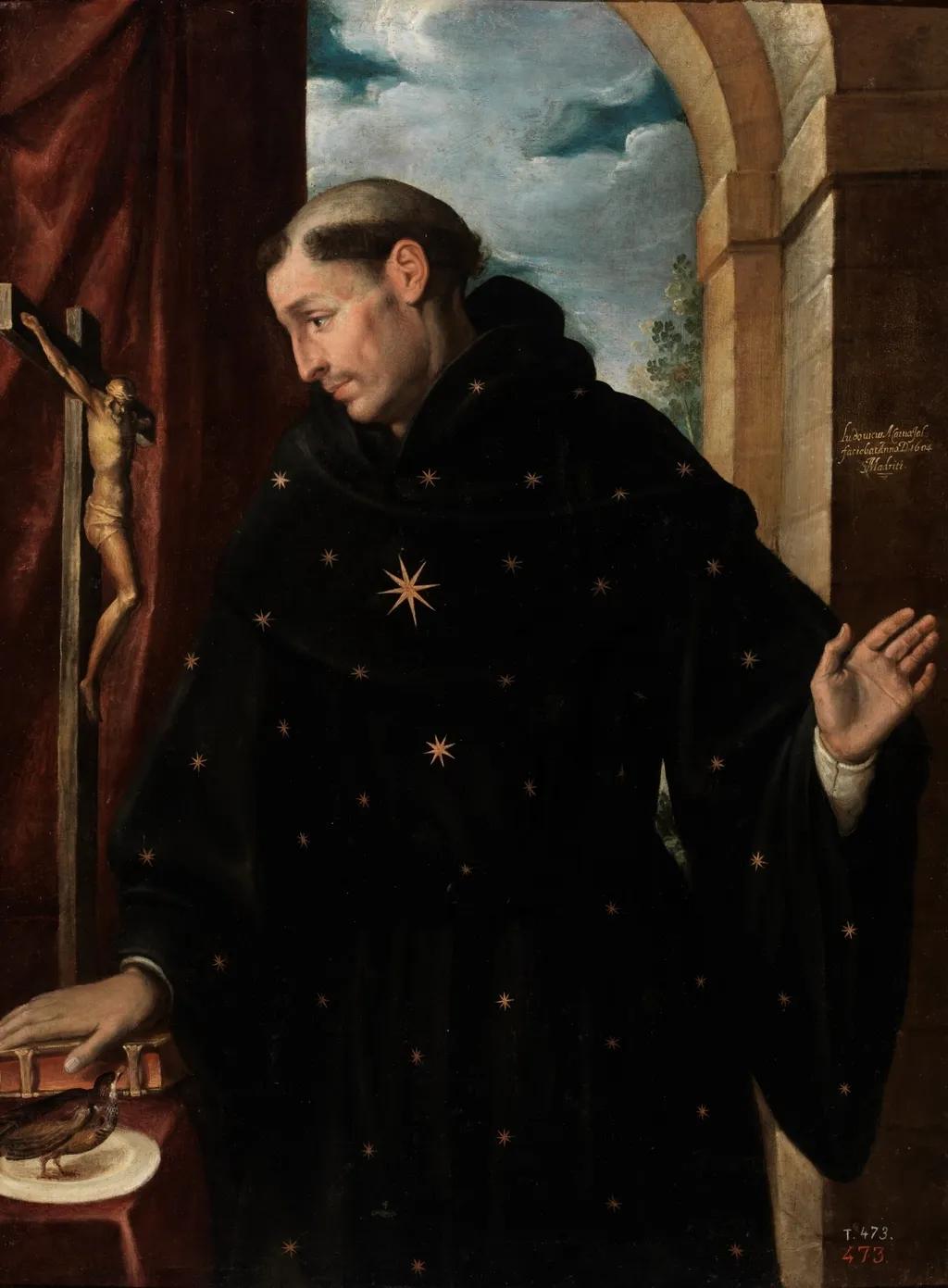
Saint Nicholas of Tolentino is an oil painting by the Early Baroque Italian artist Luis de Carvajal. It dates from 1604 and is held in the collection of the Museo del Prado.
About this work
Overview
Luis de Carvajal’s 1604 oil painting presents Saint Nicholas of Tolentino in a moment of serene devotion. The saint stands before a red drapery and a stone arch, his black habit embroidered with gold stars catching the light. A raised right hand and a contemplative pose convey a quiet, reflective atmosphere.
Subject & Meaning
The composition centers on Nicholas of Tolentino, a 13th‑century Augustinian friar renowned for his charitable works and miracles. He holds a book, symbolizing his scholarly and spiritual authority, while a crucifix to his left underscores his devotion to Christ’s Passion. A small bird perched on the book may allude to the soul’s ascent or the saint’s connection to nature.
Technique & Style
Executed in oil on canvas, the work displays Carvajal’s careful handling of light and texture. The contrast between the deep black habit and the luminous gold star embellishments creates a subtle chiaroscuro effect. The background sky, rendered with soft clouds, and the rich red curtain enhance the spatial depth and lend a calm, ethereal quality.
History & Provenance
Painted in 1604, the canvas entered the collection of the Museo del Prado, where it remains on display. Its provenance traces back to Spanish ecclesiastical patronage, reflecting the Counter‑Reformation’s emphasis on saintly exemplars as models of piety.
Context
Carvajal worked during Spain’s Golden Age, a period marked by prolific religious art commissioned for churches and monasteries. Depictions of saints like Nicholas of Tolentino served both devotional and didactic purposes, reinforcing Catholic doctrine amid the era’s theological debates.
Own this work as a print
Artist & collection
