Artwork
''Cloister'' - Cloister of Santa Maria degli Angeli (Rome).
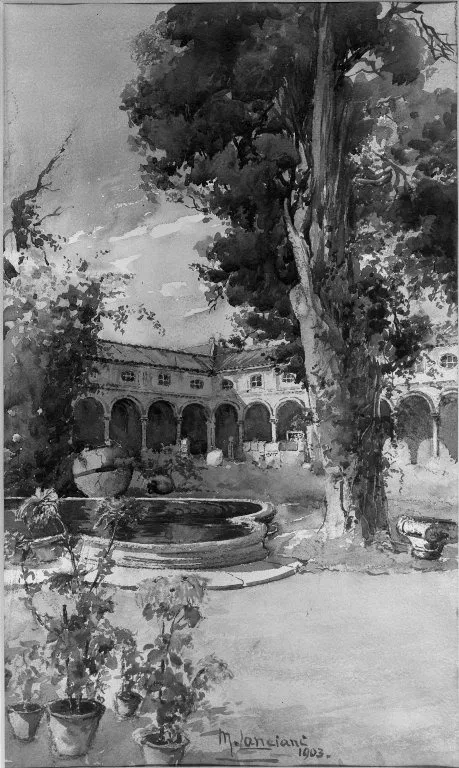
''Cloister'' - Cloister of Santa Maria degli Angeli (Rome). is a watercolor painting by M. Lanciani. It dates from 1903 and is held in the collection of the Brooklyn Museum. Created in 1903 by M.
About this work
If you want to learn more about this style of painting, you could look up the technique of watercolor.
This painting shows a cloister, a courtyard surrounded by a building with arches. The cloister is filled with trees and plants in pots. The building has a tiled roof and many windows. In the background, there is a wall with arches.
The cloister is depicted in a detailed and realistic way, with many textures and colors. The artist used watercolor paint to create the image. The painting is very old, from the year 1903.
If you want to learn more about this style of painting, you could look up the technique of watercolor.
Overview
Created in 1903 by M. Lanciani, this watercolor depicts the cloister of Santa Maria degli Angeli in Rome. The work is part of the Brooklyn Museum’s collection and exemplifies early 20th-century topographical watercolor painting. Its focus on architectural detail and natural elements reflects a documentary approach to urban and religious spaces in Italy during a period of renewed interest in historical preservation.
Subject & Meaning
The painting captures a quiet, enclosed courtyard typical of monastic architecture, framed by arched walkways and filled with potted vegetation. The presence of plants suggests cultivated serenity, contrasting with the rigid stone structure. The scene conveys stillness and contemplation, evoking the cloister’s function as a space for reflection within the religious community, without overt symbolism or narrative.
Technique & Style
Lanciani employed watercolor to render fine architectural details and subtle gradations of light. The medium allowed for transparent layers that suggest texture in stone, tile, and foliage without heavy brushwork. The composition is precise and observational, prioritizing accuracy over expressive flourish, aligning with the tradition of architectural watercolor as a tool for recording built environments.
History & Provenance
The painting was completed in 1903 and entered the Brooklyn Museum’s collection at an unspecified later date. Its origin in Rome and the artist’s documented interest in Italian ecclesiastical sites suggest it was made during a period of scholarly or personal study. No significant alterations or restorations are recorded, and the work remains in its original state.
Context
In early 1900s Italy, artists and antiquarians increasingly documented historic religious sites amid urban modernization. Lanciani’s work fits within this trend, mirroring efforts by scholars to preserve visual records of medieval and Renaissance architecture. Watercolor was favored for its portability and immediacy, making it ideal for on-site studies of structures like the cloister at Santa Maria degli Angeli.
Legacy
While not widely exhibited, the painting contributes to a broader archive of architectural watercolors from the period. It serves as a visual reference for the cloister’s appearance in the early 20th century, offering insight into the condition and aesthetic of the site before later interventions. Its preservation in a major museum underscores its value as a historical document.
Artist & collection
Artist
M. Lanciani painted watercolors of quiet places in early 1900s Italy. In *Cloister*, a soft wash of greens and blues shows the arches and paving of Santa Maria degli Angeli in Rome, capturing a moment of stillness after…

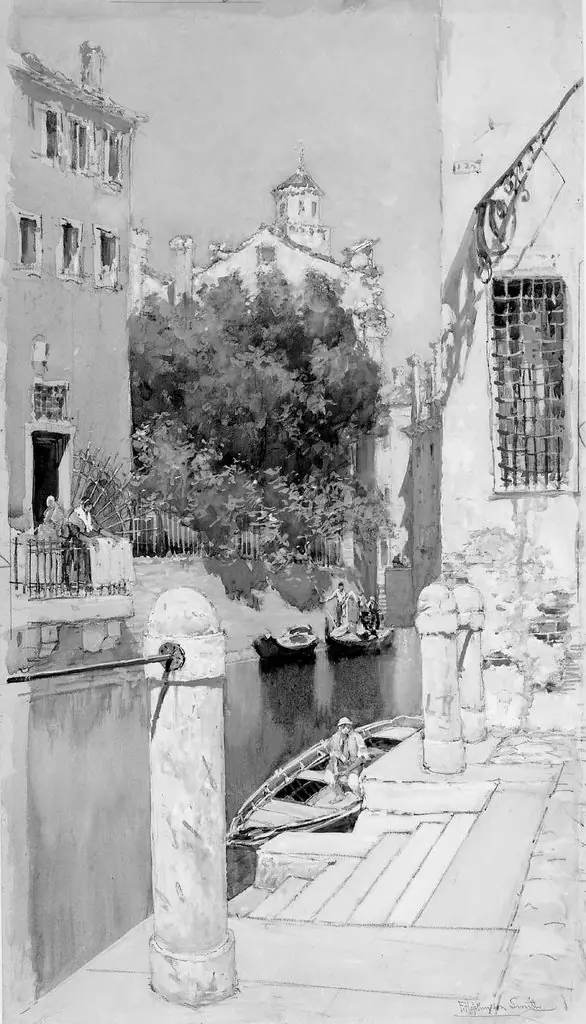 Canal Scene
 Port Cochere at 39 Elm Street, Worcester, Mass.
 Landscape
 A Glade
 House and Trees across a Garden Wall
 Ascent to the Farnese Gardens on the Palatine
 Italian Lake Scene with Villa (from Cropsey Album)
 Architecture. Pilgrims Receiving Alms
 Parti fra Frederiksværk
 Naples
 Cattle by a Ford
 Granada. A View of Generalife