Artwork
Lola de Valence
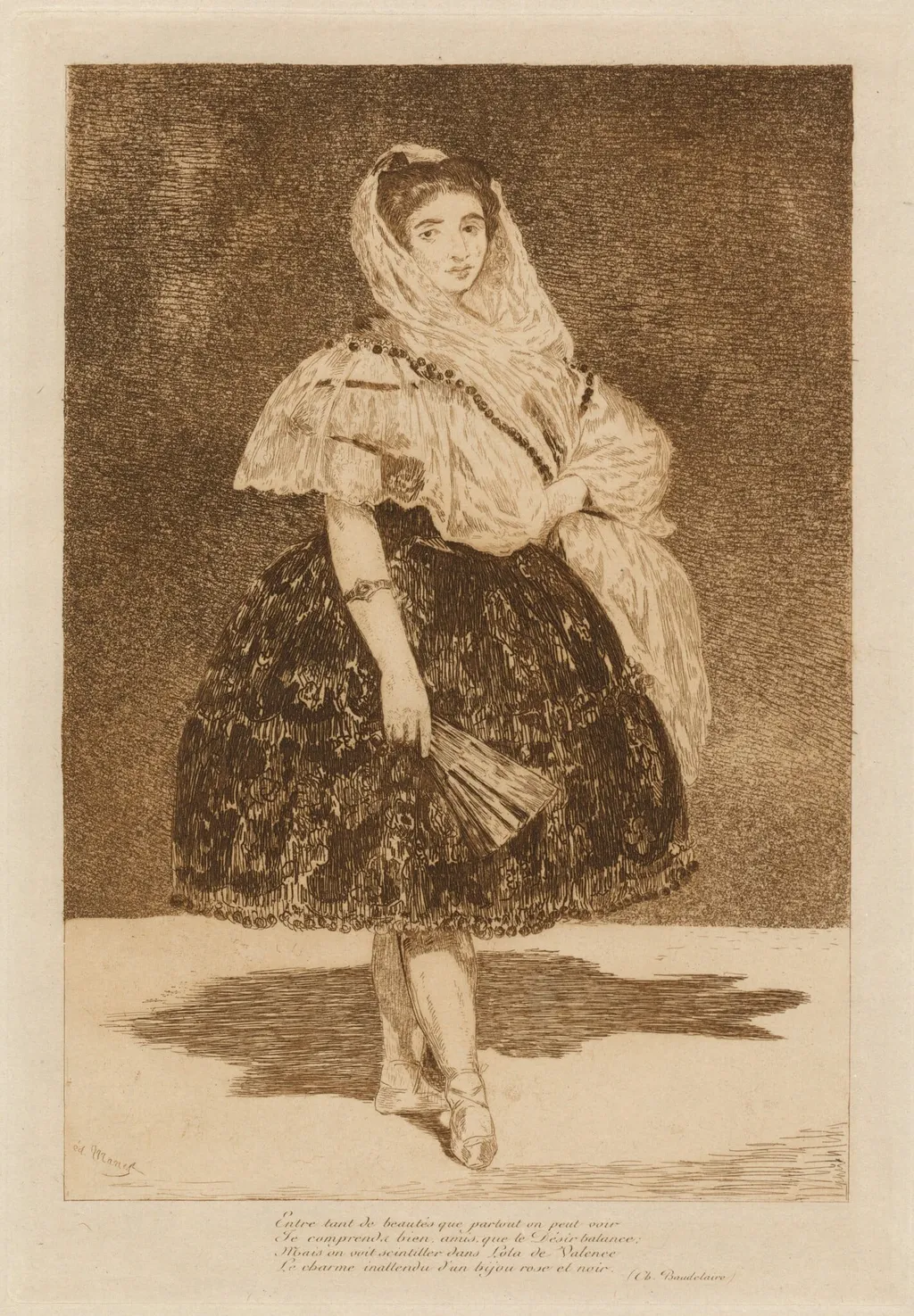
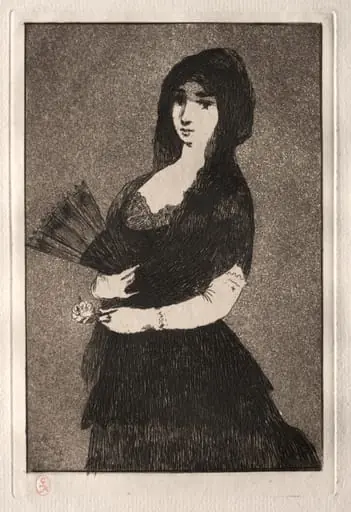
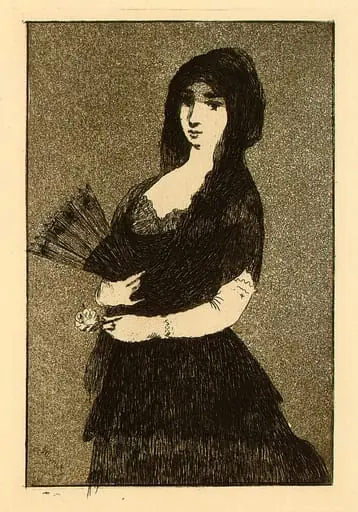
Lola de Valence is an ink print by the Impressionist artist Edouard Manet. It dates from 1862 and is held in the collection of the National Gallery of Art.
About this work
Overview
The work reflects Manet’s interest in capturing character through dress and posture, rather than narrative context.
Lola de Valence is a black-and-white print made by Édouard Manet in 1862 using etching and aquatint techniques. It depicts a woman in period attire, rendered with fine lines and tonal gradations. The composition is tightly focused on the figure, with no distracting elements in the background. The work reflects Manet’s interest in capturing character through dress and posture, rather than narrative context.
Subject & Meaning
The subject is a woman named Lola de Valence, likely a performer or figure from Spanish or Andalusian culture, dressed in traditional garments. Her elaborate skirt, lace veil, and fan suggest a theatrical or ceremonial setting. The pose is composed yet informal, conveying dignity without idealization. Manet’s choice to portray her in costume, rather than as a portrait of a known individual, points to an interest in cultural types and visual storytelling.
Technique & Style
Manet employed etching for precise linework and aquatint to achieve subtle gradations of gray. The shading models the folds of fabric and the contours of her face with delicate tonal shifts, avoiding harsh outlines. The plain background isolates the figure, emphasizing texture and form. The technique balances spontaneity with control, characteristic of Manet’s approach to printmaking—direct, observational, and unadorned.
History & Provenance
Created in 1862, the print was likely made as a standalone work or for a limited circulation among collectors and artists. It was not widely reproduced during Manet’s lifetime. Early impressions are rare, and the work entered major collections in the 20th century, often linked to studies of Manet’s engagement with Spanish themes and his experimentation beyond oil painting.
Context
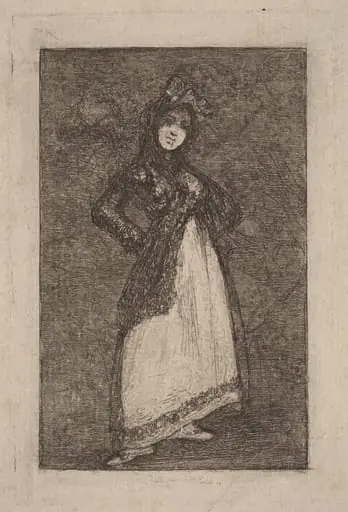
In the early 1860s, Manet was exploring Spanish subjects influenced by Goya and contemporary interest in exoticism. Lola de Valence reflects this fascination, aligning with other works depicting Spanish dancers and figures. Unlike academic portraiture, this print presents its subject with immediacy and minimal embellishment, reflecting Manet’s broader shift toward modern realism in both subject and technique.
Legacy
Lola de Valence remains a key example of Manet’s printmaking, illustrating his ability to convey presence through minimal means. It influenced later artists interested in the expressive potential of etching and the depiction of non-idealized figures. The work is studied for its technical restraint and its quiet challenge to conventional portraiture, contributing to the evolving status of print as a serious artistic medium.
Artist & collection

Artist
Édouard Manet didn’t have much time to make his mark—he died at 51—but he used every year.