Artwork
Marsh Sunset, Newburyport, Massachusetts
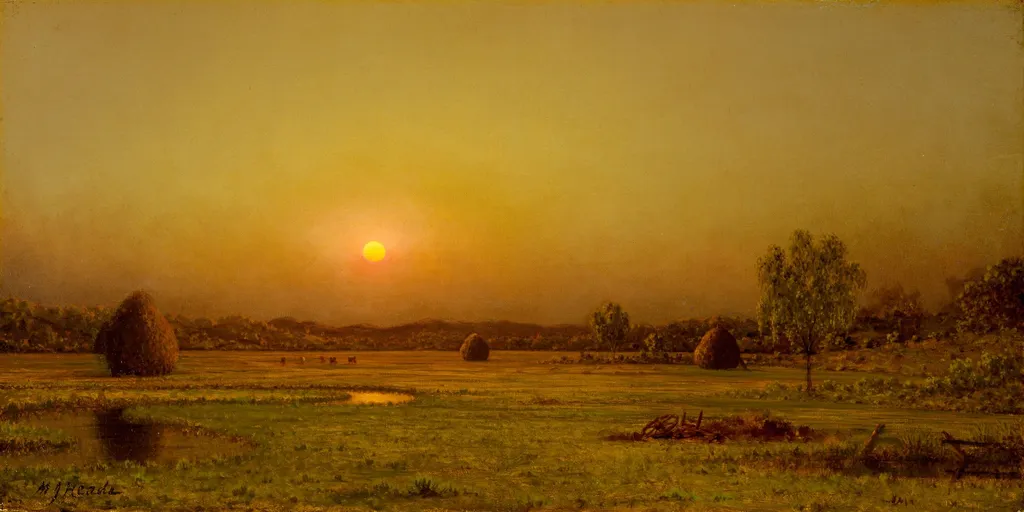
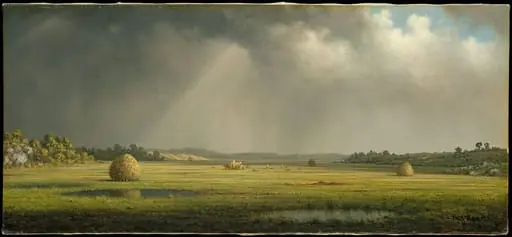
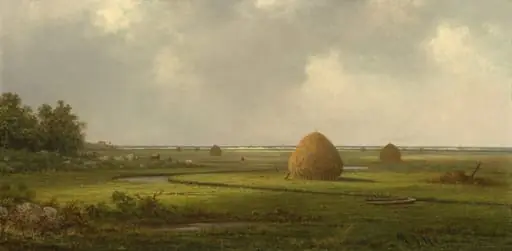
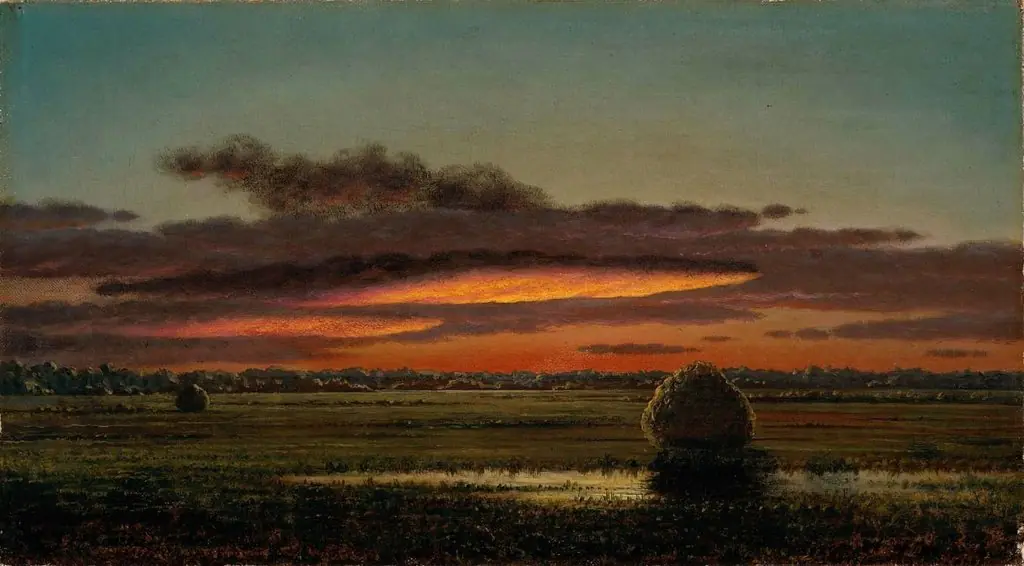
Marsh Sunset, Newburyport, Massachusetts is an oil painting by the American Impressionist artist Martin Johnson Heade. It dates from 1888 and is held in the collection of the Museum of Fine Arts, Houston.
About this work
Overview
Painted in 1888, *Marsh Sunset, Newburyport, Massachusetts* is an oil work by Martin Johnson Heade that captures a quiet coastal landscape at twilight.
Painted in 1888, *Marsh Sunset, Newburyport, Massachusetts* is an oil work by Martin Johnson Heade that captures a quiet coastal landscape at twilight. It belongs to a series of marsh scenes Heade produced in his later years, reflecting his sustained interest in atmospheric conditions and the subtle interplay of light over wet terrain. The painting is part of the Museum of Fine Arts Houston’s collection.
Subject & Meaning
The scene depicts a damp salt marsh near Newburyport, with a solitary haystack standing in the distance beneath a low, glowing sun. Trees frame the edge of the field, and a shallow puddle mirrors the fading sky. Rather than emphasizing human activity, Heade focuses on stillness and the quiet transition from day to night, suggesting a contemplative relationship between land and light.
Technique & Style
Heade employed soft, layered brushwork to render the hazy glow of the setting sun and the dampness of the marsh grass. Warm ochres, pale yellows, and muted reds dominate the palette, with cool shadows grounding the composition. The haystacks are rendered with careful attention to how light falls across their forms, revealing his sensitivity to optical effects without adopting the broken brushwork typical of French Impressionism.
History & Provenance
Created during Heade’s final decade, the painting reflects his retreat from urban subjects to rural coastal environments after settling in St. Augustine, Florida. Though he gained recognition earlier for tropical birds and orchids, his marsh landscapes became his most consistent late output. The work entered the Museum of Fine Arts Houston’s collection through documented acquisition, preserving its connection to Heade’s New England period.
Context
While American Impressionism was gaining traction in the 1880s, Heade’s approach remained distinct—less concerned with fleeting moments and more with sustained, quiet luminosity. His marsh scenes responded to the Hudson River School’s reverence for nature but rejected its grandeur, favoring intimate, low-lying vistas. This work aligns with a broader 19th-century shift toward personal, observational landscapes over narrative or heroic themes.
Legacy
Heade’s marsh paintings, including this one, were largely overlooked until the mid-20th century, when scholars reevaluated his role in American landscape art. His precise handling of light and mood influenced later regionalists and tonalists. Today, these works are recognized for their quiet intensity and their contribution to a uniquely American vision of nature that prioritizes serenity over spectacle.
Artist & collection